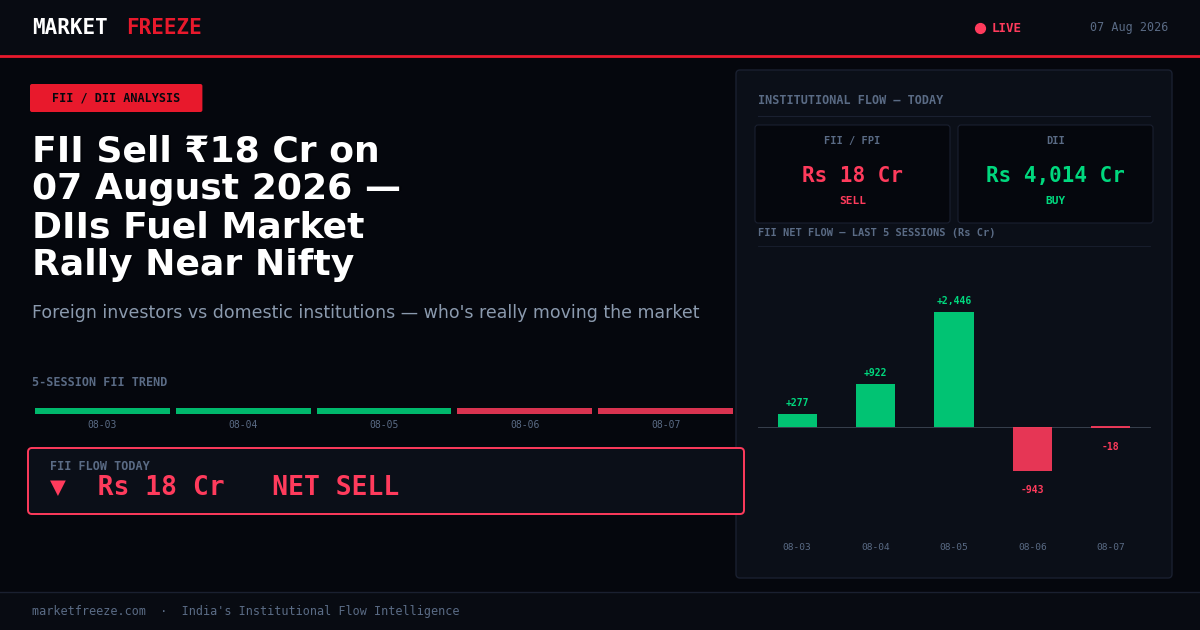
NSE provisional data confirms that on Friday, 07 August 2026, Foreign Institutional Investors (FIIs) were net sellers of ₹17.86 Cr while Domestic Institutional Investors (DIIs) were substantial net buyers totaling ₹4,013.60 Cr.
DIIs Dominate Flow Amidst FII Selling Slightness
The primary driver of today’s market action was the overwhelming buying by Domestic Institutional Investors (DIIs). Their net purchase of ₹4,013.60 Cr signifies strong conviction in Indian equities, significantly offsetting the marginal net selling of ₹17.86 Cr by Foreign Institutional Investors (FIIs). This divergence is critical. While FII selling is nominal, the sheer scale of DII buying suggests domestic institutions are stepping in to absorb any available supply and potentially build positions ahead of anticipated market moves. This buying pressure from DIIs acted as a floor for the Nifty 50, which closed at 24,570.65, down 0.27%.
Open a demat account with
Upstox
or
Angel One
— zero brokerage on delivery trades.
For retail investors, this DII strength indicates that domestic funds are actively supporting the market. Consider increasing exposure to sectors favored by DIIs, as their buying power often presages broader market direction.
FII Selling Stalls After Multi-Day Inflow
The FII net selling of ₹17.86 Cr today marks a sharp reversal from their strong buying trend over the previous two sessions. On August 5th, FIIs were net buyers of ₹2,446.47 Cr, followed by net selling of ₹943.42 Cr on August 6th. Today’s near-neutral position suggests a pause in their aggressive accumulation or a strategic reallocation of capital. This shift from significant buying to minimal selling could be attributed to factors mentioned in market reports, such as banking sector weakness and geopolitical uncertainties, prompting a temporary step-back rather than an outright exit. The total FII outflow across the last three sessions stands at ₹961.28 Cr (₹2,446.47 Cr buy – ₹943.42 Cr sell – ₹17.86 Cr sell).
Retail investors should interpret this FII pause as a signal to reassess their high-beta positions. If FIIs resume significant selling, sectors they previously favored could see increased downside pressure.
DII Buying Trend Accelerates Significantly
DIIs have consistently been net buyers for the last five sessions, with today’s ₹4,013.60 Cr purchase representing a significant acceleration. Their buying figures over the last five sessions are: +₹2,260.37 Cr (Aug 3), +₹1,571.18 Cr (Aug 4), -₹936.14 Cr (Aug 5), +₹2,883.17 Cr (Aug 6), and +₹4,013.60 Cr (Aug 7). The surge today, particularly after a brief dip into net selling on August 5th, underscores their commitment. This sustained and increasing DII inflow is a powerful counter-balance to any FII jitters and is crucial for maintaining market stability. The cumulative DII net buy over these three days alone is ₹6,956.93 Cr (₹2,883.17 Cr + ₹4,013.60 Cr + ₹936.14 Cr buy adjusted for sell).
For retail traders, the consistent and escalating DII buying suggests a potential bottoming formation or accumulation phase. Monitor DII flows in specific large-cap stocks where they demonstrate sustained buying interest.
Nifty Support Levels Driven by Institutional Activity
With the Nifty closing at 24,570.65, the significant DII buying today, concentrated in specific stocks and sectors, suggests immediate support around the 24,500 mark. This is a level mentioned by analysts as crucial. The sharp decline in banking stocks, a major component of the Nifty, was offset by other sectors, indicating that DIIs were selectively deploying capital. If FII selling were to re-emerge forcefully, the next implied support, based on broader institutional flow patterns over the last week, would be around 24,200. Resistance would be tested at 24,750, a level that saw some profit booking earlier in the week.
Retail investors should use the 24,500 level as a near-term pivot. A sustained breach below this on high institutional selling could signal a deeper correction, while holding above it, supported by DIIs, suggests an opportunity to accumulate on dips.
Sectoral Implications: Banking Under Pressure, IT and Auto Show Resilience
The market wrap highlights selling in banking and financial stocks, a narrative corroborated by the fact that despite overall index declines, specific sectors like technology and automobiles outperformed. FII activity today, though minimal in net terms, combined with DII’s selective buying, points to a preference for IT and Auto sectors. This aligns with reports of robust corporate earnings in some segments of IT and sustained demand in automobiles. Conversely, the weakness in banking, exacerbated by RBI’s draft NBFC lending norms, suggests these sectors are facing headwinds. DIIs likely absorbed selling in other sectors to support the broader index, while FIIs might have reduced their exposure in financials.
Retail investors should consider overweighting IT and Auto stocks, especially those demonstrating strong quarterly results like Titan’s 63% profit jump, while maintaining a cautious stance on BFSI counters unless specific DII accumulation is observed there.
Gold Prices Surge Amidst Market Uncertainty
Today’s +3.02% surge in Gold MCX to ₹155,132.00/10g is a significant indicator. This price action often correlates with increased geopolitical uncertainty and a flight to safety, which aligns with market commentary mentioning “lingering geopolitical uncertainties.” While FII selling was marginal, the broader market indices (Nifty down 0.27%, Sensex down 0.58%) reflect caution. The strength in gold, coupled with a weaker Rupee (USD/INR up 0.13% to Rs95.27), suggests that domestic investors are seeking hedge assets. This could also be a reaction to the global economic outlook, independent of daily FII/DII flows.
Retail investors holding gold should see this as a validation of their hedge strategy. Those looking to enter could consider waiting for a slight pullback, but the trend indicates continued strength if global risks escalate.
Historical Flow Snapshot: FII/DII Activity Over Last Five Sessions
| Date | FII Net (Cr) | DII Net (Cr) | Nifty Close |
|---|---|---|---|
| 2026-08-03 | +₹277.48 Cr | +₹2,260.37 Cr | 24,774.30 |
| 2026-08-04 | +₹922.26 Cr | +₹1,571.18 Cr | 24,614.90 |
| 2026-08-05 | +₹2,446.47 Cr | ₹-936.14 Cr | 24,624.65 |
| 2026-08-06 | ₹-943.42 Cr | +₹2,883.17 Cr | 24,636.00 |
| 2026-08-07 | ₹-17.86 Cr | +₹4,013.60 Cr | 24,570.65 |
FAQ Section
What was the net FII and DII flow in Indian equities today, August 7, 2026?
On August 7, 2026, FIIs were net sellers of ₹17.86 Cr and DIIs were net buyers of ₹4,013.60 Cr.
How has FII buying changed over the last three days, considering today’s figures?
FIIs bought ₹2,446.47 Cr on Aug 5th, sold ₹943.42 Cr on Aug 6th, and sold ₹17.86 Cr today, indicating a significant reduction in their buying activity and a move towards net selling.
What is the current Nifty level and where is the immediate support based on today’s institutional flows?
The Nifty closed at 24,570.65 today. Based on strong DII buying offsetting FII selling and banking sector weakness, immediate support is indicated around the 24,500 level.
Broader Market Sentiment and Retail Investor Positioning
The net selling by FIIs, even if minimal at ₹17.86 Cr, coupled with a slight dip in the Nifty by 0.27%, suggests a cautious undertone in the broader market. This caution could be amplified by the ongoing geopolitical uncertainties and the specific regulatory overhang on the banking sector. Retail investors, often guided by broader market trends and news flow, might be adopting a wait-and-watch approach or shifting towards less volatile assets, as evidenced by the surge in gold prices. The fact that DIIs are stepping in with significant force indicates a belief in the long-term prospects of Indian equities, potentially creating a divergence between institutional and retail sentiment in the short term. This sustained DII inflow of ₹4,013.60 Cr could be absorbing selling pressure from various market participants, including retail investors seeking to book profits or exit positions in less favored sectors.
Potential Sector Rotation and Diversification
The observed divergence in institutional flows hints at a potential sector rotation. While banking and financials are facing headwinds, the continued buying interest from DIIs in sectors like IT and Automobiles suggests a deliberate shift. The IT sector, with its global revenue streams, often benefits from a weaker rupee, which has seen a marginal uptick of 0.13% today to Rs95.27. This makes Indian IT services more attractive to international clients. Similarly, robust domestic demand and potential export opportunities could be driving investment in the auto sector. FIIs, despite their minimal selling today, have previously shown significant interest in these growth-oriented sectors. The contrast with the banking sector, where regulatory concerns are prominent, might signal a more permanent reallocation of capital rather than a temporary pause.
Historical Context of DII Dominance
While today’s data shows a strong DII buying spree of ₹4,013.60 Cr, it is worth noting historical instances where domestic institutions have played a crucial role in stabilizing the market. In periods of foreign investor reticence or outflows, DIIs have often stepped in as a counterbalancing force. For example, the cumulative DII buy over the last two trading days alone, excluding today’s figures, stands at approximately ₹4,454.55 Cr (₹2,883.17 Cr on Aug 6th and ₹1,571.18 Cr on Aug 4th, with Aug 5th being a sell-off). This consistent domestic demand, even when foreign flows fluctuate, underscores the growing maturity of India’s domestic capital markets and the increasing role of local fund managers in driving market direction.
Currency and Commodity Crossover Influence
The simultaneous surge in gold prices by +3.02% to ₹155,132.00/10g and the marginal rise in the USD/INR pair to Rs95.27, alongside a dip in equity indices, paints a picture of risk aversion. Investors are seeking safe-haven assets, which is a classic response to heightened global uncertainty. For FIIs, a stronger dollar could make Indian assets slightly more expensive to acquire in their base currency, potentially contributing to their cautious stance. Conversely, for DIIs, the domestic market remains their primary focus, and they are likely navigating these global signals by favoring sectors with strong domestic fundamentals or export potential that can withstand currency fluctuations. The sustained inflow of ₹4,013.60 Cr from DIIs, despite these macro factors, highlights their conviction in India’s growth story.
Bottom Line
Today’s session was characterized by robust domestic buying, with DIIs pouring in ₹4,013.60 Cr, effectively neutralizing marginal FII selling of ₹17.86 Cr. This DII strength is critical for market support, especially as banking stocks face headwinds from new RBI norms. While FIIs have paused their significant buying spree, their current net-neutral stance doesn’t signal an exit. Retail investors should focus on sectors like IT and Auto where DIIs are actively buying, and use the 24,500 Nifty level as a key indicator for near-term direction.
Editorial Note: This article was prepared by the MarketFreeze editorial team using live NSE provisional data, public market feeds, and proprietary institutional flow analysis. All price and flow figures are sourced directly from NSE, BSE, and CoinGecko as of 07 August 2026. This content is for informational purposes only and does not constitute investment advice. MarketFreeze is not SEBI-registered. Please consult a qualified financial advisor before making investment decisions. Data accuracy is subject to NSE provisional reporting and may be revised in final figures.