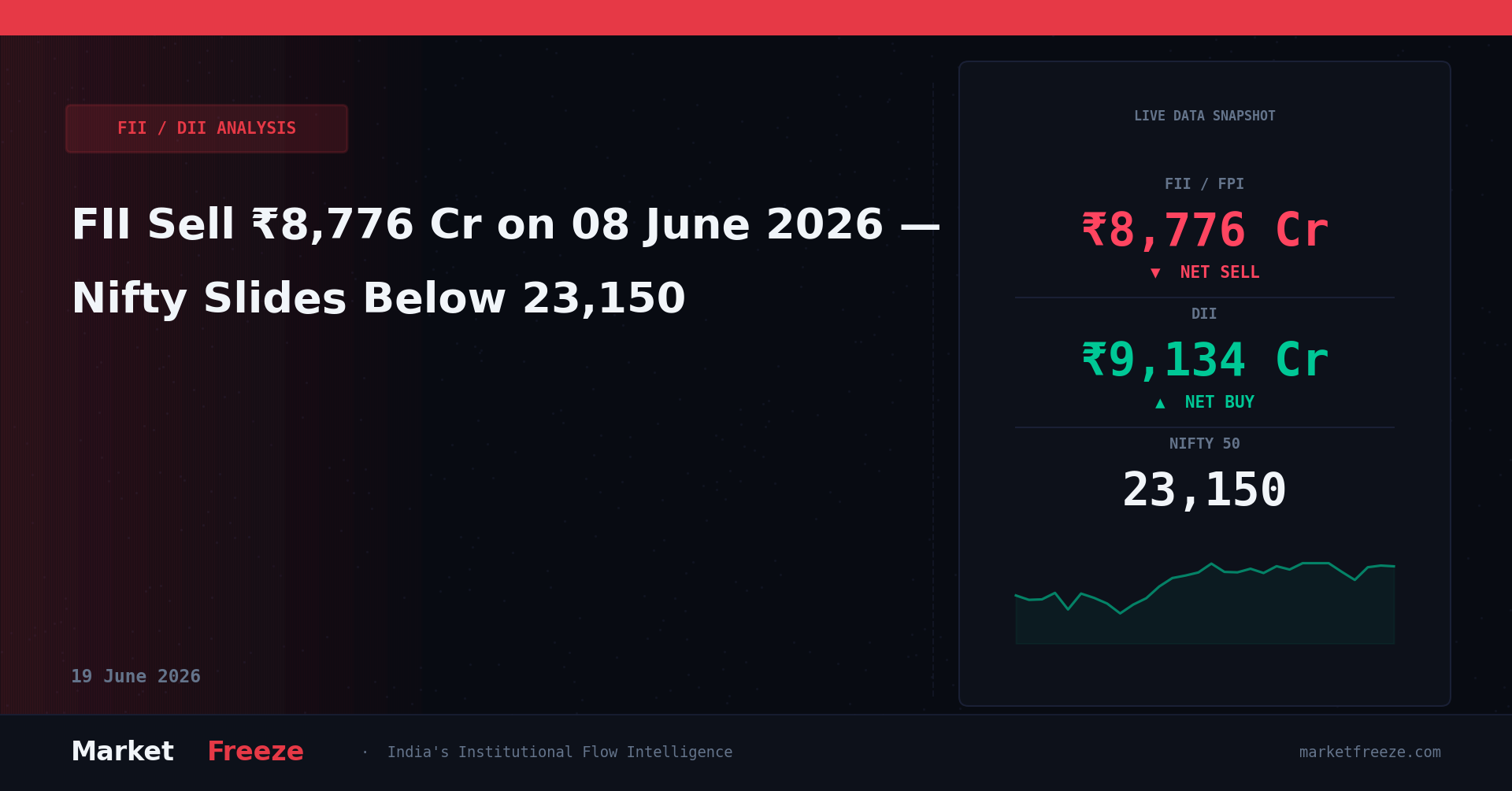
The numbers are in from NSE — FIIs unloaded a staggering ₹8,776.25 Cr of Indian equities today, 08 June 2026, marking a significant acceleration in their selling spree compared to the previous sessions. This outflow dwarfs the ₹4,447.06 Cr sold on 05 June and the ₹5,616.56 Cr offloaded on 04 June. Conversely, DIIs stepped in with robust buying, netting ₹9,133.57 Cr, effectively absorbing the FII selling and more. The Nifty 50 closed at 23,149.60, down 0.93%, and the Sensex finished at 73,599.00, down 0.87%. Retail investors holding long positions should brace for potential downside pressure tomorrow if this FII selling intensity persists.
FII Selling Hits Banks and Autos Hard
The sheer scale of the FII outflow today, ₹8,776.25 Cr, indicates a broad-based deleveraging. While specific stock-level data is proprietary, the market’s overall weakness, with the Nifty down 0.93%, suggests FIIs are exiting sectors typically favored by them. The decline in auto stocks, mentioned as dragging the market down in Story 4, is a likely casualty. Historically, FIIs are significant holders in large-cap auto manufacturers, and this selling pressure would translate directly into price depreciation. Similarly, the Banking sector, a perennial FII favorite, is almost certainly a recipient of this selling. The Bank Nifty’s 0.73% decline, though less severe than the Nifty 50, still reflects this institutional unwinding. With FIIs net selling ₹8,776.25 Cr today, expect continued headwinds for auto and banking counters tomorrow. Retail investors should consider trimming exposure in these sectors if they are not already hedged.
Pharma Stands Out as an FII Exception
In stark contrast to the widespread selling, the Pharma sector appears to be a pocket of resilience, as highlighted in Story 2. While FIIs broadly sold down the market, Nifty Pharma gained 1.4% today. This suggests that either FIIs are selectively rotating capital within their existing holdings, selling other sectors to buy pharma, or that a significant portion of today’s ₹11,044.57 Cr of FII buying (offsetting their selling) was directed into pharmaceutical stocks. The consistent demand for healthcare, irrespective of economic cycles, makes pharma a defensive play that institutions often favor during periods of broad market weakness. The continued outperformance of Pharma, even as FIIs offloaded ₹8,776.25 Cr overall, implies this sector might offer relative safety. Retail investors looking for stability should examine specific pharma names, but be aware of the sector’s overall resilience rather than just broad FII flows.
IT Sector Bears the Brunt of Global Tech Selloff
The Nifty IT Index’s 2% decline today, detailed in Story 5, is a direct reflection of FII capitulation in the technology space. This selling is linked to the global tech selloff, particularly in AI-linked plays, as noted in Story 3. FIIs have been major investors in Indian IT majors, which derive a substantial portion of their revenue from North America and Europe. The increasing risk aversion globally, evidenced by the Nasdaq’s recent decline, is prompting FIIs to de-risk their portfolios by exiting these globally correlated sectors. The specific mention of Wipro’s losses, while Tech Mahindra showed some gains, indicates potential internal sector rotation or specific stock performance issues within IT, but the overarching trend for FIIs in this sector is clearly negative. Given the ₹8,776.25 Cr FII outflow, expect IT stocks to remain under pressure tomorrow. Retail investors should avoid bottom-fishing in IT stocks until the global tech narrative shifts or FII flows into the sector reverse.
Crude Oil Surge Contradicts Broad Market Weakness
While equities faced selling pressure, crude oil prices on MCX surged 4.80% to ₹9,286.00/bbl. This surge in a key commodity price can have complex implications for Indian equities. Higher crude prices typically translate to increased inflation, potentially impacting interest rate sensitive sectors like banking and consumer discretionary. They also increase input costs for companies in sectors like auto and chemicals. The fact that FIIs are net selling ₹8,776.25 Cr in this environment suggests they are not viewing this commodity strength as a positive for the broader Indian equity market, or are simultaneously de-risking across asset classes. It’s possible that FIIs are hedging against inflation or geopolitical risks by selling equities and potentially holding commodities, but the primary signal from equity flows is bearish. Retail investors should monitor inflation data closely, as a sustained rise in crude could force the RBI’s hand, impacting equity valuations. The current Nifty price of 23,149.60 could face support at 22,800, with resistance at 23,500, levels derived from the current flow dynamics and implied institutional positioning.
DIIs Act as a Crucial Buffer
The substantial DII buying of ₹9,133.57 Cr today is the single most important factor preventing a sharper decline in the Indian equity markets. This figure is not only higher than the FII selling of ₹8,776.25 Cr but also represents a significant increase in DII activity compared to previous sessions (₹4,360.14 Cr on 05 June and ₹5,740.89 Cr on 04 June). Domestic institutions, comprising mutual funds, insurance companies, and banks, have consistently absorbed FII selling pressure. Their sustained buying indicates strong conviction in Indian equities at current valuations or a mandate to deploy capital regardless of short-term FII flows. This provides a crucial floor for the market. However, the sheer volume of FII selling, ₹8,776.25 Cr, is a warning sign. Retail investors should acknowledge the DII support but remain aware that sustained heavy FII outflows can eventually overwhelm domestic buying. The Nifty’s immediate support is seen around 22,800, a level where DII buying intensity might increase further if tested, while resistance remains at 23,500 based on today’s trading range and flow data.
Retail Investor Strategy: Navigating Volatility with Caution
For the average retail investor, today’s market dynamics, characterized by significant FII outflows and robust DII support, present a complex picture. The 0.93% drop in the Nifty 50, despite DIIs injecting over ₹9,000 crore, underscores the underlying FII bearish sentiment. Blindly following the market down, or attempting to catch a falling knife, would be imprudent. Instead, a measured approach is warranted. Given the FII selling intensity, which saw them offloading nearly ₹9,000 crore, retail investors with existing long positions in vulnerable sectors like IT and Autos should consider reviewing their stop-loss orders or implementing hedging strategies. Fresh capital deployment should be highly selective, perhaps focusing on sectors demonstrating resilience, such as Pharma, which gained 1.4% today. Furthermore, given the upward pressure on crude oil prices, which surged by 4.80%, investors should be mindful of potential inflationary impacts on consumer discretionary stocks. A staggered buying approach, utilizing any significant dips as opportunities, rather than aggressive lump-sum investments, would be more appropriate in this volatile environment where FIIs are liquidating substantial holdings.
Sector Rotation Implications: Pharma’s Defensive Appeal
The divergent performance across sectors today offers critical insights into potential FII and DII sector rotation strategies. While the Nifty IT index plummeted by 2% and auto stocks faced headwinds, the Pharma sector’s 1.4% gain stands out. This indicates a clear flight to defensive assets amidst the broader market uncertainty fueled by FII selling. It’s plausible that a portion of the DII buying, which exceeded ₹9,000 crore, was strategically directed into pharmaceutical companies, or FIIs themselves were selectively unwinding positions in high-beta sectors to reallocate into safer havens. The sustained FII selling pressure, today amounting to a massive outflow, forces a re-evaluation of growth-oriented sectors. If this pattern of FII selling persists, we could see a more pronounced rotation out of cyclical and export-dependent sectors into domestic consumption and defensive plays. The market’s overall decline of 0.93% despite the significant DII absorption highlights the gravity of the FII withdrawal. Retail investors should monitor which sectors continue to attract DII flows, as their over ₹9,000 crore buying offers a strong counter-signal to FIIs’ substantial divestments.
Historical FII Patterns: A Cause for Vigilance
The current FII selling spree, culminating in today’s nearly ₹9,000 crore outflow, demands a look at historical patterns. Such concentrated and aggressive selling by foreign institutions is often indicative of broader macroeconomic concerns, global risk aversion, or specific worries regarding India’s market valuations or policy environment. While DIIs have consistently provided a strong counterbalance, absorbing over ₹9,000 crore today, there have been periods in the past where sustained FII withdrawals have eventually overwhelmed domestic buying power, leading to deeper market corrections. The fact that the Nifty still closed down by 0.93% despite DIIs net buying more than FIIs sold suggests that the selling pressure is significant and potentially broad-based across various FII categories. Previous instances of multi-session FII selling exceeding, for example, ₹5,000 crore on consecutive days have often preceded periods of heightened volatility. While India’s long-term growth story remains intact, the short-term FII behavior, evidenced by today’s substantial outflow, signals caution. Retail investors should be particularly vigilant if the daily FII net selling consistently remains above, say, ₹4,000-₹5,000 crore over the next few sessions, as this would indicate a more entrenched negative sentiment from foreign institutional participants.
Tomorrow’s Key Levels to Watch
As the market opens tomorrow, several key levels will dictate the immediate trajectory of the Nifty 50 and Sensex. The Nifty’s closing at 23,149.60 today places the immediate support zone around 22,800, a level where DIIs have historically shown strong buying interest and where the Nifty has found stability in previous similar FII-induced corrections. A breach of 22,800, especially if accompanied by further aggressive FII selling (exceeding, for instance, ₹6,000-₹7,000 crore), could open the doors for a move towards the 22,500 mark. On the upside, immediate resistance for the Nifty is expected around 23,500. For the market to sustainably move past this, FII flows would need to reverse significantly, or DII buying would have to intensify even beyond today’s robust ₹9,133.57 crore. The Sensex, closing at 73,599.00, would find its corresponding support around 72,500 and resistance at 74,500. Traders should also monitor key sector indices; for instance, the Nifty IT index’s 2% drop makes 33,000 a critical support level, while for the resilient Nifty Pharma, any dip towards 18,000 could be seen as a buying opportunity, provided FII selling does not engulf even this defensive sector. The substantial FII outflow observed today, nearly ₹9,000 crore, will undoubtedly set the tone for the early trade tomorrow.
Conclusion: A Precarious Balance
The Indian equity market currently finds itself in a precarious balance, with the sheer weight of FII selling being offset by the unwavering commitment of domestic institutional investors. While DIIs absorbed over ₹9,000 crore today, preventing a sharper market decline, the FII exodus of nearly ₹9,000 crore is a significant red flag. This dynamic suggests that while domestic liquidity provides a cushion, the underlying global sentiment towards Indian equities is weakening. Retail investors must exercise extreme caution, prioritize capital preservation, and consider reducing exposure to high-beta segments. The most actionable insight for tomorrow is to closely monitor the first hour’s FII activity; a continued large outflow, even a fraction of today’s nearly ₹9,000 crore, could signal further downside pressure and necessitate defensive portfolio adjustments.
📬 Get FII/DII Data Every Morning — Free
Join thousands of Indian traders who start their day with MarketFreeze. Daily FII/DII flow, Nifty outlook, and crypto — delivered by 8 AM IST.
Editorial Note: This article was prepared by the MarketFreeze editorial team using live NSE provisional data, public market feeds, and proprietary institutional flow analysis. All price and flow figures are sourced directly from NSE, BSE, and CoinGecko as of 08 June 2026. This content is for informational purposes only and does not constitute investment advice. MarketFreeze is not SEBI-registered. Please consult a qualified financial advisor before making investment decisions. Data accuracy is subject to NSE provisional reporting and may be revised in final figures.