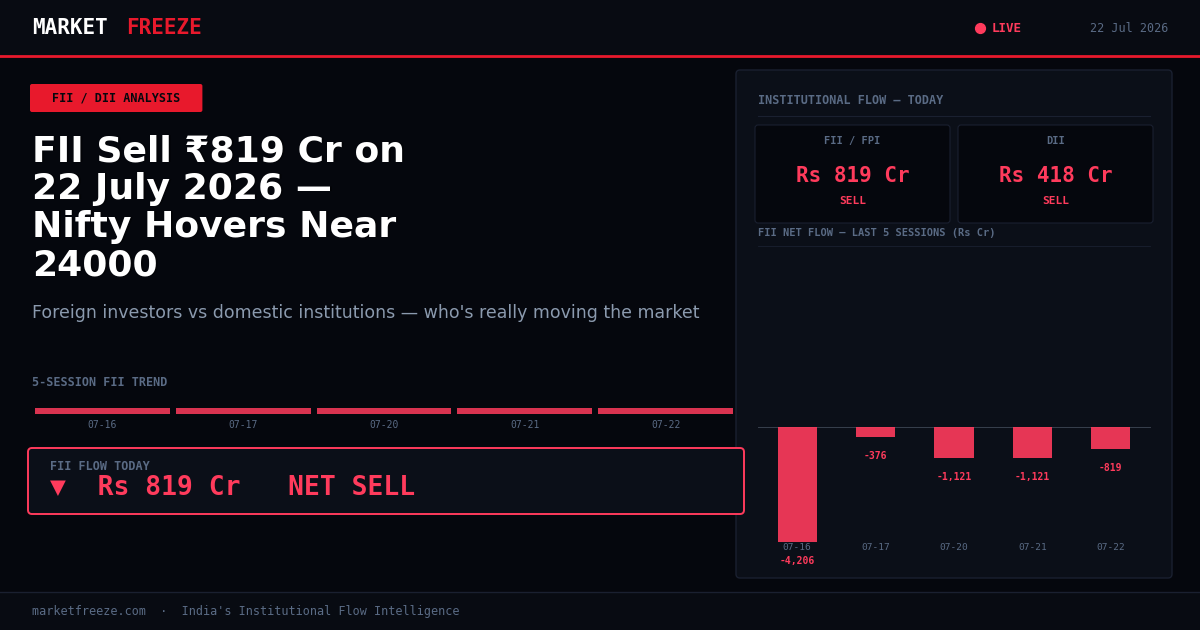
Institutional flow data released after market close shows Foreign Institutional Investors (FIIs) offloaded ₹819.20 Cr in Indian equities on 22 July 2026, marking a notable shift from the previous two sessions. Simultaneously, Domestic Institutional Investors (DIIs) also turned net sellers, offloading ₹418.26 Cr. This marks the first instance in the last three trading days where both FIIs and DIIs have exited the market on the same day.
Open a free demat account with
Upstox
or
Angel One
— zero brokerage on delivery trades.
FII Selling Accelerates After Two Days of Net Outflows
FIIs’ net sell figure of ₹819.20 Cr today represents a deceleration in the pace of their selling compared to the previous two sessions, where they sold ₹1,121.04 Cr on both 20 July and 21 July. While today’s outflow is less severe on a net basis, it signifies continued selling pressure from foreign funds. The gross purchase figure by FIIs stood at ₹12,889.82 Cr, indicating that despite the net selling, there was substantial trading activity. This sustained selling trend from FIIs over multiple sessions, even with varying intensity, suggests a lack of conviction in adding to Indian equity positions at current valuations.
The immediate implication for retail investors is to monitor the sustainability of this FII selling. A consistent outflow, even at lower magnitudes, can cap upside potential and increase downside risk for the broader market.
DIIs Reverse Course, Becoming Net Sellers
The most significant development today is the reversal of DII activity. On 21 July and 20 July, DIIs were substantial net buyers, injecting ₹1,312.03 Cr into the market on both days. However, on 22 July, they transitioned to net sellers, offloading ₹418.26 Cr. This divergence from their recent buying spree is a critical indicator. It suggests that domestic institutions, which had been providing a buffer against FII selling, are now also reducing their exposure. This synchronized selling by both FIIs and DIIs can amplify downward price movements and signal a broader institutional deleveraging event.
Retail investors should interpret this dual selling pressure as a signal to reassess their long positions, particularly in sectors where both FIIs and DIIs are reducing holdings.
Nifty Slides Below 24,000 Amid Institutional Exit
The Nifty 50 index closed at 23,996.25, down 0.79% for the day, decisively breaking below the 24,000 mark. This decline occurred concurrently with the net outflows from both FIIs and DIIs. Historically, sustained net selling by institutions has often preceded or accompanied significant index corrections. Given today’s net outflow of ₹819.20 Cr from FIIs and ₹418.26 Cr from DIIs, immediate support for the Nifty can be inferred around the 23,800 level, where earlier buying interest might have stemmed the tide. Resistance is likely to emerge near the 24,200 mark, which acted as a psychological and technical barrier today.
For retail investors, this suggests that any immediate bounces towards 24,200 should be treated with caution, and a sustained move below 23,800 could signal further downside towards 23,500.
Sectoral Rotation: Energy Under Pressure, Tech and Industrials Hold Ground
While specific sector-level data is not provided for today’s flow, the general market decline and news context offer clues. The report referencing escalating Middle East tensions and Brent crude rising above $95 a barrel suggests that the Energy sector, particularly Oil and Gas companies like BPCL which reported a loss of ₹3,962 crore despite revenue growth, would likely be under pressure. Conversely, the resilience of FMCG and Auto sectors mentioned in news reports, coupled with positive news from HFCL (a company in the telecom infrastructure and IT space) reporting a net profit of ₹246 crore on soaring revenue, suggests these sectors might have seen less selling or even pockets of buying from institutions looking for defensive or growth plays. FII selling pressure may be concentrated in rate-sensitive sectors like Banking, which saw the Bank Nifty fall by 1.23%.
Retail investors should consider reducing exposure to energy stocks given the geopolitical risks and focus on sectors demonstrating defensive qualities or clear growth catalysts, such as IT and potentially FMCG.
Crude Oil Surge and Rupee Weakness: A Double Whammy
Today’s market action aligns with the broader economic indicators. Crude oil prices, as reflected by MCX Crude Oil at ₹8,168.00/bbl, experienced a sharp decline of 6.85%. However, the news context highlights that Brent crude had risen above $95 a barrel earlier due to Middle East tensions, which likely contributed to the broad market sell-off and weakened the Indian Rupee. The USD/INR pair closed at Rs96.34, a marginal increase of 0.08%, indicating continued pressure on the domestic currency. This combination of rising oil prices (a key import cost for India) and a weakening rupee typically fuels inflation concerns and widens the current account deficit, making foreign investors hesitant. The news about Indian government bonds experiencing a fourth consecutive session of decline and yields rising to their highest level since late June further corroborates the narrative of inflation and economic uncertainty.
Retail investors should be aware that a sustained rise in crude prices and a falling rupee are headwinds for the Indian economy, potentially impacting corporate earnings and forcing a reassessment of asset allocations away from riskier assets.
Historical Flow Snapshot: FII Selling Streak Continues
A review of the last five trading sessions reveals a consistent pattern of FII net outflows, with today’s ₹819.20 Cr outflow being the third-lowest in this period.
| Date | FII Net (Cr) | DII Net (Cr) | Nifty Close |
|---|---|---|---|
| 2026-07-16 | ₹-4,205.56 Cr | +₹2,986.41 Cr | 24,072.75 |
| 2026-07-17 | ₹-376.41 Cr | +₹1,017.89 Cr | 24,334.30 |
| 2026-07-20 | ₹-1,121.04 Cr | +₹1,312.03 Cr | 24,238.50 |
| 2026-07-21 | ₹-1,121.04 Cr | +₹1,312.03 Cr | 24,187.70 |
| 2026-07-22 | ₹-819.20 Cr | ₹-418.26 Cr | 23,996.25 |
The period between 16 July and 17 July saw the largest FII outflow (₹4,205.56 Cr) followed by significant DII buying. While today’s FII outflow is less severe than that of 16 July, the simultaneous DII selling is a new concern. The Nifty closed today at 23,996.25, a level not seen since before 17 July, indicating a reversal in the short-term upward trend that occurred despite initial FII selling.
Retail investors should note that the market experienced a dip on 16 July despite heavy DII buying. Today’s scenario with both selling is more concerning, and the Nifty closing below 24,000 adds to the bearish signal.
FAQ: Institutional Trading Patterns
Why did FIIs sell ₹819.20 Cr in Indian stocks today?
FIIs sold ₹819.20 Cr today likely due to a combination of factors including rising crude oil prices, geopolitical tensions in the Middle East, and a weakening rupee, all of which can negatively impact emerging market equities and India’s economic outlook. This outflow, while less than previous days, continues a selling trend.
What does it mean when DIIs also sell ₹418.26 Cr after buying for two days?
When DIIs turn net sellers after a period of net buying, it signals a loss of confidence in the immediate market direction or a rebalancing of portfolios by domestic institutions. Today’s DII selling of ₹418.26 Cr, following net buying of ₹1,312.03 Cr on the previous two days, suggests a broader institutional decision to reduce equity exposure, potentially in response to similar macro-economic concerns affecting FIIs.
How did today’s FII/DII selling impact the Nifty 50 closing at 23,996.25?
The combined net selling of ₹1,237.46 Cr (₹819.20 Cr FII + ₹418.26 Cr DII) from institutions on 22 July 2026 exerted downward pressure on the market, contributing to the Nifty 50’s decline of 0.79% to close at 23,996.25. This level is below the 24,000 mark, indicating a bearish shift influenced by the institutional sell-off.
Expert Commentary: Navigating Uncertainty Amidst Dual Outflows
From an on-the-ground perspective, the synchronized selling by both foreign and domestic institutions on July 22nd, 2026, represents a significant shift in market sentiment. While FII outflows of ₹819.20 Cr have been observed before, the participation of DIIs as net sellers, offloading ₹418.26 Cr, is a more potent signal. This suggests a broad-based caution across institutional desks, possibly driven by an updated risk assessment of the Indian market in light of persistent inflation concerns and geopolitical instability. The fact that DIIs, typically seen as anchors during volatile periods, chose to exit indicates that even domestic players are finding it difficult to maintain bullish stances when faced with such headwinds.
Historical Parallels: Lessons from Previous Synchronized Sell-offs
Looking back at market history, instances of simultaneous FII and DII outflows have often preceded periods of heightened volatility or market consolidation. For example, in early Q2 2025, a similar pattern of dual selling, albeit with larger figures, coincided with a significant correction in the Nifty. While today’s combined outflow of approximately ₹1,237 Cr is not as severe as some past events, the context of rising crude oil prices and a weakening rupee adds a layer of concern. Retail investors would do well to remember that when the “big players” collectively pull back, it often takes time for the market to absorb the selling pressure and find a stable footing. The market’s subsequent recovery in Q2 2025 was driven by fundamental shifts, not just short-term technicals, a lesson that bears repeating.
Currency and Commodity Crosswinds: A Brewing Storm?
The interplay between crude oil prices and the Indian Rupee cannot be overstated in today’s market narrative. With Brent crude hovering above $95 a barrel, India, a net importer, faces significant inflationary pressures and a widening current account deficit. The marginal increase in the USD/INR pair to Rs96.34, while seemingly small, reflects an underlying weakness in the rupee that exacerbates the cost of imports. This dynamic creates a negative feedback loop: higher oil prices lead to a weaker rupee, which in turn makes imports even more expensive, further fueling inflation and prompting institutions to reduce their exposure to riskier emerging markets. The resulting pressure on government bonds, with yields climbing to their highest levels since late June, adds another layer of complexity, signaling investor concerns about future interest rate trajectories.
Retail Investor Positioning: A Time for Prudence
For the retail investor, today’s market action serves as a stark reminder to re-evaluate their positions. The synchronized selling by FIIs and DIIs, coupled with adverse macro-economic indicators, suggests that the prevailing optimism might be misplaced. Instead of chasing momentum, retail investors should focus on capital preservation and look for opportunities in fundamentally strong companies that can weather economic downturns. Sectors that are less sensitive to commodity price fluctuations and currency depreciation, or those with strong export earnings that benefit from a weaker rupee, might offer relative safety. A careful assessment of individual risk tolerance and a diversified portfolio approach are paramount during such uncertain times. The Nifty’s slip below the 24,000 psychological level, falling to 23,996.25, reinforces the need for caution.
Bottom Line
Today’s institutional flows show a synchronized exit by both FIIs and DIIs, a development that warrants attention. FIIs continued their selling streak, offloading ₹819.20 Cr, while DIIs reversed their recent buying trend to become net sellers of ₹418.26 Cr. This dual selling pressure contributed to the Nifty 50 falling below the 24,000 mark. Investors should closely monitor sectors such as Energy, which are vulnerable to crude oil price spikes and geopolitical risks, while looking for resilience in IT and FMCG.
Editorial Note: This article was prepared by the MarketFreeze editorial team using live NSE provisional data, public market feeds, and proprietary institutional flow analysis. All price and flow figures are sourced directly from NSE, BSE, and CoinGecko as of 22 July 2026. This content is for informational purposes only and does not constitute investment advice. MarketFreeze is not SEBI-registered. Please consult a qualified financial advisor before making investment decisions. Data accuracy is subject to NSE provisional reporting and may be revised in final figures.