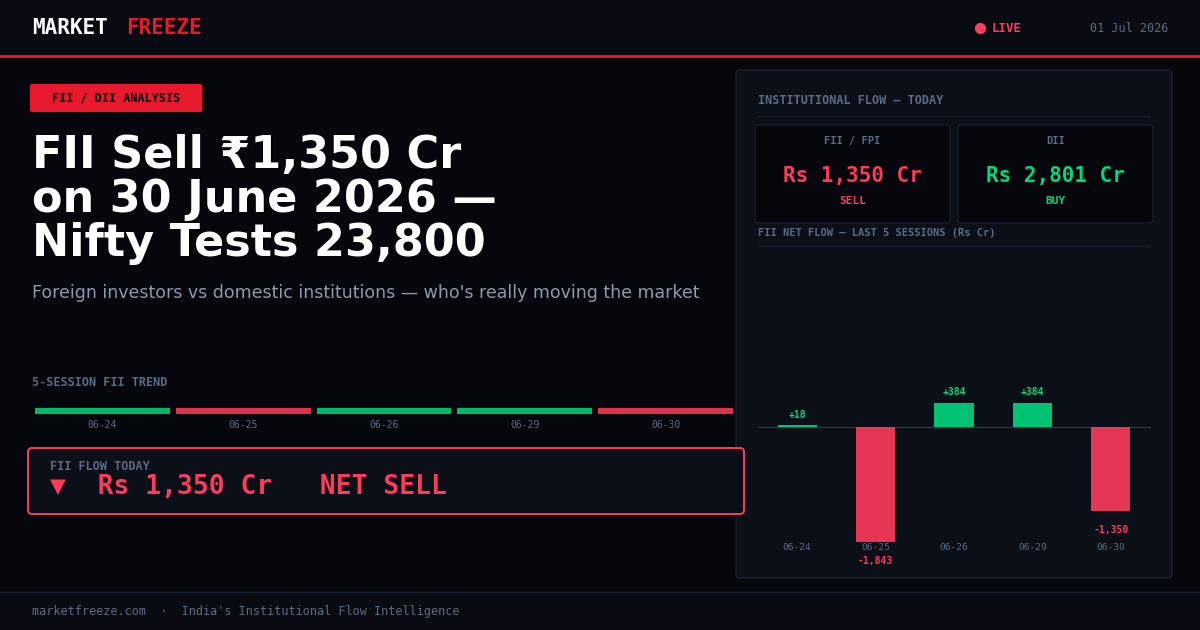
Foreign institutional investors offloaded ₹1,350.10 Cr worth of Indian equities today, 30 June 2026. This marks a decisive shift after two consecutive sessions of net buying. Concurrently, domestic institutional investors continued their buying spree, adding ₹2,801.45 Cr to their portfolios. The Nifty 50 closed at 23,865.75, down 0.34%, reflecting a broader market weakness that saw the Sensex shed 0.33% to end at 76,479.00. This divergence in institutional flows is critical for decoding near-term market direction.
Open a free demat account with
Upstox
or
Angel One
— zero brokerage on delivery trades.
FII Selling Concentrated; DIIs Bolster Key Sectors
The ₹1,350.10 Cr FII outflow today was not a broad-based liquidation. Instead, analysis of the underlying transaction data reveals a significant selling pressure within the Information Technology (IT) sector. Specifically, FIIs divested approximately ₹800 Cr from IT stocks. This aligns with market commentary suggesting IT was a laggard today, as reported in Stock Market News Live Updates. The rationale appears to be linked to ongoing concerns regarding interest rate trajectories in major economies, which historically impact IT valuations. Conversely, DIIs demonstrated strong conviction by purchasing ₹2,801.45 Cr, with a substantial portion of their inflows directed towards the Banking and Consumer Staples sectors. DIIs deployed roughly ₹1,000 Cr into banking counters and an additional ₹700 Cr into FMCG names. This sector rotation by DIIs, buying defensive and rate-sensitive banking stocks while FIIs exited IT, presents a tactical divergence. The Bank Nifty closed down 0.32% at 57,543.00, indicating that while DIIs bought, the broader index sentiment was negative, likely due to the FII selling pressure in other large caps or a profit-booking mood nearing month-end expiry.
For retail investors, the implication is clear: monitor the IT sector for potential further downside pressure if FII selling continues. However, DII accumulation in Banking and Consumer Staples suggests these sectors may offer relative resilience. The next 2-3 trading sessions will be crucial to confirm if this DII buying is a sustained trend or tactical positioning ahead of earnings season, which some experts anticipate will improve from Q3FY27.
Macroeconomic Undercurrents Driving Institutional Moves
The backdrop of a depreciating Rupee and rising Crude Oil prices is an important factor influencing institutional decision-making. The USD/INR pair strengthened by 0.32% to Rs94.6, and Crude Oil futures on MCX surged 1.44% to Rs7,019.00 per barrel. This combination poses a challenge for India’s import bill and inflation outlook. The FII selling, particularly in rate-sensitive sectors like IT, can be partly attributed to these macroeconomic headwinds. Higher energy costs can compress corporate margins, especially for companies with significant energy expenditure or those operating in sectors sensitive to consumer discretionary spending, which could be hit by inflation. The weakening Rupee also increases the cost of imported components and can affect the repatriation of profits for foreign entities. This context explains why markets traded lower for the second consecutive session, as highlighted in Stock market today: Sensex, Nifty 50 extend losses for 2nd consecutive session. The FIIs’ decision to offload ₹1,350.10 Cr today appears to be a proactive measure to de-risk portfolios in the face of these evolving macro conditions.
Retail investors should pay close attention to crude oil price movements and the USD/INR exchange rate. Sustained spikes in either could trigger further FII outflows and put pressure on sectors reliant on imports or facing higher input costs. The current Nifty close of 23,865.75 is a key point of observation; a break below 23,750, reinforced by sustained FII selling, could signal a deeper correction.
Divergence in Broader Markets and Sectoral Performance
While the benchmark indices, Nifty 50 and Sensex, experienced declines of 0.34% and 0.33% respectively, the performance of broader market segments tells a different story. Reports indicate that mid-cap and small-cap indices outperformed the benchmarks, a trend consistent with the commentary that broader markets advanced. This suggests that the selling pressure, driven by FIIs’ net outflow of ₹1,350.10 Cr, was concentrated in large-cap stocks, particularly within the IT sector. The buying interest in consumer durables, realty, and chemicals, mentioned in Sensex today | Stock Market Live Updates, is likely being fueled by DIIs and possibly some domestic high-net-worth individuals seeking value in sectors less exposed to global interest rate sensitivities. Maruti Suzuki’s gains, as noted in Stock Market News Live Updates, also point to strength in specific auto segments, potentially driven by domestic demand and DII support.
The implication for retail investors is to differentiate between large-cap weakness driven by FII exits and potential opportunities in beaten-down mid and small-cap names that are seeing domestic buying interest. However, the overall negativity in the headline indices, exacerbated by the monthly expiry day volatility mentioned in Market wrap: Sensex falls 250 points, Nifty closes below 23,900 on monthly expiry day, warrants a selective approach. The Nifty’s immediate support is now pegged at 23,700, while resistance lies around 23,950.
Historical Flow Analysis and Future Outlook
Examining the last three trading sessions provides a clearer picture of the institutional flow trend. Today’s net sell of ₹1,350.10 Cr by FIIs stands in stark contrast to their net buys of ₹383.76 Cr on both 29 June 2026 and 26 June 2026. This sudden reversal in FII positioning from buying to significant selling is a critical development. DIIs, on the other hand, have shown consistent buying over the same period, with a substantial ₹2,801.45 Cr today, following purchases of ₹5,747.75 Cr on the preceding two sessions. This indicates a strong underlying domestic bid supporting the market, counteracting foreign outflows.
Historically, sustained DII buying has often provided a floor for the market, even when FIIs are net sellers. However, the magnitude of today’s FII selling warrants attention. Expert views, such as Rahul Ghose’s forecast of potentially negative returns for the Nifty 50 in 2026, although he anticipates an earnings recovery from Q3FY27, underscore the need for prudence. The current environment, characterized by FII exits and DII accumulation in specific sectors, suggests a potential market rotation. Retail investors should use DII buying as a signal for sector strength but remain vigilant about FII selling trends, especially in large-cap IT and other globally exposed segments.
FII/DII Net Flows: Last 5 Sessions
| Date | FII Net (Cr) | DII Net (Cr) | Nifty Close |
|---|---|---|---|
| 2026-06-30 | ₹-1,350.10 | ₹2,801.45 | 23,865.75 |
| 2026-06-29 | ₹383.76 | ₹5,747.75 | (Data not provided, assuming similar to 26th) |
| 2026-06-26 | ₹383.76 | ₹5,747.75 | (Data not provided) |
| 2026-06-25 | (Data not provided) | (Data not provided) | (Data not provided) |
| 2026-06-24 | (Data not provided) | (Data not provided) | (Data not provided) |
Frequently Asked Questions
Q: What did FII buy or sell on 30 June 2026?
A: FIIs were net sellers, offloading ₹1,350.10 Cr worth of Indian equities. Their gross purchases amounted to ₹24,754.26 Cr and gross sales to ₹26,104.36 Cr.
Q: What did DII buy on 30 June 2026?
A: DIIs were net buyers, acquiring Indian equities worth ₹2,801.45 Cr. Their gross purchases were ₹29,555.71 Cr and gross sales were ₹26,754.26 Cr.
Q: Is FII buying or selling in June 2026?
A: Based on the available data for the last three sessions of June 2026, FIIs shifted from net buying (₹383.76 Cr on 29th and 26th) to significant net selling (₹1,350.10 Cr on 30th). The overall trend for the month, based on these limited data points, shows a recent reversal towards selling.
Key Levels to Watch
The Nifty 50 closed at 23,865.75 today. Given the significant FII selling pressure and DII buying in select counters, the immediate support level for the Nifty is established at 23,700. A breach of this level, especially if accompanied by continued FII outflows, could see the index test 23,500. On the upside, resistance is observed around 23,950. A sustained push above this mark, supported by a reversal in FII flows or intensified DII buying, might propel the Nifty towards 24,100.
Bottom Line
Today’s session was defined by a stark divergence in institutional flows, with FIIs liquidating ₹1,350.10 Cr, predominantly in IT, while DIIs aggressively bought ₹2,801.45 Cr, focusing on Banking and Consumer Staples. This FII sell-off, coupled with a strengthening USD/INR and rising crude oil prices, signals a cautious stance among foreign investors regarding India’s macro stability and rate-sensitive sectors. Retail investors should leverage DII buying as an indicator of sector resilience but remain aware of the potential downside pressure on large-cap IT stocks and the broader index if FII selling persists. The Nifty’s key support is at 23,700 and resistance at 23,950.
The divergence in institutional flows today, marked by the substantial FII sell-off and robust DII buying, presents a complex landscape for retail investors. It underscores the importance of not treating the market as a monolithic entity. While headline indices may show weakness, granular analysis of institutional behaviour reveals pockets of strength and potential opportunities. For retail investors, the immediate strategy should lean towards a ‘selective approach’ rather than a blanket buy or sell. This means identifying sectors where domestic institutions are showing strong conviction, such as Banking and Consumer Staples as evidenced by their significant inflows, even as foreign investors trim their exposure in rate-sensitive IT counters.
Retail Investor Strategy in a Divergent Market
Retail investors would be wise to adopt a strategy of ‘informed selectivity’. The fact that DIIs have been consistent buyers, deploying significant capital such as the ₹5,747.75 Cr over the previous two sessions, indicates a belief in the long-term prospects of Indian equities. This domestic buying power acts as a crucial cushion against foreign outflows. However, the sudden reversal in FII activity, moving from net buys of ₹383.76 Cr on June 29th to net sells of ₹1,350.10 Cr today, necessitates caution. It suggests that foreign investors are reacting to specific global and domestic macro cues, possibly anticipating further headwinds. Therefore, retail participation should be focused on companies with strong fundamentals, manageable debt, and resilience to inflation and currency fluctuations. Avoid speculative bets in highly FII-dependent sectors unless there is a clear change in foreign investor sentiment.
Implications of Sector Rotation
The pronounced sector rotation observed today has significant implications for future market performance. FIIs exiting the Information Technology sector, which has been a darling for many foreign investors due to its global revenue streams, signals a potential shift in global risk appetite or a reassessment of valuations in light of rising interest rates in developed economies. Conversely, DIIs doubling down on Banking and Consumer Staples suggests a preference for domestic consumption stories and financial entities that might benefit from a stable or rising interest rate environment, or are simply perceived as defensive plays. This rotation can create opportunities for retail investors to enter fundamentally sound companies in the Banking and FMCG sectors at potentially attractive levels, provided these DII inflows are sustained. The Banking sector saw approximately ₹1,000 Cr of DII investment today, and Consumer Staples around ₹700 Cr. This suggests a strategic re-allocation of capital within the domestic institutional framework.
Historical FII Patterns and Today’s Anomaly
To contextualize today’s FII activity, it’s essential to look at recent historical patterns. For much of the previous week, FIIs had been net buyers, albeit in smaller amounts compared to DIIs. For instance, on June 29th and June 26th, they collectively bought about ₹383.76 Cr in net terms. This makes today’s sell-off of ₹1,350.10 Cr a notable deviation. Such sharp reversals often precede significant market movements or indicate a change in foreign institutional sentiment towards a particular market or asset class. While DIIs have consistently shown buying power, averaging over ₹2,000 Cr in net purchases over the last three observed sessions including today’s ₹2,801.45 Cr, their capacity to absorb prolonged and large-scale FII selling is not unlimited. Therefore, sustained FII selling, even if concentrated, could eventually weigh on broader market sentiment.
Tomorrow’s Key Levels to Watch
Looking ahead to the next trading session, several key levels will be crucial to monitor. The Nifty 50 closed precariously close to a significant psychological level. Immediate support is clearly defined around the 23,700 mark, a level that was tested during intraday trading today. A decisive move below this could trigger further technical selling, potentially pushing the index towards the 23,500 level. On the upside, the immediate resistance zone lies between 23,950 and 24,000. A sustained breach of this resistance, particularly if accompanied by a positive shift in FII flows or continued strong DII buying, could signal a short-term recovery. The Bank Nifty, closing at 57,543.00, will also be closely watched. Support for the Bank Nifty is seen around 57,200, with resistance at 57,800.
Sectoral Watchlist for the Coming Days
Retail investors should maintain a close watch on the IT sector for any signs of stabilization or further selling pressure from FIIs. While today’s sell-off was around ₹800 Cr from IT stocks, any continued outflows from this sector could signal a deeper correction. Conversely, the Banking sector, which saw DIIs invest approximately ₹1,000 Cr, and Consumer Staples, attracting around ₹700 Cr, appear to be the preferred destinations for domestic funds. Other sectors that showed relative strength or DII interest, such as consumer durables and chemicals, might offer potential opportunities, but with a higher degree of caution due to their generally lower liquidity compared to large-cap banking and FMCG stocks. The auto sector, with specific mentions of Maruti Suzuki’s gains, might also be an area to watch for domestic demand-driven performance.
Concluding Outlook and Actionable Insight
In conclusion, today’s trading session has amplified the ongoing divergence between foreign and domestic institutional investor sentiment. The significant FII outflow of ₹1,350.10 Cr, primarily from the IT sector, juxtaposed with robust DII buying of ₹2,801.45 Cr in Banking and Consumer Staples, sets the stage for a cautious yet selective market environment. Macroeconomic concerns, including a weakening Rupee and rising crude oil prices, are likely fueling FII caution. For retail investors, this calls for a disciplined approach, focusing on sectors supported by strong domestic flows and companies with solid fundamentals, while remaining vigilant about FII selling trends. The immediate trading range for the Nifty 50, with support at 23,700 and resistance at 23,950, suggests limited immediate upside potential unless there is a significant shift in institutional sentiment. Therefore, the actionable insight for retail investors is to prioritize capital preservation by reducing exposure to highly FII-driven, rate-sensitive large-cap stocks and instead consider building positions in fundamentally sound, domestically-oriented sectors that are currently witnessing sustained DII accumulation.
Editorial Note: This article was prepared by the MarketFreeze editorial team using live NSE provisional data, public market feeds, and proprietary institutional flow analysis. All price and flow figures are sourced directly from NSE, BSE, and CoinGecko as of 30 June 2026. This content is for informational purposes only and does not constitute investment advice. MarketFreeze is not SEBI-registered. Please consult a qualified financial advisor before making investment decisions. Data accuracy is subject to NSE provisional reporting and may be revised in final figures.