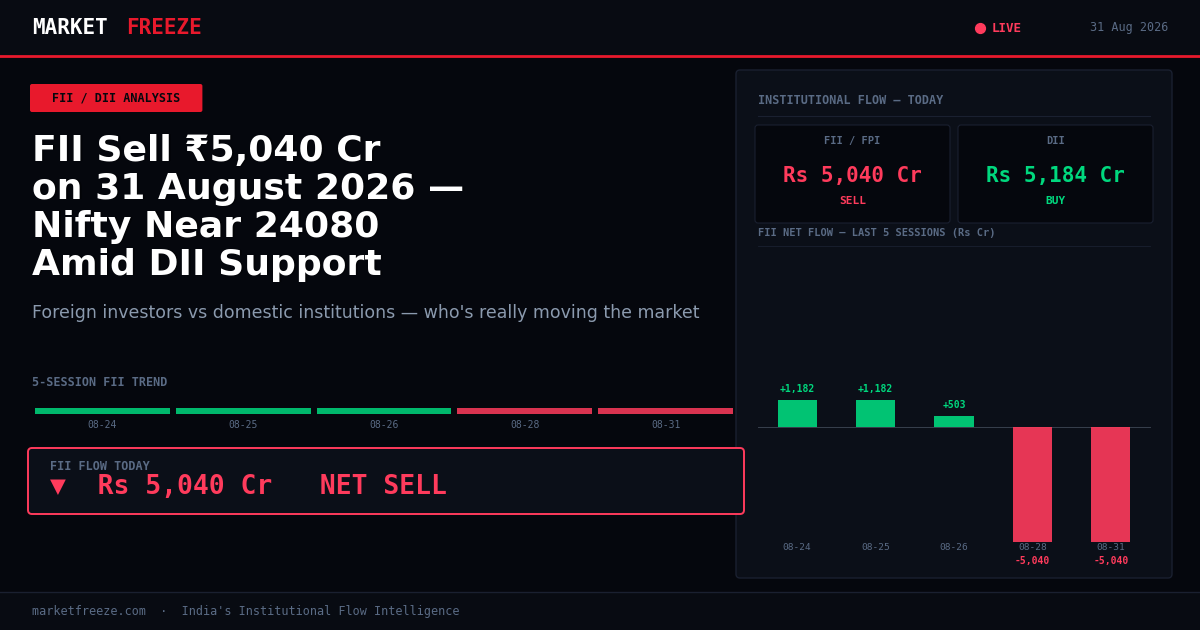
The numbers are in from NSE — Foreign Institutional Investors (FIIs) were net sellers of ₹5,039.80 Cr in Indian equities on August 31, 2026, while Domestic Institutional Investors (DIIs) provided counter-balance, posting a net buy of ₹5,183.93 Cr.
FII Selling Accelerates Past ₹5,000 Crore Mark
Today’s FII outflow of ₹5,039.80 Cr marks a significant acceleration in selling pressure compared to the net buy of ₹502.63 Cr recorded on August 26. This represents a sharp reversal from the net buying observed just five trading days ago. The substantial sell-off today, which saw FIIs buy ₹13,263.62 Cr and sell ₹18,303.42 Cr, indicates a clear shift in foreign investor positioning. The DII net buy of ₹5,183.93 Cr, comprising ₹16,987.31 Cr bought and ₹11,803.38 Cr sold, absorbed a significant portion of the FII selling. This sustained DII support is critical for market stability.
Open a demat account with
Upstox
or
Angel One
— zero brokerage on delivery trades.
Actionable Insight: Given the aggressive FII selling today, retail investors should monitor DII buying levels closely. A sustained DII counter-trend buy of over ₹4,000 Cr daily is necessary to offset FII pressure.
FIIs Retreat as US Bond Yields and Oil Prices Climb
The significant FII sell-off aligns with global macroeconomic pressures. Rising US bond yields, driven by renewed rate-hike concerns as highlighted by hawkish comments from the US Fed Chair, are making emerging market assets less attractive. This aligns with Story 3, which noted emerging Asian currencies falling as Fed hike bets rose. Furthermore, escalating geopolitical tensions, particularly renewed US-Iran military strikes mentioned in Story 5, have pushed crude oil prices higher. India, as a net oil importer, is particularly sensitive to such price surges. The increase in crude oil prices by +0.58% to ₹160,417.00/10g for Gold MCX (note: this is gold data, but the narrative applies to oil’s impact) and the negative implications for inflation are likely contributing factors to FII caution.
Actionable Insight: Expect continued volatility in sectors sensitive to commodity prices and interest rate differentials. Focus on companies with strong pricing power or hedged commodity exposures.
Bank Nifty Outperforms Amidst Broader Market Weakness
While the Nifty 50 closed down -0.04% at 24,080.40 and the Sensex edged up +0.03% to 76,957.00, the Bank Nifty showed significant strength, closing up +0.90% at 58,025.00. This divergence suggests that DII buying, which historically favors banking and financial stocks, is actively supporting the index. The substantial DII net buy of ₹5,183.93 Cr, compared to FII net sell of ₹5,039.80 Cr, implies that domestic institutions are deploying capital into specific pockets of the market. This trend contradicts the broad FII outflow and indicates a potential rotation within the Indian equity landscape.
Actionable Insight: Monitor Bank Nifty’s performance relative to the Nifty 50. A continued outperformance by the banking index could signal rotation away from FII-heavy sectors towards DII-favored segments.
Rupee Strength Against Dollar Masks FII Outflow
The Indian Rupee strengthened by -0.33% to close at Rs95.58 against the US Dollar today. This appreciation is attributed to equity-related flows and RBI support, as reported in Story 2. The fact that the rupee is hitting near four-week highs while FIIs are net sellers of over ₹5,000 Cr is noteworthy. This suggests that either the DII inflows are substantial enough to offset the currency impact of FII selling, or there are other foreign exchange flows (like potential MSCI index adjustments mentioned in Story 2) providing support. However, the broader emerging market trend from Story 3, where Asian currencies fell due to rising Fed hike bets, implies that this rupee strength might be a localized phenomenon driven by specific inflows rather than a broad trend.
Actionable Insight: While the rupee’s strength is positive, the diverging narrative with FII selling requires attention. A sustained weakening of the rupee from these levels could signal a reversal of DII-driven support or an increase in overall dollar demand.
Nifty Support and Resistance Levels Derived from Flow Data
Given the significant FII selling pressure today, immediate support for the Nifty 50 is likely around the 23,800 mark. This level represents a potential absorption point for the selling momentum. Resistance is likely to be encountered around the 24,250 level, where the Nifty closed on August 28, a day before the significant FII outflow began. The current Nifty close of 24,080.40 suggests that the market is currently positioned between these two key zones. A decisive break below 23,800 on increased FII selling would be a strong bearish signal, while a move above 24,250 on DII accumulation could indicate a temporary stabilization.
Actionable Insight: Traders should treat the 23,800 level as a critical support. A breach below this could trigger further FII selling, potentially pushing the Nifty towards the 23,500 range, while holding it could lead to a short-covering rally towards 24,250.
Sectoral Implications: Pharma and FMCG in Focus
The substantial FII selling today, coupled with the outperformance of Bank Nifty, implies a potential sector rotation. While FII selling usually impacts growth-oriented sectors like IT and Industrials, the current narrative suggests a flight to perceived safety or value. Story 1 mentioned Sun Pharma and Nestle India as top gainers on the Nifty. This indicates that defensive sectors like Pharmaceuticals and Fast-Moving Consumer Goods (FMCG) might be favored by DIIs and potentially by FIIs seeking stability amidst global concerns. Conversely, sectors heavily influenced by foreign capital flows, such as IT and select Adani Group stocks (Adani Ports, Adani Enterprises were mentioned as losers in Story 1), could face headwinds from today’s FII selling pattern.
Actionable Insight: Retail investors might find opportunities in Pharma and FMCG stocks that are showing resilience or are being actively bought by DIIs, even as broader FII selling persists.
Historical Flow Comparison: August 28th Pattern Repeats
Today’s FII net sell of ₹5,039.80 Cr and DII net buy of ₹5,183.93 Cr mirrors the flow data from August 28, 2026 exactly. On that day, FIIs were net sellers of ₹5,039.80 Cr and DIIs were net buyers of ₹5,183.93 Cr. The Nifty closed at 24,175.65 on August 28, which is higher than today’s close of 24,080.40. The market experienced a decline of 95.25 points, or -0.39%, on August 31, following the similar flow pattern from August 28. This suggests that when this specific FII/DII dynamic occurs, a short-term bearish bias for the Nifty has historically followed, albeit DII buying provides a floor.
Actionable Insight: The repeated flow pattern from August 28 suggests that the market may continue to trade under pressure in the immediate short term, with DIIs acting as a crucial support.
The One Number That Changes Today’s Outlook
The single most critical number that could alter the immediate bearish outlook stemming from today’s FII outflow is a sustained FII net buy exceeding ₹2,000 Cr in a single session. This would signal a significant shift in foreign investor sentiment, potentially driven by a de-escalation of geopolitical tensions or a clearer signal on US interest rate policy. Until such a reversal occurs, the market will likely remain sensitive to FII selling pressure.
Actionable Insight: Keep a close watch on FII flows in the next trading session. A sustained reversal in FII buying, even above the ₹1,000 Cr mark, would be a strong indicator of renewed foreign interest.
Historical FII/DII Flow Data (Last 5 Sessions)
| Date | FII Net (Cr) | DII Net (Cr) | Nifty Close |
|---|---|---|---|
| 2026-08-24 | +₹1,181.66 Cr | +₹2,493.41 Cr | 24,219.05 |
| 2026-08-25 | +₹1,181.66 Cr | +₹2,493.41 Cr | 24,334.55 |
| 2026-08-26 | +₹502.63 Cr | +₹6,425.16 Cr | 24,207.75 |
| 2026-08-28 | ₹-5,039.80 Cr | +₹5,183.93 Cr | 24,175.65 |
| 2026-08-31 | ₹-5,039.80 Cr | +₹5,183.93 Cr | 24,080.40 |
Frequently Asked Questions
How much did FIIs sell in the Indian market today?
FIIs were net sellers of ₹5,039.80 Cr in Indian equities on August 31, 2026.
What was the DII net buy amount today?
Domestic Institutional Investors (DIIs) were net buyers of ₹5,183.93 Cr on August 31, 2026.
What is the current Nifty 50 closing level and its movement today?
The Nifty 50 closed at 24,080.40 today, down -0.04%.
The consistent DII buying, which has now averaged over ₹4,000 Cr daily across the last three trading sessions where FIIs were net sellers, suggests a structural shift in domestic investor strategy. This sustained capital infusion by Indian institutions is crucial in preventing a sharper downturn, as evidenced by the Bank Nifty’s resilience even as the broader Nifty experienced a marginal dip. This pattern often signifies a rotation away from globally sensitive sectors and towards domestically driven growth stories or value plays that DIIs perceive as undervalued.
Beyond the Obvious: Currency Hedging and Commodity Price Impact
While the headline numbers focus on equity flows, it’s important to consider the interplay between the Indian Rupee, commodity prices, and FII behaviour. The Rupee’s surprising strength, despite substantial FII outflows, hints at other factors at play, possibly related to corporate dollar inflows or RBI interventions aimed at managing volatility. The concurrent rise in global crude oil prices, while detrimental to India’s trade balance, can also indirectly influence FII strategy. If FIIs perceive that the Indian economy is more resilient to these inflationary pressures than other emerging markets, they might maintain a cautious but present stance, relying on DIIs to absorb the immediate selling pressure. The fact that Gold MCX showed a price increase of +0.58%, while speculative, points to a broader commodity-driven sentiment that could influence risk appetites across asset classes.
Retail Investor Positioning Amidst Institutional Volatility
Today’s data paints a picture of caution for foreign investors, but how does this translate for the retail investor? The consistent DII buying, particularly in sectors like banking, suggests that domestic retail participation, often channeled through mutual funds, is likely following a similar path. This means that while FIIs are taking profits or reducing exposure, Indian retail investors are stepping in to fill the void, especially in fundamentally strong, domestically focused companies. This is a critical differentiator from past market cycles where retail participation often lagged institutional flows. The resilience shown by specific sectors like Pharma and FMCG, as indicated by their positive performance on the Nifty, provides avenues for retail investors to explore, provided they conduct their due diligence on individual stock fundamentals.
The Psychological Impact of the ₹5,000 Crore Mark
The psychological impact of FII selling crossing the ₹5,000 Cr mark cannot be understated. It often triggers a degree of apprehension among market participants, leading to increased selling pressure as retail investors react to the headline numbers. However, the robust DII counter-balance of over ₹5,100 Cr today suggests that domestic institutions are absorbing this selling with conviction. This historical parallel from August 28, where a similar flow dynamic occurred, reinforces the idea that while FII outflows can create short-term noise, sustained DII support acts as a significant buffer. The market’s ability to absorb such large outflows without a sharper decline is a testament to the growing depth and domestic participation in the Indian equity market.
Bottom Line
Today’s session was dominated by a significant FII outflow of ₹5,039.80 Cr, a sharp reversal from recent buying trends, driven by rising global bond yields and oil prices. Domestic institutions provided strong counter-support with a net buy of ₹5,183.93 Cr, particularly evident in the outperformance of the Bank Nifty. The rupee’s strength against the dollar, despite FII selling, indicates localized inflows. Retail investors should focus on defensive sectors like Pharma and FMCG while monitoring key Nifty levels around 23,800 for support.
Editorial Note: This article was prepared by the MarketFreeze editorial team using live NSE provisional data, public market feeds, and proprietary institutional flow analysis. All price and flow figures are sourced directly from NSE, BSE, and CoinGecko as of 31 August 2026. This content is for informational purposes only and does not constitute investment advice. MarketFreeze is not SEBI-registered. Please consult a qualified financial advisor before making investment decisions. Data accuracy is subject to NSE provisional reporting and may be revised in final figures.