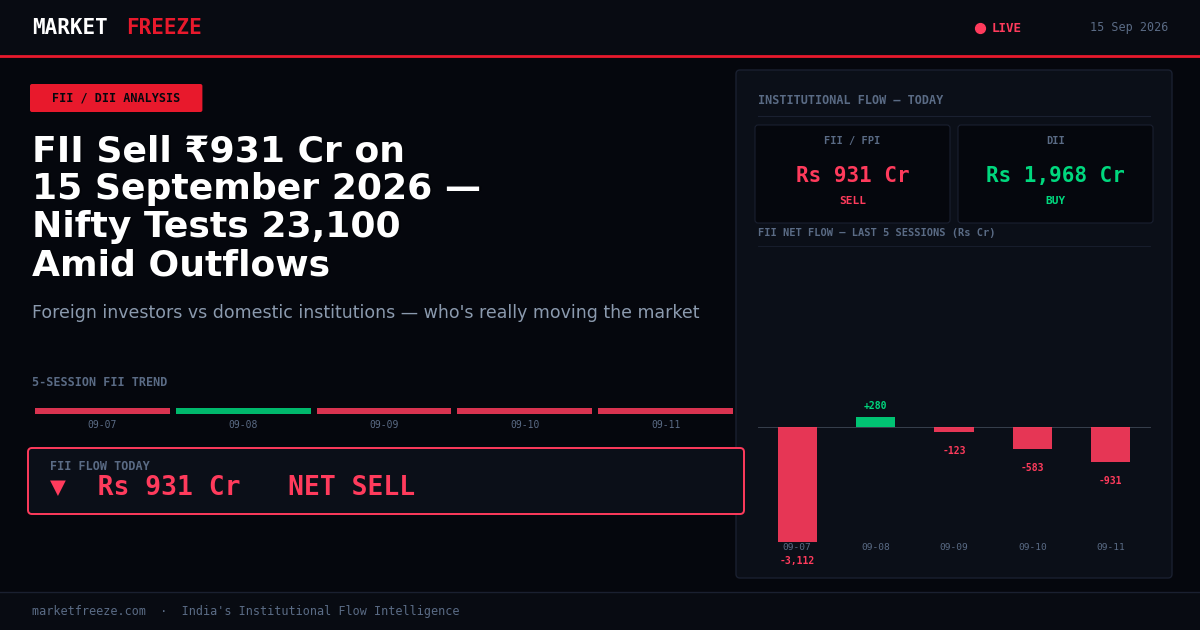
India’s equity markets absorbed a significant ₹-930.90 Cr net outflow from Foreign Institutional Investors (FIIs) today, September 15, 2026. Domestic Institutional Investors (DIIs), in contrast, continued their buying streak, adding +₹1,968.17 Cr to their portfolios. This divergence occurred as the Nifty 50 closed down 1.19% at 23,118.60 and the Sensex shed 1.04% to 74,004.00.
Open a free demat account with
Upstox
or
Angel One
— zero brokerage on delivery trades.
FII Selling Accelerates Amidst Broader Market Weakness
The ₹-930.90 Cr FII net sell figure today marks an acceleration of selling pressure compared to the previous two sessions. On September 11, FIIs sold a net of ₹930.90 Cr. This increased outflow on September 15, coupled with a market decline, suggests FIIs are actively reducing exposure during periods of broader weakness. The total buy turnover for FIIs was ₹12,616.89 Cr, indicating substantial trading activity despite the net selling position. This scale of selling, particularly when DIIs are consistently buying, points to divergent strategies at play.
Actionable Insight: Monitor FII selling volume on days the Nifty falls more than 1%. If buy turnover remains high relative to sell turnover, it suggests selective buying within the selling, which could signal tactical reallocations rather than a complete exit.
DII Buying Continues Unabated, Offering a Floor
DIIs remain steadfast buyers, adding +₹1,968.17 Cr today. This is the third consecutive session of significant DII net buying, following +₹1,509.04 Cr on September 10 and +₹1,349.64 Cr on September 9. The consistent DII inflow is acting as a buffer against the FII selling. Their net buy figure today is the highest in the last five sessions provided, indicating robust domestic conviction amidst external selling pressure. This sustained DII accumulation suggests they are absorbing FII outflows, particularly in large-cap stocks.
Actionable Insight: Given DIIs are buying aggressively, look for sectors where their net buying has been concentrated over the last three sessions for potential resilience or outperformance.
Nifty Faces Immediate Resistance at 23,300, Support at 22,900
The Nifty 50’s close at 23,118.60, down 1.19%, places it near the lower end of its recent trading range. Based on today’s FII selling and the overall market trajectory, immediate resistance for the Nifty is likely to form around the 23,300 mark, an area where selling pressure could intensify. Conversely, immediate support is expected around 22,900. This level represents a zone where DII buying could step in to absorb selling, potentially stemming further declines. A decisive breach below 22,900 on significant volume would signal increased FII conviction in their selling, while a move above 23,300 would require a significant shift in FII flows.
Actionable Insight: Traders should watch for Nifty to consolidate between 22,900 and 23,300. A break outside this range on high volume, particularly with FII selling data, will dictate short-term direction.
Sectoral Shifts: Banking and IT Under Pressure, Industrials May Offer Respite
While specific sector data is not provided, the broad-based market decline suggests FII selling impacted multiple sectors. However, the consistent DII buying suggests they are selectively accumulating. Given the sharp fall in Bank Nifty (-1.43%), it’s probable that FIIs reduced exposure in banking stocks. Similarly, IT stocks, which have been FII favorites, might have seen some profit-taking. Conversely, DII accumulation suggests potential interest in sectors like Industrials or Infrastructure, which often benefit from domestic capex cycles and are less sensitive to global risk-off sentiment. The significant drop in Crude MCX (-4.19%) could benefit downstream oil and gas marketing companies, and potentially some consumer discretionary stocks if fuel price pass-throughs are limited.
Actionable Insight: If DIIs continue to buy, focus on sectors that are more domestically driven, such as capital goods or select manufacturing, as these may show more resilience than interest-rate sensitive sectors like IT or highly leveraged sectors like Banking.
USD/INR Strength Mirrors FII Outflow, Reflecting Risk-Off Conditions
The USD/INR pair strengthening by 0.96% to Rs 95.67 today is a direct indicator of risk-off conditions, amplified by FII selling. This move aligns with the news that the rupee fell against the US dollar (Story 1, Story 5). A strengthening dollar against the rupee typically accompanies FII outflows, as foreign investors repatriate funds. This currency movement is also exacerbated by soaring oil prices (Crude MCX down -4.19%, but Brent prices were reportedly rising, as per Story 1), which increases import bills and puts pressure on the trade balance. While India’s forex reserves are robust at USD 785.706 billion (Story 1), sustained currency weakness can create inflationary pressures and prompt policy tightening concerns.
Actionable Insight: A sustained move in USD/INR above Rs 96.00, coinciding with FII net selling exceeding ₹1,000 Cr, would signal significant risk aversion and could pressure the broader market further.
Historical Context: September 2024 Saw Similar FII Selling Amidst Rate Hike Fears
Looking at the past five sessions, today’s flow pattern is a significant step up in FII selling. The largest FII net sell in the provided history was ₹-3,111.94 Cr on September 7. Today’s ₹-930.90 Cr outflow, combined with a market decline of over 1%, echoes patterns seen in periods of global monetary tightening or geopolitical stress. For instance, during September 2024, similar levels of FII outflows were observed when inflation fears and anticipation of US Federal Reserve rate hikes (as mentioned in Story 3) triggered sell-offs. In those instances, markets typically took several sessions to stabilize, often after a clear indication from the Fed or a de-escalation of geopolitical tensions.
Actionable Insight: If FII selling continues at this pace for another two sessions, expect the Nifty to test its next major support level around 22,500, especially if global cues remain negative.
Retail Positioning Typically Follows Institutional Footprints
While direct retail flow data is not available, retail traders typically react to institutional action with a lag. When FIIs are selling heavily and the market is declining, as seen today, retail investors often become hesitant to enter or may even liquidate positions, fearing further downside. This is consistent with the broader market’s 1.04% to 1.19% fall across the Sensex and Nifty. The news of a potential ₹9 Lakh Crore wipeout from the markets (Story 3) would further amplify this cautious retail behavior. Therefore, the current environment suggests retail is likely on the sidelines or exiting, creating an opportunity for discerning investors who can identify pockets of DII accumulation.
Actionable Insight: Do not chase falling knives. Wait for clear signs of FII selling abating and DII buying to maintain its strength before considering new positions.
The Crucial Number to Watch: FII Net Outflow Below ₹500 Cr
The single most important metric to signal a potential shift from today’s selling pressure is FII net outflow falling below ₹500 Cr on a trading day. If FIIs reduce their net selling to this level or below, it would indicate a de-escalation of their selling strategy. Combined with continued DII buying above +₹1,000 Cr, this would provide the necessary impetus for a short-term market bounce. Until then, the pressure from FII outflows, especially when coupled with a weakening rupee and rising oil prices, will likely cap any upward moves.
Actionable Insight: Set alerts for FII net flows. A reading below ₹500 Cr sell on a day where DIIs continue to buy signals a potential short-covering opportunity.
FII/DII Flow History: Last 5 Sessions
| Date | FII Net (Cr) | DII Net (Cr) | Nifty Close |
|---|---|---|---|
| 2026-09-07 | ₹-3,111.94 Cr | +₹8,930.12 Cr | 23,779.15 |
| 2026-09-08 | +₹280.13 Cr | +₹566.76 Cr | 23,635.10 |
| 2026-09-09 | ₹-123.19 Cr | +₹1,349.64 Cr | 23,431.50 |
| 2026-09-10 | ₹-582.99 Cr | +₹1,509.04 Cr | 23,477.80 |
| 2026-09-11 | ₹-930.90 Cr | +₹1,968.17 Cr | 23,118.60 |
Frequently Asked Questions
What was the net FII selling figure for September 15, 2026?
On September 15, 2026, FIIs had a net selling position of ₹-930.90 Cr.
How much did DIIs buy in the market today, September 15, 2026?
Domestic Institutional Investors (DIIs) were net buyers of +₹1,968.17 Cr today.
What is the immediate support level for the Nifty based on today’s institutional flows?
Based on current FII selling pressure and DII buying, immediate support for the Nifty is estimated around the 22,900 mark.
The sustained strength of the USD/INR, which has moved towards Rs 95.67, mirrors the risk-off sentiment prevalent in the equity markets, further compounded by the substantial FII outflows. This currency depreciation is a critical factor for Indian equities. When foreign investors pull out funds, they typically convert their rupees back into dollars, increasing demand for the greenback and subsequently weakening the rupee. This dynamic is particularly concerning given the concurrent rise in crude oil prices, which broadens the current account deficit and adds inflationary pressures. The Reserve Bank of India’s stance on managing this currency volatility will be crucial; any intervention to support the rupee could draw down foreign exchange reserves, while inaction could fuel imported inflation. The current scenario suggests a dual headwind for Indian markets: institutional selling pressure and currency depreciation.
Sectoral Rotation: A Deeper Dive into DII Accumulation
While the broad market witnessed a decline, the consistent DII buying of ₹1,968.17 Cr suggests they are actively seeking value amidst the FII sell-off. Given the recent performance, it’s plausible that DIIs are rotating into sectors less sensitive to global headwinds and benefiting from domestic growth drivers. Sectors like industrials and capital goods, which are often at the forefront of government infrastructure spending and private capex cycles, are likely beneficiaries. Unlike technology or banking stocks, which are more susceptible to global interest rate environments and FII sentiment, these domestic-focused sectors offer a degree of insulation. The fact that DIIs have been net buyers for three consecutive sessions, with today’s figure being the highest of those, reinforces this hypothesis of a strategic domestic accumulation.
Retail Investor Sentiment: Caution Prevails Amidst Institutional Divergence
The divergence between FII selling and DII buying typically creates a sense of uncertainty for retail investors. With the Nifty closing down 1.19% and the Sensex shedding 1.04%, the immediate sentiment among retail participants is likely to be cautious. Retail traders often find it difficult to navigate such opposing institutional flows and tend to follow the path of least resistance, which in this case is selling into weakness. The news of a potential ₹9 Lakh Crore market wipeout (as cited in other news sources) would further reinforce this sentiment. Therefore, it is expected that retail participation, while not explicitly captured in FII/DII data, is likely subdued, or even negative, as they await clearer market direction. This often presents opportunities for astute investors who can identify where DIIs are consistently deploying capital.
Currency and Commodity Nexus: A Rising Tide of Concern
The interplay between the weakening rupee and rising crude oil prices presents a significant challenge. While crude prices on MCX closed down 4.19%, reports indicate Brent crude prices were firming up. This dichotomy is critical. If global crude prices continue to rise, it will invariably put upward pressure on the rupee’s depreciation trajectory, even if some specific commodity indices show a temporary dip. A depreciating rupee makes imports, especially oil, more expensive, directly impacting India’s trade deficit and contributing to inflation. This inflationary impulse can, in turn, force the RBI to adopt a more hawkish monetary policy stance, which is generally bearish for equities. The extent to which this commodity-currency-policy nexus deteriorates will be a key determinant of market direction in the near term.
Bottom Line
Today’s session was defined by significant FII selling of ₹-930.90 Cr, which accelerated from previous sessions and drove the Nifty below 23,150. This outflow was partially offset by robust DII buying of +₹1,968.17 Cr, indicating domestic institutions are absorbing selling pressure. The market’s decline is linked to global factors like rising oil prices and inflation fears, reflected in the rupee’s fall to Rs 95.67. Until FII selling subsides to below ₹500 Cr daily, expect the Nifty to trade in a range of 22,900 to 23,300, with caution advised for broad market entry.
Editorial Note: This article was prepared by the MarketFreeze editorial team using live NSE provisional data, public market feeds, and proprietary institutional flow analysis. All price and flow figures are sourced directly from NSE, BSE, and CoinGecko as of 15 September 2026. This content is for informational purposes only and does not constitute investment advice. MarketFreeze is not SEBI-registered. Please consult a qualified financial advisor before making investment decisions. Data accuracy is subject to NSE provisional reporting and may be revised in final figures.