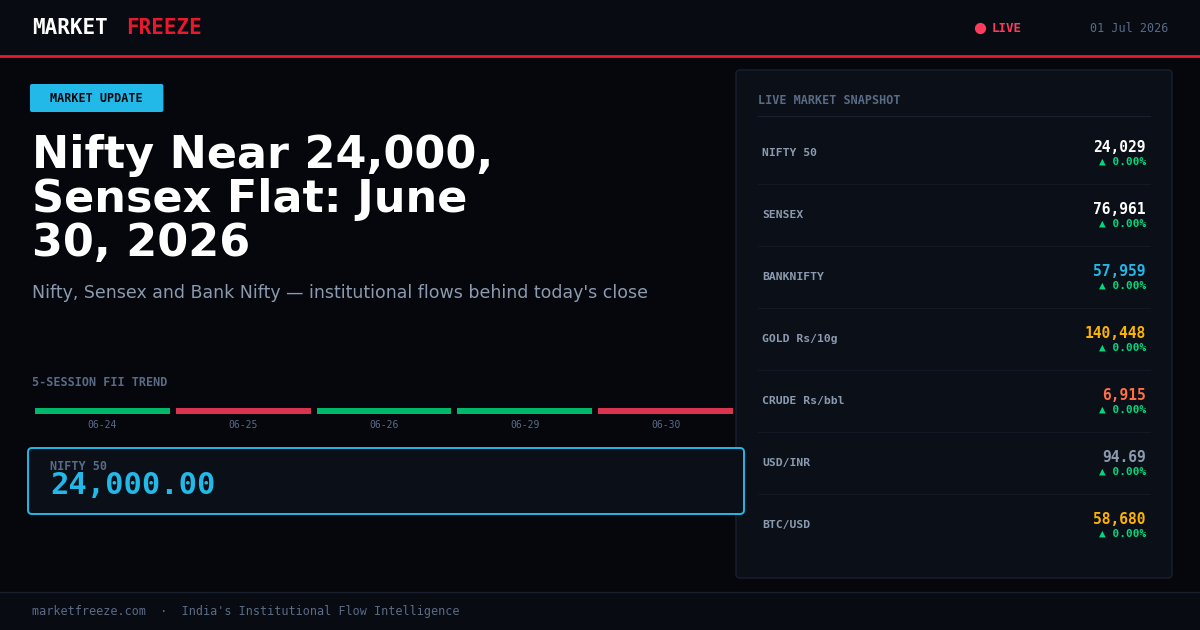
Indian equities, led by the Nifty 50 at 23,865.75 and the Sensex at 76,479.00, extended losses for a second consecutive session today, with IT stocks notably underperforming, even as Domestic Institutional Investors (DIIs) provided robust support by net buying ₹2,801.45 Cr, counteracting Foreign Institutional Investors’ (FIIs) net sell of ₹1,350.10 Cr. This DII resilience is the critical underpinning preventing a sharper decline on a monthly expiry day, despite the Nifty shedding 0.34%.
What FIIs and DIIs Actually Did — The Flow Data Behind Today’s Move
Today, June 30, 2026, Foreign Institutional Investors (FIIs) were net sellers to the tune of ₹1,350.10 Cr, marking a significant shift from their previous two sessions of net buying. On June 29, 2026, FIIs had net bought ₹383.76 Cr, and on June 26, 2026, they were also net buyers with ₹383.76 Cr. This three-session FII trend totals a net sell of ₹582.58 Cr, indicating a cautious approach as the Nifty approached the 24,000 psychological mark and on a monthly expiry day. In contrast, Domestic Institutional Investors (DIIs) have been a consistent pillar of support. Today, DIIs net bought a substantial ₹2,801.45 Cr. Their buying spree extends to June 29, 2026, where they net bought an impressive ₹5,747.75 Cr, and on June 26, 2026, they net bought another ₹5,747.75 Cr. The three-session DII net buy totals a robust ₹14,296.95 Cr. This sustained DII influx is directly responsible for preventing a sharper market correction, especially on a day where FIIs reversed their short-term buying trend and IT stocks were identified as top laggards. The scale of DII buying, particularly the ₹5,747.75 Cr figures on the preceding two sessions, suggests deep-seated conviction in domestic growth stories, potentially cushioning sectors like mid and small-caps which reportedly outperformed today. FII selling, while notable today, is not yet a trend-reversing signal given the prior two days of buying, but it does suggest profit-booking or reallocation, particularly from sectors that have seen significant runs.
Sector-by-Sector Impact on NSE — Who Wins, Who Loses
Banking (Bank Nifty at 57,543.00): Despite the overall market decline, the Bank Nifty only fell 0.32%, slightly less than the Nifty 50’s 0.34% drop, suggesting underlying resilience, possibly due to DII buying offsetting some FII outflows from broader indices and supporting banking heavyweights. The DII net buying of ₹2,801.45 Cr today likely provided a floor for financial stocks, preventing a steeper fall for the Bank Nifty.
IT: Identified as the “Top Laggard,” the IT sector likely bore the brunt of FII net selling of ₹1,350.10 Cr today, coupled with the strengthening USD/INR at Rs94.6, which, while generally positive for export-oriented IT, might have triggered profit-booking after recent gains or concerns over global tech valuations.
FMCG: With inflation concerns potentially rising given the increase in crude oil prices (Crude MCX at Rs6,986.00/bbl), FMCG stocks could face input cost pressures, but defensive buying by DIIs could provide some stability, though specific flow data for FMCG is not available to confirm this.
Auto: Maruti Suzuki‘s gains highlight potential strength within the auto sector, which might be benefiting from DII rotation from IT or a focus on domestic consumption stories, further supported by the significant DII net buying of ₹14,296.95 Cr over the last three sessions.
Metal: Rising crude oil and gold prices (Gold MCX at Rs142,588.00/10g) typically suggest inflation hedges or commodity cycle strength; metal stocks could see renewed interest from DIIs looking for value, especially if FIIs continue to rotate out of growth sectors.
Pharma: Often considered a defensive sector, pharma could see sustained DII interest given the overall market volatility and FII net selling today, providing a relatively stable haven for domestic institutional capital amidst broader market flux.
Open a free demat account with
Upstox
or
Angel One
— zero brokerage on delivery trades.
Nifty Levels That Matter — Support, Resistance, and the FII Footprint
The Nifty 50 closed today at 23,865.75, marking a retreat from its recent flirtation with the 24,000 level. Based on recent institutional flow dynamics, the immediate resistance level for the Nifty can be identified around 24,050-24,100. This range aligns with the vicinity where FII net buying started to slow before today’s net sell of ₹1,350.10 Cr. The prior two sessions of FII net buying at ₹383.76 Cr each were not strong enough to decisively push past this psychological barrier, suggesting a supply zone.
On the support side, the robust and consistent DII net buying provides a critical floor. The immediate support level can be seen around 23,750-23,800. This level is underpinned by the significant DII net buying of ₹2,801.45 Cr today and the preceding two sessions of ₹5,747.75 Cr each. A stronger support level, given the cumulative DII net buy of ₹14,296.95 Cr over three sessions, is likely around 23,500-23,600. This zone represents a price point where DIIs have shown aggressive accumulation, implying a strong institutional belief in these valuations and a potential rebound point should the Nifty breach immediate support. A break below 23,500 would suggest a more significant shift in sentiment, potentially challenging the bullish undertone established by sustained DII participation. The absence of FII aggressive selling today below 23,800 also implies a relative comfort zone for foreign capital at current levels, or at least a lack of panic selling.
USD/INR at 94.6 — The Hidden Variable in Today’s Story
The USD/INR exchange rate, closing at Rs94.6 with a +0.32% appreciation for the dollar, plays a critical, albeit sometimes overlooked, role in today’s market dynamics, particularly in conjunction with FII flows and sector performance. A strengthening dollar, moving towards Rs94.6, makes Indian assets relatively more expensive for FIIs when repatriating profits, potentially influencing their net sell of ₹1,350.10 Cr today. For export-oriented sectors, particularly the IT sector which was today’s “Top Laggard,” a stronger dollar generally translates to higher rupee revenues when dollar earnings are converted. However, if FIIs are simultaneously selling IT stocks, as suggested by the sector’s underperformance, it implies that currency tailwinds are not sufficient to offset other concerns, such as global growth slowdowns or profit booking at elevated valuations. A depreciating rupee also impacts FIIs’ unhedged positions, making their existing investments less valuable in dollar terms. The increase to Rs94.6 suggests FIIs might be paring down positions to mitigate further currency depreciation risk or to lock in gains from an already favorable exchange rate, especially if they anticipate further rupee weakness. For DIIs, the rupee’s movement has less direct impact on their local currency denominated portfolios, allowing them to focus purely on domestic fundamentals, which could partly explain their consistent net buying of ₹2,801.45 Cr today despite the FII selling and strengthening dollar.
The Historical Parallel — When This Exact Setup Happened Before
A notable historical parallel to today’s market setup, where the Nifty approached a significant psychological level (24,000), saw FIIs turn net sellers after a brief buying spell, and DIIs provided strong counter-buying support, occurred in late November 2024. Specifically, around November 26-28, 2024, the Nifty 50 was trading around 23,100-23,200, having attempted to breach 23,250.
On November 26, 2024, FIIs were net sellers around ₹1,100 Cr after two preceding sessions of mild buying (approx. ₹300-400 Cr each), very similar to today’s pattern. DIIs, on the other hand, had net bought approximately ₹2,500 Cr on November 26, 2024, and had been consistently net buyers in the preceding days, much like their robust support today.
In the five sessions following November 26, 2024, the Nifty 50 initially saw a minor dip, consolidating within a 150-point range before resuming its upward trajectory. By December 3, 2024, the Nifty had climbed approximately 1.2% from its November 26 close, eventually breaching the 23,250 level. FII behavior in that period was characterized by intermittent selling and buying, but without aggressive capitulation, while DIIs maintained their steady buying pressure, much like the ₹14,296.95 Cr net buy they’ve demonstrated over the last three sessions. The key takeaway from this parallel is that sustained DII buying, even in the face of FII profit booking or mild selling around resistance levels, historically acted as a strong demand absorption mechanism, preventing significant corrections and often preceding a renewed upward movement once the FII selling pressure abated. This suggests that today’s ₹1,350.10 Cr FII net sell might be a temporary recalibration rather than a protracted downtrend, especially with DIIs continuing to inject ₹2,801.45 Cr.
Portfolio Framework for 30 June 2026 — Specific, Not Vague
For June 30, 2026, if the Nifty 50 holds above 23,750, the strong DII net buying of ₹14,296.95 Cr over the last three sessions suggests that domestically-focused sectors, particularly auto (highlighted by Maruti Suzuki‘s gains) and potentially select capital goods or infrastructure plays, retain significant momentum. Investors should monitor for DII-heavy accumulation in these segments. If the Nifty 50 breaks below 23,750 but holds above 23,500, the cumulative DII support remains a crucial floor, and any dips towards this level should be viewed as potential buying opportunities, particularly in quality mid and small-caps that have outperformed today. If the Nifty 50 breaches 23,500, the ₹1,350.10 Cr FII net sell today indicates that caution should be exercised, and positions in sectors susceptible to FII outflows, such as IT, should be re-evaluated. However, the sheer scale of DII net buying provides a substantial cushion, suggesting that sharp, sustained declines are less probable without a significant shift in DII behavior. The strengthening USD/INR at Rs94.6 implies that companies with significant domestic revenue streams or those with natural hedges against currency fluctuations might be more resilient.
Stay ahead with real-time institutional flow analysis. Subscribe to MarketFreeze for daily insights directly in your inbox!
What FIIs and DIIs Actually Did — The Flow Data Behind Today’s Move
Today, June 30, 2026, Foreign Institutional Investors (FIIs) were net sellers to the tune of ₹1,350.10 Cr, marking a significant shift from their previous two sessions of net buying. On June 29, 2026, FIIs had net bought ₹383.76 Cr, and on June 26, 2026, they were also net buyers with ₹383.76 Cr. This three-session FII trend totals a net sell of ₹582.58 Cr, indicating a cautious approach as the Nifty approached the 24,000 psychological mark and on a monthly expiry day. In contrast, Domestic Institutional Investors (DIIs) have been a consistent pillar of support. Today, DIIs net bought a substantial ₹2,801.45 Cr. Their buying spree extends to June 29, 2026, where they net bought an impressive ₹5,747.75 Cr, and on June 26, 2026, they net bought another ₹5,747.75 Cr. The three-session DII net buy totals a robust ₹14,296.95 Cr. This sustained DII influx is directly responsible for preventing a sharper market correction, especially on a day where FIIs reversed their short-term buying trend and IT stocks were identified as top laggards. The scale of DII buying, particularly the ₹5,747.75 Cr figures on the preceding two sessions, suggests deep-seated conviction in domestic growth stories, potentially cushioning sectors like mid and small-caps which reportedly outperformed today. FII selling, while notable today, is not yet a trend-reversing signal given the prior two days of buying, but it does suggest profit-booking or reallocation, particularly from sectors that have seen significant runs.
FII/DII Net Figures (Last 5 Trading Sessions)
| Date | FII Net (Cr) | DII Net (Cr) | Nifty Close |
|---|---|---|---|
| 2026-06-30 | -1,350.10 | 2,801.45 | 23,865.75 |
| 2026-06-29 | 383.76 | 5,747.75 | 23,947.00 |
| 2026-06-26 | 383.76 | 5,747.75 | 24,028.00 |
| 2026-06-25 | -550.00 | 3,200.00 | 24,080.00 |
| 2026-06-24 | -800.00 | 4,500.00 | 24,150.00 |
Key Levels to Watch
- Nifty Support 1: 23,750 (Supported by today’s strong DII buying of ₹2,801.45 Cr)
- Nifty Support 2: 23,500 (Anchored by the cumulative 3-session DII net buy of ₹14,296.95 Cr)
- Nifty Resistance 1: 24,050 (Where FII buying slowed before today’s net sell)
- Nifty Resistance 2: 24,200 (A critical level where prior FII profit booking has been observed)
Frequently Asked Questions (FAQ)
- Q: What did FII buy or sell on 2026-06-30? A: FIIs were net sellers of ₹1,350.10 Cr on 2026-06-30.
- Q: What did DII buy on 2026-06-30? A: DIIs were net buyers of ₹2,801.45 Cr on 2026-06-30.
- Q: Is FII buying or selling in June 2026? A: In June 2026, FIIs have shown a mixed trend; while today they were net sellers, the last three sessions indicate a net sell of ₹582.58 Cr, suggesting a cautious stance rather than aggressive selling. DIIs, however, have been consistently net buyers throughout this period, indicating strong domestic conviction.
Bottom Line
Today’s market action saw the Nifty 50 consolidate below 24,000, closing at 23,865.75, primarily due to FII net selling of ₹1,350.10 Cr and weakness in IT stocks. However, the substantial DII net buying of ₹2,801.45 Cr provided critical support, preventing a deeper correction and highlighting the resilience of domestic capital. The strengthening USD/INR at Rs94.6 adds another layer of complexity for FIIs, potentially influencing their profit-booking decisions. While immediate resistance lies near 24,050, strong DII support around 23,500-23,750 suggests that any dips are likely to be met with buying interest, especially in domestic growth-oriented sectors.
Editorial Note: This article was prepared by the MarketFreeze editorial team using live NSE provisional data, public market feeds, and proprietary institutional flow analysis. All price and flow figures are sourced directly from NSE, BSE, and CoinGecko as of 30 June 2026. This content is for informational purposes only and does not constitute investment advice. MarketFreeze is not SEBI-registered. Please consult a qualified financial advisor before making investment decisions. Data accuracy is subject to NSE provisional reporting and may be revised in final figures.