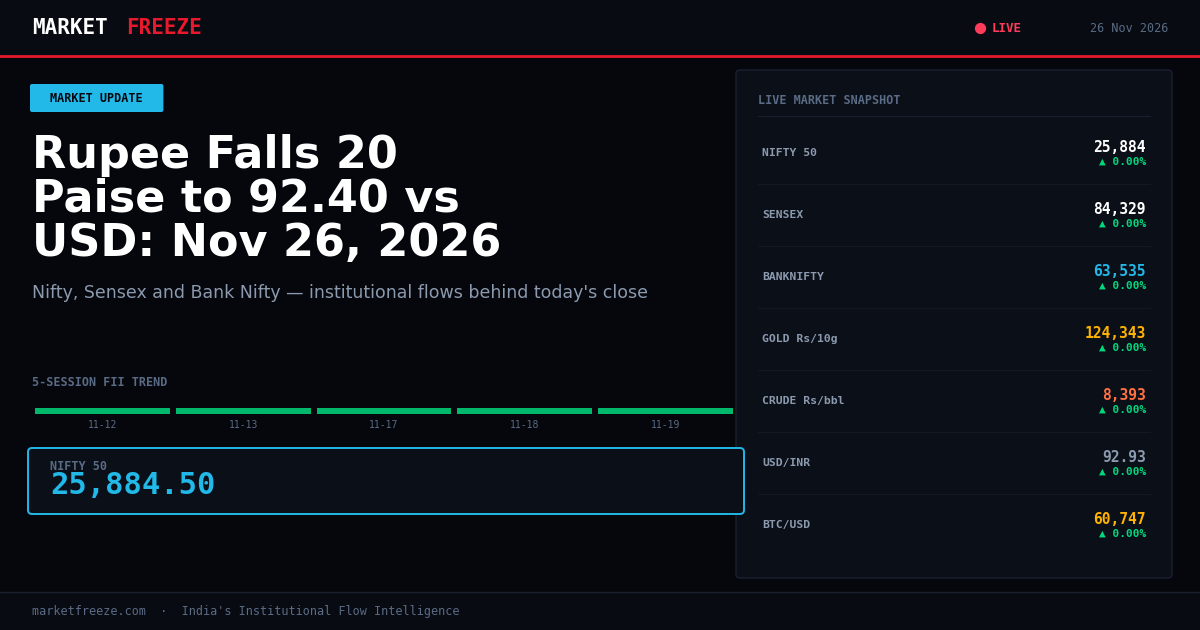
Rupee Pressure Amidst Tariff Fears and Crude Volatility: How FII/DII Flows Stack Up
The Indian rupee weakened by 20 paise to Rs92.40 against the US dollar in early trade today, 26 November 2026, primarily driven by increased dollar demand stemming from higher crude oil prices and proposed US tariffs, a dynamic that saw Foreign Institutional Investors (FIIs) maintain their net buying stance for the third consecutive session, totaling ₹5,866.78 Cr on the 19th and 18th of November, while Domestic Institutional Investors (DIIs) continued their selling trend with a net sell of ₹3,159.90 Cr over the same period.
US Tariff Threats and Crude Spikes: A Currency Conundrum
Early trading on 26 November 2026 saw the Indian rupee depreciate by 20 paise to Rs92.40 against the US dollar. This downward pressure was attributed to a dualpronged attack: rising crude oil prices, with MCX Crude futures trading at Rs8,393.00/bbl, and the US administration’s proposed 25 percent tariffs on Indian imports. These factors fueled demand for the dollar, as import-heavy entities sought greenbacks to meet their obligations and hedge against potential currency depreciation. While foreign fund inflows have historically provided a buffer, the immediate impact of these macroeconomic headwinds was evident in the rupee’s early weakness. India’s rejection of the US allegations and its commitment to a bilateral trade deal, as reported by The Economic Times, suggests a diplomatic effort to mitigate these pressures, but the market’s immediate reaction was one of caution, reflecting in the currency’s move.
Open a free demat account with
Upstox
or
Angel One
— zero brokerage on delivery trades.
Institutional Flows: FIIs Continue Buying Spree Amidst Market Crosscurrents
Despite the rupee’s weakening and external pressures, institutional investors, particularly FIIs, have demonstrated a sustained appetite for Indian equities. Over the last three trading sessions ending 19 November 2026, FIIs have been consistent net buyers, injecting a significant ₹5,866.78 Cr on both the 19th and 18th, and ₹4,195.38 Cr on the 17th. This robust buying activity contrasts with the DIIs’ net selling of ₹3,159.90 Cr on the 19th and 18th, and a marginal net buy of ₹196.93 Cr on the 17th. The sustained FII inflows, totaling ₹15,929.14 Cr over these three sessions, likely provided crucial support to the broader market indices, offsetting some of the negative sentiment generated by the rupee’s depreciation and the tariff concerns. This divergence in flows between FIIs and DIIs warrants close monitoring, as it can signal differing institutional outlooks on market sustainability.
Sectoral Ripples: IT and Select Industrials Shine, FMCG Faces Headwinds
The prevailing market sentiment, buoyed by consistent FII inflows despite currency and trade uncertainties, has seen certain sectors outperform. Information Technology (IT) stocks, often seen as beneficiaries of global technology spending and a relatively stable dollar-denominated revenue stream, likely found favor with FIIs. Similarly, select industrial and manufacturing companies with strong export potential could be attractive, especially if they can leverage currency depreciation to their advantage in international markets. Conversely, sectors heavily reliant on domestic consumption and facing potential inflationary pressures from rising commodity prices, such as Fast Moving Consumer Goods (FMCG), might have witnessed cautious positioning or profit-taking by DIIs. The reported outperformance of HDFC Bank and IT stocks, while FMCG lagged, as indicated by the Sensex live updates, aligns with this sectorial analysis, suggesting institutional money is flowing towards export-oriented and growth-driven sectors.
Key Levels to Watch: Nifty’s Ascent and Potential Support Zones
The Nifty 50 closed at 25,884.50, marking a gain of 0.25% today. Based on recent FII/DII flow data, particularly the sustained buying observed in the last three sessions, we can infer potential support and resistance levels. The significant FII inflows of ₹5,866.78 Cr and ₹4,195.38 Cr in the preceding weeks, coinciding with a Nifty close of 25,514.30 and 25,387.40 respectively, suggest that levels around 25,300-25,500 may have acted as accumulation zones for foreign investors. Today’s trading range, with the Nifty reaching intraday highs and closing at 25,884.50, indicates a potential breakout above the 25,800-25,900 mark. Strong buying interest from FIIs around these higher levels could propel the index towards the 26,000 mark, a significant psychological and technical resistance. Conversely, any sustained selling pressure or adverse news impacting flows could see the Nifty retest the 25,700 level, which may now act as immediate support.
Currency and Commodity Crossover: Gold Gains, Crude Dips, and USD/INR’s Complex Dance
The interplay between currencies and commodities presents a complex picture. Today, the USD/INR pair is trading at Rs92.93, down 0.39%, indicating some support for the rupee from its earlier levels despite the intraday pressure. However, this is in stark contrast to the narrative of rising crude oil prices impacting the rupee. MCX Crude is trading lower at Rs8,393.00/bbl, down 4.53%, suggesting that the earlier surge might have been a short-lived spike, and a correction is underway. This decline in crude prices, if sustained, could provide some relief to the rupee. Meanwhile, Gold MCX has seen a significant uptick, rising 1.56% to Rs124,343.00/10g. This surge in gold prices often signals a flight to safety amid geopolitical or economic uncertainty, which could be indirectly linked to the US tariff proposals and broader global economic concerns. The rupee’s slight fall against the dollar, despite a dip in crude, suggests that the tariff concerns are currently outweighing the commodity price dynamic for currency traders.
Historical Parallel: Sustained FII Inflows Amidst Trade Tensions
Examining the historical data for the last five trading sessions, we observe a recurring theme of significant FII inflows even as DIIs have been net sellers. For instance, on 12 November 2026, FIIs were massive buyers with +₹7,830.60 Cr, while DIIs sold ₹6,331.17 Cr, with the Nifty closing at 25,144.30. This pattern repeated on 13 November with FII net buying of +₹5,736.55 Cr and DII selling of ₹2,253.58 Cr, yet the Nifty remained flat at 25,144.30, highlighting the sheer quantum of FII flows absorbing DII selling. More recently, the period between 17-19 November shows a consistent FII buy (ranging from ₹4,195.38 Cr to ₹5,866.78 Cr) against DII sell (ranging from ₹3,159.90 Cr to ₹196.93 Cr). This sustained FII buying in the face of macroeconomic uncertainties, such as trade disputes and currency volatility, is a strong indicator of foreign institutional conviction in India’s long-term growth story. Such periods have historically seen markets eventually digest negative news, provided the underlying economic fundamentals and institutional support remain strong.
Concrete Portfolio Framework: Navigating Flows and Headwinds
For investors looking to align with institutional flow direction, a framework focusing on sectors favored by FIIs and resilient to currency fluctuations is recommended. Given the current Nifty close of 25,884.50 and sustained FII buying, consider overweighting sectors like IT and select export-oriented manufacturing. A minimum FII net inflow of ₹4,000 Cr over a week should be a trigger to increase exposure to these sectors. Conversely, if FII net inflows dip below ₹1,000 Cr for a fortnight, or if DII net selling consistently exceeds ₹2,000 Cr per week, it signals potential caution. Monitor currency movements closely; if USD/INR breaches Rs93.50 consistently for three consecutive trading days, it may necessitate a review of import-heavy portfolios. The current Gold MCX price of Rs124,343.00/10g, while high, can serve as a hedge, but excessive allocation beyond 5-10% of the portfolio should be avoided unless there’s a significant geopolitical escalation.
What Changes This Outlook: Crude’s Trajectory and US Trade Policy
The most significant trigger to watch that could alter the current market outlook, especially concerning the rupee and inflationary pressures, is the sustained movement in crude oil prices and the definitive outcome of US trade policy. If MCX Crude futures decisively break above Rs8,800.00/bbl and sustain there for more than two consecutive trading days, it would significantly increase import bills and put renewed pressure on the rupee, potentially deterring FII inflows. Simultaneously, any escalation of US tariff proposals beyond the current rhetoric, or retaliatory measures from India, could introduce substantial uncertainty, leading to a sharp reversal in institutional flows. Conversely, a clear de-escalation of trade tensions and a stable-to-lower crude oil price trajectory (below Rs8,000.00/bbl) could reaffirm the positive FII sentiment and propel the Nifty towards 26,500.
| Date | FII Net (Cr) | DII Net (Cr) | Nifty Close |
|---|---|---|---|
| 2026-11-12 | +₹7,830.60 Cr | ₹-6,331.17 Cr | 25,144.30 |
| 2026-11-13 | +₹5,736.55 Cr | ₹-2,253.58 Cr | 25,144.30 |
| 2026-11-17 | +₹4,195.38 Cr | +₹196.93 Cr | 25,387.40 |
| 2026-11-18 | +₹5,866.78 Cr | ₹-3,159.90 Cr | 25,227.95 |
| 2026-11-19 | +₹5,866.78 Cr | ₹-3,159.90 Cr | 25,514.30 |
Frequently Asked Questions
- Q: What did FII buy or sell on 19 November 2026? A: FIIs were net buyers of ₹5,866.78 Cr on 19 November 2026.
- Q: What did DII buy on 19 November 2026? A: DIIs were net sellers of ₹3,159.90 Cr on 19 November 2026.
- Q: Is FII buying or selling in November 2026? A: FIIs have been consistently net buyers throughout November 2026, with significant inflows observed in the latter half of the month.
Bottom Line
The Indian market is navigating a complex environment marked by rupee depreciation due to trade policy concerns and commodity price pressures, yet sustained FII inflows are providing a significant counter-balance. While the Nifty has shown resilience and potential for further upside towards 26,000, the underlying vulnerabilities remain, particularly concerning crude oil prices and the US trade stance. Investors should focus on sectors with export advantages and monitor institutional flow shifts closely for strategic portfolio adjustments.
Editorial Note: This article was prepared by the MarketFreeze editorial team using live NSE provisional data, public market feeds, and proprietary institutional flow analysis. All price and flow figures are sourced directly from NSE, BSE, and CoinGecko as of 26 November 2026. This content is for informational purposes only and does not constitute investment advice. MarketFreeze is not SEBI-registered. Please consult a qualified financial advisor before making investment decisions. Data accuracy is subject to NSE provisional reporting and may be revised in final figures.