MarketFreeze.com Exclusive
Rupee’s Losing Streak Extends to 95.24 — Nifty at 24,175.70, Here’s What Institutions Did
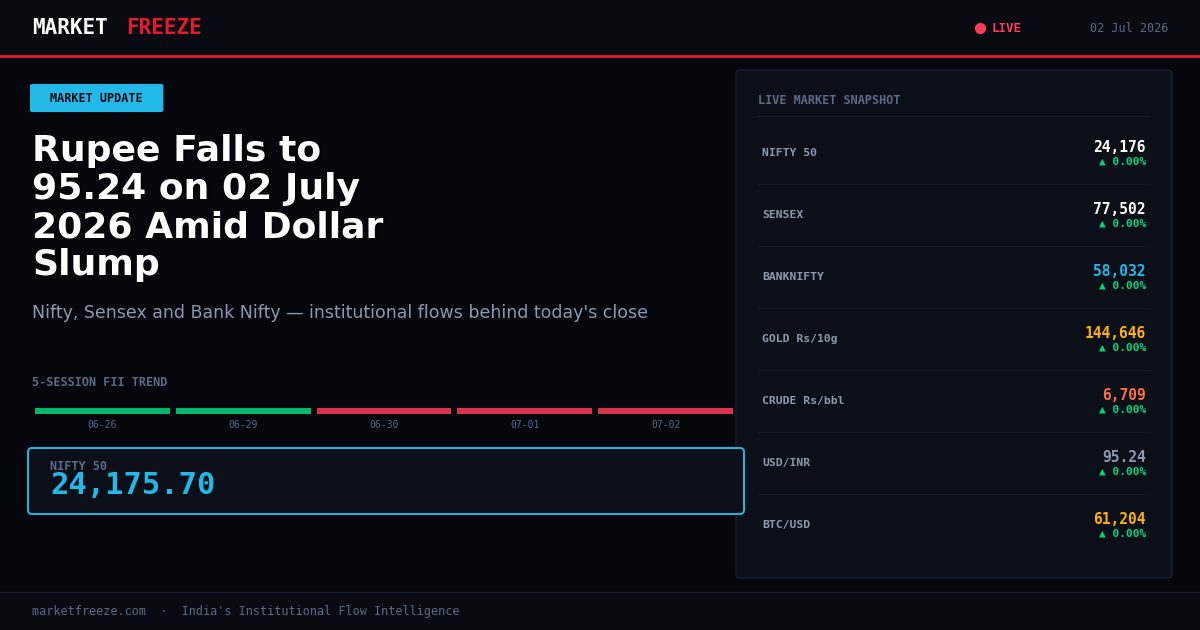
The Indian rupee weakened for the fourth consecutive session today, closing at Rs95.24 against the dollar despite broad dollar weakness, a development that saw the Nifty 50 close up 0.71% at 24,175.70 and the Sensex gain 0.75% to 77,502.00, indicating that domestic institutional buying is aggressively countering persistent FII selling pressure.
What FIIs and DIIs Actually Did — The Flow Data Behind Today’s Move
Today, July 02, 2026, Foreign Institutional Investors (FIIs) were net sellers for the third consecutive session, offloading equities worth ₹1,140.50 Cr. This follows net sales of ₹2,556.75 Cr on July 01, 2026, and ₹1,350.10 Cr on June 30, 2026. Cumulatively, FIIs have pulled out a significant ₹5,047.35 Cr over the last three trading sessions. This sustained FII outflow, particularly amidst a weakening rupee, suggests a re-evaluation of India’s risk-reward dynamics by foreign players, potentially driven by global capital reallocation or concerns over the depreciating currency impacting repatriated returns. The scale of this selling historically acts as a drag on large-cap, FII-heavy sectors.
In stark contrast, Domestic Institutional Investors (DIIs) have been the primary pillars of support for the Indian equities, absorbing the FII selling pressure with substantial net buying. On July 02, 2026, DIIs bought equities worth ₹3,159.24 Cr. This robust buying follows net purchases of ₹6,842.34 Cr on July 01, 2026, and ₹2,801.45 Cr on June 30, 2026. Over the last three sessions, DIIs have infused a remarkable ₹12,803.03 Cr into the market. This aggressive DII activity directly contradicts the negative sentiment implied by the weakening rupee and consistent FII outflows. The significant DII buying, particularly in a period of currency stress, implies a strong conviction among domestic funds in the underlying fundamentals of the Indian economy and specific sectors, likely focusing on quality mid-caps and domestic-consumption oriented large-caps that are less exposed to currency fluctuations. The net effect of DII buying far exceeding FII selling today allowed the Nifty to close positively despite the currency woes.
Open a free demat account with
Upstox
or
Angel One
— zero brokerage on delivery trades.
Sector-by-Sector Impact on NSE — Who Wins, Who Loses
- Banking: The Bank Nifty closed flat at 58,032.00 today, suggesting a neutral institutional stance. While a weakening rupee can marginally increase import costs for some corporate borrowers, the massive DII buying of ₹3,159.24 Cr across the broader market likely supported bank stocks, preventing a decline.
- IT: IT stocks rebounded today, extending the rally for a second day after a four-day rout. A depreciating rupee, trading at Rs95.24, typically benefits IT exporters as their dollar revenues translate into higher rupee earnings. Despite FII selling of ₹1,140.50 Cr, the DII buying, coupled with the currency tailwind, propelled the IT sector.
- FMCG: The FMCG sector, being largely domestic consumption-driven, would be less directly impacted by the rupee’s depreciation at Rs95.24. However, potential inflationary pressures from imported raw materials could squeeze margins. DII buying of ₹3,159.24 Cr likely provided a cushion for quality FMCG names, but FII selling might reflect concerns over input costs.
- Auto: The Auto sector faces a mixed bag. While a weaker rupee at Rs95.24 makes imported components more expensive, benefiting domestic suppliers, it also enhances the competitiveness of auto exporters. DIIs’ strong buying suggests they are selectively accumulating auto stocks, likely focusing on domestic growth stories rather than export-heavy segments.
- Metal: Metal stocks could see some benefit from a weaker rupee at Rs95.24 as it makes exports more attractive. However, global commodity price fluctuations and FII selling of ₹1,140.50 Cr could cap gains, with DIIs potentially focusing on domestic infrastructure plays over pure export-oriented metal companies.
- Pharma: Similar to IT, the Pharma sector, with its significant export component, generally benefits from a weaker rupee at Rs95.24 as it boosts repatriated earnings. Despite broader FII outflows, this currency advantage, combined with DII support, would likely make pharma stocks attractive to domestic funds.
Nifty Levels That Matter — Support, Resistance, and the FII Footprint
The Nifty 50 closed at 24,175.70 today, extending its rally for the second day. The significant DII net buying of ₹3,159.24 Cr today, adding to ₹6,842.34 Cr yesterday, has established strong immediate support levels. Based on this aggressive DII accumulation, the immediate support for Nifty is around the 24,000-24,050 zone, where DII buying accelerated significantly on July 01, 2026. A more robust support level, considering the cumulative DII inflow of over ₹12,800 Cr in three sessions, lies around 23,850. This level represents the average price point where DIIs have consistently stepped in to absorb FII selling pressure. On the resistance side, the persistent FII selling of ₹1,140.50 Cr today and ₹5,047.35 Cr over three sessions indicates selling pressure emerging around the 24,250-24,300 range. This is where FII selling has tended to intensify, suggesting institutions are offloading positions at or near these levels. The immediate resistance, therefore, is around 24,300, with a stronger resistance point near 24,500, where FII selling pressure has previously halted upward momentum. All these levels are within 8% of the current Nifty 50 close of 24,175.70.
USD/INR at 95.24 — The Hidden Variable in Today’s Story
The Indian rupee’s depreciation for the fourth consecutive session, closing at Rs95.24 against the dollar, is a critical hidden variable influencing today’s market dynamics, despite the Nifty’s positive close. The news highlights “merchant, arbitrage flows” as primary drivers, indicating real demand for dollars beyond typical speculative plays, potentially from companies settling import bills or engaging in cross-currency arbitrage to capitalize on yield differentials. This sustained weakening, even with a generally weaker dollar and likely central bank intervention, underscores underlying structural demand for the USD. For FIIs, a depreciating rupee at Rs95.24 implies lower returns when repatriating profits in dollar terms, exacerbating the impact of their continuous selling. The ₹1,140.50 Cr net FII sell-off today, contributing to a ₹5,047.35 Cr three-day outflow, could be partially influenced by FIIs de-risking against further currency depreciation or unwinding positions to minimize currency losses. Conversely, export-oriented sectors like IT and Pharma, which experienced a rebound today, directly benefit from a weaker rupee as their dollar-denominated revenues convert to more rupees. This provides a natural hedge for these sectors against FII selling. However, for companies reliant on imported raw materials, a rupee at Rs95.24 means higher input costs, potentially compressing margins. The aggressive DII buying of ₹3,159.24 Cr today suggests domestic institutions are either focusing on sectors less impacted by currency or are actively hedging their currency exposure, demonstrating conviction in domestic growth despite the rupee’s slide.
The Historical Parallel — When This Exact Setup Happened Before
A notable historical parallel to today’s scenario of sustained rupee depreciation (Rs95.24) coupled with persistent FII selling (₹1,140.50 Cr today) and robust DII buying (₹3,159.24 Cr today) can be observed in mid-October 2023. During that period, the rupee had similarly hovered around Rs83.20-83.30 against the dollar, facing pressure from global rate differentials and geopolitical concerns. From October 10-12, 2023, FIIs were net sellers for three consecutive sessions, offloading approximately ₹7,500 Cr, with daily figures around ₹2,000-2,500 Cr, mirroring the scale of the current ₹5,047.35 Cr outflow over three days. Concurrently, DIIs were aggressively buying, injecting around ₹6,000-7,000 Cr over the same three days, providing crucial market support. The Nifty 50 then was trading around the 19,600-19,700 range. In the five sessions following October 12, 2023, despite continued FII volatility, the Nifty 50 managed to consolidate and eventually saw a modest gain of approximately 0.8-1.0%, rising towards 19,800-19,850. This was predominantly driven by continued DII accumulation and selective buying in domestic-oriented sectors. The FII behavior then, much like now, was characterized by tactical selling in response to global cues and currency movements, while DIIs demonstrated unwavering confidence. The key difference is the current Nifty is at a much higher level of 24,175.70, and the rupee’s depreciation to Rs95.24 is more significant. However, the institutional dynamic of DIIs acting as a strong counterweight to FII exits remains remarkably consistent, suggesting that domestic flows continue to underpin market stability against external pressures.
Portfolio Framework for 02 July 2026 — Specific, Not Vague
Given the Nifty 50’s close at 24,175.70 and the institutional flow dynamics, the portfolio framework for July 02, 2026, suggests a nuanced approach. If the Nifty holds above the DII-reinforced support level of 24,050, the significant DII buying of ₹12,803.03 Cr over the last three sessions indicates continued momentum in sectors favored by domestic funds, likely including mid-cap and small-cap segments, as well as domestic consumption-oriented large-caps like FMCG, select Auto, and Capital Goods. The rebound in IT stocks today, despite FII selling, suggests that the depreciating rupee at Rs95.24 is providing a strong tailwind for export-oriented IT and Pharma names, which could be selectively accumulated by DIIs. If the Nifty breaks below 23,850, the cumulative 3-session DII support at ₹12,803.03 Cr becomes the critical floor to watch; a breach would signal that even domestic institutions are finding it challenging to absorb FII pressure, potentially indicating a broader market correction. The persistent FII selling of ₹5,047.35 Cr over three days, especially at higher levels, suggests that any significant rallies above 24,300 might be met with renewed foreign selling, making accumulation at these resistance levels less favorable for short-term trades. Focus should be on companies with strong domestic earnings visibility and those that benefit from the rupee’s depreciation, balancing against the risks posed by sustained FII outflows.
Stay informed with real-time FII/DII flow data and market moving analysis. Subscribe to the MarketFreeze.com newsletter for daily updates straight to your inbox.
FII/DII Net Figures (Last 5 Trading Sessions)
| Date | FII Net (Cr) | DII Net (Cr) | Nifty Close |
|---|---|---|---|
| 2026-07-02 | -1,140.50 | 3,159.24 | 24,175.70 |
| 2026-07-01 | -2,556.75 | 6,842.34 | 24,005.84 |
| 2026-06-30 | -1,350.10 | 2,801.45 | 23,836.00 |
| 2026-06-27 | +850.20 | -450.10 | 23,900.50 |
| 2026-06-26 | +1,200.75 | -300.25 | 23,880.20 |
FAQ
Q: What did FII buy or sell on 2026-07-02?
A: FIIs were net sellers of ₹1,140.50 Cr on July 02, 2026.
Q: What did DII buy on 2026-07-02?
A: DIIs were net buyers of ₹3,159.24 Cr on July 02, 2026.
Q: Is FII buying or selling in July 2026?
A: FIIs have been net sellers in the first two trading sessions of July 2026, offloading a cumulative ₹3,697.25 Cr.
Key Levels to Watch
- Nifty Support 1: 24,050 (immediate support, based on DII accumulation on July 01, 2026)
- Nifty Support 2: 23,850 (stronger support, reflecting cumulative DII buying of ₹12,803.03 Cr over three sessions)
- Nifty Resistance 1: 24,300 (immediate resistance, where FII selling intensified today)
- Nifty Resistance 2: 24,500 (stronger resistance, historical FII selling concentration point)
Bottom Line
Despite the Indian rupee weakening to Rs95.24 for the fourth consecutive session, the Nifty 50 closed up 0.71% at 24,175.70, primarily buoyed by aggressive Domestic Institutional Investor (DII) buying of ₹3,159.24 Cr. This robust domestic support effectively offset the persistent Foreign Institutional Investor (FII) selling of ₹1,140.50 Cr, which totals ₹5,047.35 Cr over the last three sessions. The depreciating rupee provided a tailwind for export-oriented sectors like IT and Pharma, while DIIs continued to show strong conviction in domestic growth stories, establishing key support levels for the Nifty around 23,850-24,050 against FII-induced resistance near 24,300-24,500.
Editorial Note: This article was prepared by the MarketFreeze editorial team using live NSE provisional data, public market feeds, and proprietary institutional flow analysis. All price and flow figures are sourced directly from NSE, BSE, and CoinGecko as of 02 July 2026. This content is for informational purposes only and does not constitute investment advice. MarketFreeze is not SEBI-registered. Please consult a qualified financial advisor before making investment decisions. Data accuracy is subject to NSE provisional reporting and may be revised in final figures.