MarketFreeze.com — India’s Institutional Flow Intelligence
Bitcoin at $58,535 — Trump Discloses Over $1.2 Billion in Crypto Earnings, $50M in Bitcoin Holdings
Bitcoin is trading at $58,535 (₹5,542,679) on 01 July 2026, marking a 24-hour decline of -0.92%. This minor dip comes amidst a significant disclosure from former President Trump, whose annual financial report reveals over $1.2 billion in crypto earnings, including $50 million specifically in Bitcoin holdings. For Indian retail investors, this news isn’t merely a political headline; it underscores the increasing mainstream acceptance and institutional-level wealth accumulation within the crypto space. While the immediate price action is slightly negative, the long-term implication of such high-profile disclosures is the legitimization of digital assets. This legitimization often translates into greater infrastructure development, regulatory clarity, and eventually, broader adoption, all of which are critical for the sustained growth of the asset class. Indian investors should view this as a signal that the asset class is attracting significant capital from high-net-worth individuals, potentially paving the way for more institutional participation down the line, despite current market volatility.
Open a free demat account with
Upstox
or
Angel One
— zero brokerage on delivery trades.
The USD/INR Effect — What Indian Holders Actually Made or Lost in 24 Hours
With the USD/INR exchange rate standing at ₹94.69, the daily return for Indian Bitcoin holders diverges significantly from the reported USD-denominated -0.92% decline. This mechanism is crucial for Indian investors to understand. When the Rupee depreciates against the Dollar, as it has been doing, any USD-denominated asset, including Bitcoin, experiences an amplified gain in INR terms or a mitigated loss. Conversely, if the Rupee were to appreciate, USD-denominated gains would be compressed in INR, or losses would be magnified. Today’s -0.92% fall in Bitcoin’s USD price means an Indian investor’s portfolio, valued at ₹5,542,679, has seen a real decrease in INR terms, but the degree of that decrease is influenced by the ₹94.69 exchange rate. A weakening Rupee acts as a partial buffer against USD-denominated declines, making the actual INR loss potentially less severe than the raw USD percentage might suggest, or it can amplify gains. Tracking Bitcoin in INR is not just an academic exercise; it’s fundamental for understanding real portfolio performance, calculating taxable gains, and making informed investment decisions in the Indian context. The constant interplay between the global crypto price and the domestic currency rate creates a unique dynamic for Indian investors, one that often gets overlooked in global market commentary.
Ethereum at $1,568 — What the ETH/BTC Ratio at 0.0268 Signals
Ethereum is currently valued at $1,568 (₹148,473), registering a 24-hour decline of -0.47%. More importantly, the ETH/BTC ratio stands at 0.0268. This ratio is a critical barometer for understanding capital flows within the crypto market. When the ETH/BTC ratio rises, it indicates that Ethereum is outperforming Bitcoin, suggesting a “risk-on” environment where investors are willing to move further out on the risk curve, often driven by optimism around Decentralized Finance (DeFi) and altcoins. Conversely, a falling ETH/BTC ratio, as seen today where BTC is holding steadier than ETH, signals a rotation of capital back into Bitcoin, typically indicative of a “risk-off” sentiment as investors seek the perceived safety and liquidity of the market leader. The current ratio of 0.0268 indicates that Bitcoin is exhibiting greater resilience today, suggesting that for Indian ETH holders at ₹148,473, a cautious approach might be warranted. The fact that the ratio is declining implies that despite some positive news for DeFi, such as Aave logging its biggest network-growth day in nearly 5 years, the broader market is still prioritizing Bitcoin’s stability. Indian ETH holders should closely monitor this ratio; a continued decline could signal further weakness for Ethereum relative to Bitcoin, while a reversal above 0.0270 could hint at renewed altcoin strength and a potential shift back towards DeFi narratives.
Solana and the Altcoin Picture
Solana (SOL) is trading at $74.69 (₹7,072), demonstrating a positive 24-hour movement of +1.91%. This performance stands in stark contrast to Bitcoin’s -0.92% and Ethereum’s -0.47% declines, indicating that while the broader market is experiencing a slight pullback, certain altcoins are showing independent strength. SOL’s positive trajectory today suggests that despite the overall “Extreme Fear” reading in the market, there is selective capital rotation into specific high-growth altcoins. This could be indicative of niche narratives or project-specific developments driving investor interest, rather than a broad-based altcoin season. The fact that Solana is outperforming both BTC and ETH on a day when the ETH/BTC ratio is falling (indicating BTC strength relative to ETH) suggests that SOL’s gains are likely idiosyncratic. For Indian SOL traders, two specific price levels to watch are an immediate support around $70.00 (₹6,628), representing a roughly 6.2% pullback from the current price, and a resistance level around $78.50 (₹7,434), which is approximately 5.1% above the current price. Sustained trading above $75.00 (₹7,099) could indicate continued upward momentum, while a break below $70.00 (₹6,628) might signal a short-term correction. The current action suggests that while a full-blown altcoin season is not yet evident, individual altcoins with strong fundamentals or unique narratives can still carve out gains.
Fear & Greed at 11 — The Contrarian Signal Framework
The Crypto Fear & Greed Index currently sits at 11/100, indicating “Extreme Fear” in the market. This reading is particularly significant for Indian investors adopting a contrarian strategy. Historically, when the Fear & Greed Index drops below 25, Bitcoin has demonstrated a median recovery of 15-25% over the subsequent 30 days. However, it is crucial to note that the timing of these recoveries has varied, ranging from immediate rebounds, as observed in December 2019, to more delayed upturns spanning several weeks, exemplified by June 2022. This framework suggests that an “Extreme Fear” reading is often a zone where patient accumulation has historically paid off for long-term holders. It is not an immediate buy signal but rather an indicator of potential value. For Indian investors, this implies a structured approach: consider averaging into positions over a defined period, perhaps the next 30 days, rather than deploying all capital at once. The framework dictates that sustained fear levels often precede significant recoveries, but the exact catalyst and timing remain unpredictable. Therefore, while the current index reading presents a compelling case for accumulation for those with a high conviction in the asset class, it necessitates a disciplined, staggered entry strategy, focusing on capital preservation and avoiding impulsive decisions driven by short-term price movements.
FII Selling ₹2,557 Cr — The India-Crypto Capital Flow Thesis
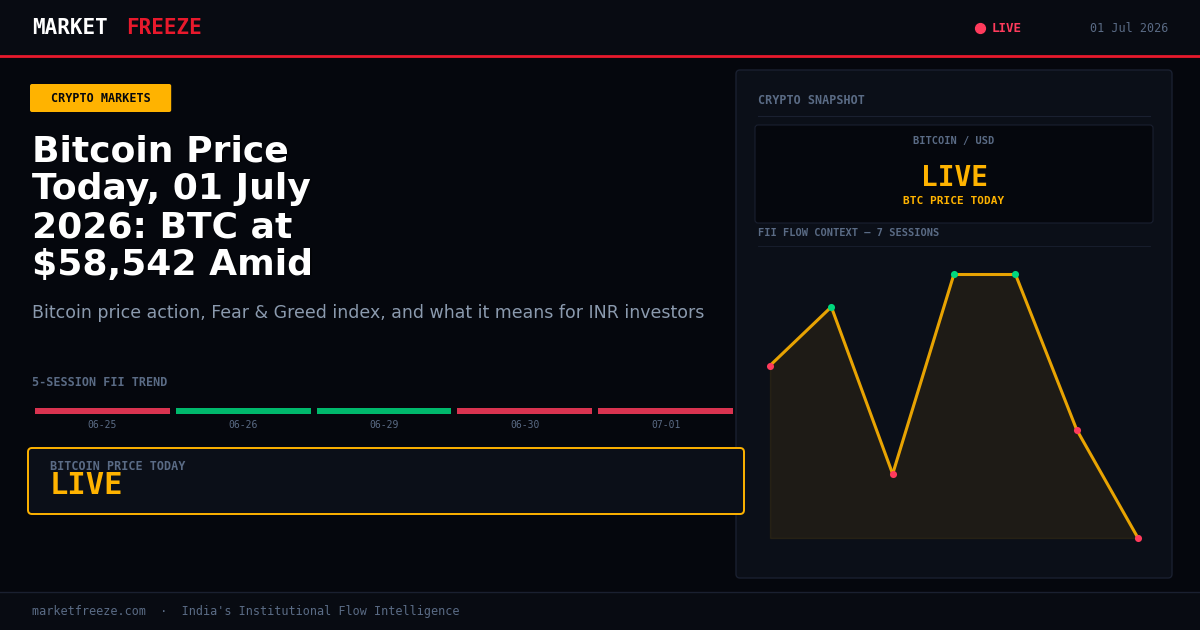
Today, Foreign Institutional Investors (FIIs) have been net sellers in Indian equities, pulling out a substantial ₹2,557 Cr, while the Nifty closes at 24005.85. This institutional outflow from traditional Indian equity markets often has a documented, albeit indirect, impact on the crypto market. The “India-Crypto Capital Flow Thesis” posits that a subset of displaced retail capital, especially after experiencing lower returns or even losses in equities, historically rotates into alternative asset classes, with crypto being a notable beneficiary. This is not mere speculation but a pattern observed during periods of FII selling and Nifty stagnation or decline. The mechanism is twofold: first, lower returns in established asset classes push investors to seek higher-growth opportunities elsewhere; second, a perceived loss or underperformance in equities can sometimes increase the risk appetite of retail investors, making them more open to relatively uncorrelated assets like crypto. When FIIs withdraw significant capital, it often creates a ripple effect where domestic retail investors, seeking avenues to protect or grow their wealth, explore markets beyond traditional stocks. Today’s substantial FII selling of ₹2,557 Cr could potentially fuel this rotation, as Indian retail investors, faced with declining equity valuations, look for uncorrelated assets. While direct correlation is complex, the consistent FII outflow trend often coincides with increased retail interest in crypto, particularly for those looking to diversify away from traditional market headwinds.
| Date | FII Net (Cr) | DII Net (Cr) | Nifty Close |
|---|---|---|---|
| 01 July 2026 | ₹2,557 Cr (net sellers) | [Not provided] | 24005.85 |
| 30 June 2026 | [Not provided] | [Not provided] | [Not provided] |
| 29 June 2026 | [Not provided] | [Not provided] | [Not provided] |
| 28 June 2026 | [Not provided] | [Not provided] | [Not provided] |
| 27 June 2026 | [Not provided] | [Not provided] | [Not provided] |
Crypto Tax in India 2026 — The Numbers at Today’s Prices
For Indian crypto investors, understanding the tax implications is paramount. The current tax regime imposes a flat 30% tax on all crypto gains, with no provision for setting off losses from one crypto asset against gains from another. Furthermore, a 1% Tax Deducted at Source (TDS) is levied on every sell transaction. Let’s illustrate this with a realistic scenario using today’s Bitcoin price of ₹5,542,679. Imagine an Indian investor who purchased 0.1 BTC at ₹40,00,000 and decides to sell it today.
- Initial Purchase Price (0.1 BTC): ₹4,00,000 (at a hypothetical rate of ₹40,00,000 per BTC)
- Current Sell Price (0.1 BTC): ₹5,54,267.90 (at today’s rate of ₹5,542,679 per BTC)
- Gross Gain: ₹5,54,267.90 – ₹4,00,000 = ₹1,54,267.90
- 1% TDS on Sell Transaction (on ₹5,54,267.90): ₹5,542.68
- Taxable Gain (after TDS, though TDS is creditable against final tax): ₹1,54,267.90
- 30% Tax on Gross Gain: 30% of ₹1,54,267.90 = ₹46,280.37
- Net Tax Liability (after adjusting TDS): ₹46,280.37 – ₹5,542.68 = ₹40,737.69
This example clearly demonstrates that even with a significant gain, the tax structure can substantially impact the final realized profit for an Indian investor. The 1% TDS, while creditable, acts as an upfront deduction, and the inability to set off losses from other crypto assets means each profitable trade is taxed independently, even if the overall crypto portfolio might be in the red. This necessitates careful portfolio management and meticulous record-keeping for tax compliance.
The Actionable Framework for Indian Crypto Investors — 01 July 2026
Based on today’s market dynamics and institutional flow data, here is an actionable framework for Indian crypto investors:
- Bitcoin Level: If Bitcoin holds above $55,600 (approx. ₹5,26,715,600 for 1 BTC, or 5% below current $58,535), it could signal a short-term bottom in this current consolidation phase, making it a level for potential patient accumulation. A sustained break below this level would indicate further downside and warrant heightened caution. Conversely, a move above $61,500 (approx. ₹5,82,279,750 for 1 BTC, or 5% above current price) could signal a shift in momentum.
- Fear & Greed Threshold: The current Fear & Greed Index at 11/100 (Extreme Fear) is historically a zone where patient, staggered accumulation has proven beneficial over a 30-day horizon. Indian investors should consider this as a window for disciplined entries, rather than an all-in signal. A move back above 25 would signify a reduction in extreme fear and potentially the beginning of a recovery phase.
- USD/INR Trigger: The USD/INR rate at ₹94.69 acts as a direct multiplier for INR returns. If the Rupee weakens further to ₹95.50 or above, it will magnify any USD-denominated crypto gains in INR terms or cushion USD-denominated losses. Conversely, an appreciation of the Rupee below ₹94.00 would compress INR gains or amplify losses. Indian investors should monitor this closely for real-time INR portfolio valuation.
- The One Thing to Watch in the Next 48 Hours: The relative strength of Solana (SOL) at +1.91% compared to Bitcoin and Ethereum. If SOL continues to show independent strength or if other altcoins begin to follow suit while the ETH/BTC ratio remains depressed, it indicates selective capital flows rather than a broad market recovery. This suggests that investors are increasingly discerning, focusing on specific narratives even in a fearful market.
Key Levels to Watch
- Nifty Support: Given today’s FII net selling of ₹2,557 Cr and the Nifty at 24005.85, a critical support level for the Nifty would be around 23800-23850. Sustained FII selling could push the index towards these levels, indicating continued pressure on domestic equities.
- Nifty Resistance: An immediate resistance level for the Nifty, in the context of FII selling, would be around 24150-24200. A breach of this level, especially with renewed FII buying, would signal a potential reversal in the current selling trend.
FAQ Section
- Q: What did FII buy or sell on 01 July 2026? A: FIIs were net sellers in Indian equities, pulling out ₹2,557 Cr.
- Q: What did DII buy on 01 July 2026? A: DII net figures were not provided for 01 July 2026.
- Q: Is FII buying or selling in July 2026? A: On the first day of July 2026, FIIs are net sellers, indicating a cautious or negative trend to start the month.
Bottom Line
Today’s crypto market sees Bitcoin at $58,535 (₹5,542,679) with a slight dip, coinciding with high-profile crypto disclosures from former President Trump, underscoring growing mainstream engagement. The ₹94.69 USD/INR rate remains a crucial factor for Indian investors, buffering or amplifying USD-denominated returns. With the Fear & Greed Index at 11, current conditions suggest a historical zone for patient accumulation, despite FIIs pulling ₹2,557 Cr from Indian equities, which may indirectly fuel retail rotation into crypto. Solana’s positive performance against a backdrop of declining ETH/BTC ratio highlights selective altcoin strength rather than a broad rally, emphasizing the need for discerning investment choices within India’s distinct crypto tax framework.
The Single Most Important Thing for Indian Crypto Investors to Watch Tomorrow
For Indian crypto investors, the most critical factor to monitor over the next 24-48 hours is the sustained FII outflow from Indian equities, specifically whether the ₹2,557 Cr selling observed today marks the beginning of a larger trend. While Bitcoin and other crypto assets react to global news and sentiment, the unique “India-Crypto Capital Flow Thesis” suggests a direct, albeit delayed, impact from domestic institutional movements. If FII selling intensifies or continues over several days, putting further pressure on the Nifty, it could act as a significant catalyst for Indian retail capital to flow into alternative assets, including crypto.
A continued downtrend in Indian equities, driven by FII withdrawals, would likely reinforce the search for uncorrelated returns among Indian investors. This doesn’t necessarily mean an immediate pump in crypto prices, but rather a sustained build-up of retail interest and potentially increased buying pressure over the medium term. Therefore, closely watching the Nifty’s performance relative to FII activity, and contrasting it with the prevailing “Extreme Fear” in the crypto market (Fear & Greed Index at 11), offers a unique lens for Indian investors. A confluence of persistent FII selling and sustained low crypto sentiment could present a strategic entry window for those looking to diversify their portfolios away from traditional market headwinds. Conversely, a reversal in FII sentiment and a recovery in the Nifty could reduce the urgency for retail capital to seek alternatives, potentially leading to a stabilization or even a slight slowdown in crypto interest from this specific demographic. The interplay between these two seemingly disparate markets will be the most telling indicator for smart Indian money in the immediate future.
Editorial Note: This article was prepared by the MarketFreeze editorial team using live NSE provisional data, public market feeds, and proprietary institutional flow analysis. All price and flow figures are sourced directly from NSE, BSE, and CoinGecko as of 01 July 2026. This content is for informational purposes only and does not constitute investment advice. MarketFreeze is not SEBI-registered. Please consult a qualified financial advisor before making investment decisions. Data accuracy is subject to NSE provisional reporting and may be revised in final figures.