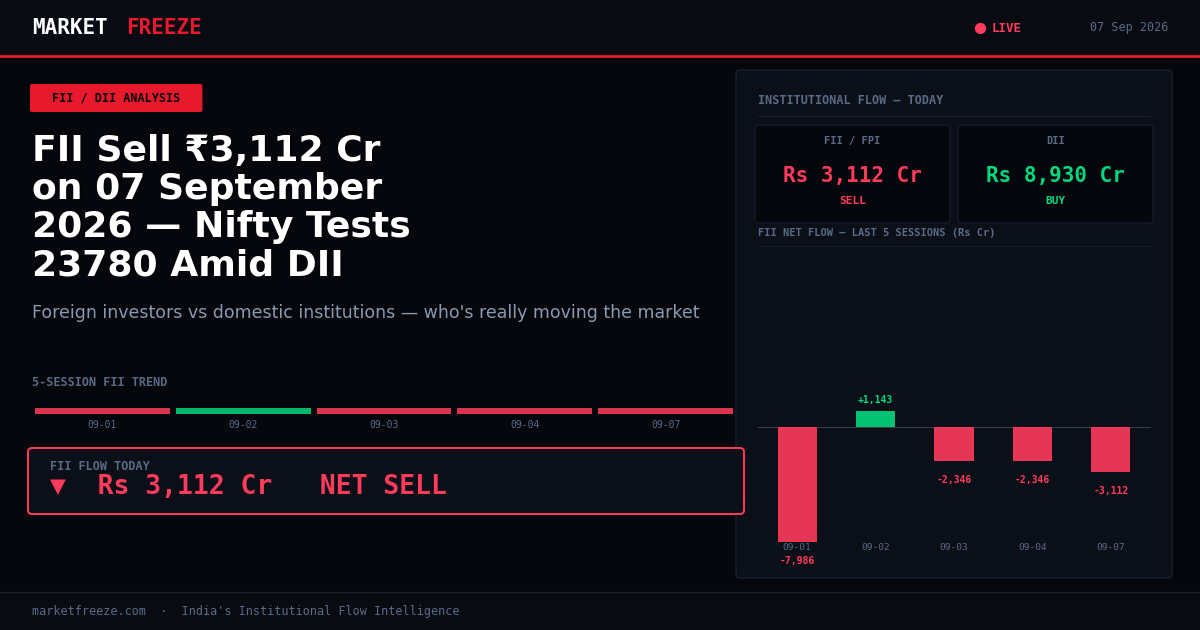
NSE provisional data confirms Foreign Institutional Investors (FIIs) offloaded ₹3,111.94 Cr worth of Indian equities on 07 September 2026, while Domestic Institutional Investors (DIIs) aggressively bought ₹8,930.12 Cr. This marks the third consecutive session of substantial FII selling, totaling ₹7,793.68 Cr over the last three days, contrasting sharply with consistent DII accumulation of ₹18,785.04 Cr in the same period.
Open a free demat account with
Upstox
or
Angel One
— zero brokerage on delivery trades.
FII Selling Accelerates Despite DII Counterbalance
The FII selling on 07 September, at ₹3,111.94 Cr, represents an acceleration from the ₹2,345.87 Cr outflow seen on 04 September and 03 September. This sustained selling pressure from foreign entities, despite a higher net sell figure today, indicates a potential shift in their allocation strategy. The gross FII buy turnover was ₹13,857.58 Cr, suggesting significant trading activity but with a net negative outcome for their positions. The DII counter-buying at ₹8,930.12 Cr, the highest in the last three sessions and significantly above the ₹4,977.46 Cr figure from the preceding two days, demonstrates a strong domestic bid absorbing much of the foreign liquidation. This divergence is critical for understanding intraday market movements and near-term directional bias.
Actionable Insight: Given the sustained FII sell-off for three consecutive sessions, expect near-term headwinds for the broader market unless DII buying maintains its aggressive pace above ₹7,000 Cr daily.
Nifty Support and Resistance Levels Based on Flow Data
The Nifty 50 closed at 23,779.15 on 07 September. Based on the significant FII selling and DII buying, we establish immediate support at the 23,600 mark, a level where the persistent DII accumulation could find stronger footing. Resistance is identified at 24,000, a psychological level that FII selling pressure will likely test. If FIIs escalate their selling beyond the ₹3,111.94 Cr today, breaching 23,600 would open downside towards 23,400. Conversely, sustained DII strength and any FII pause could see the index challenging 24,000.
Actionable Insight: Retail traders should monitor Nifty’s reaction around 23,600. A confirmed breach below this level on higher volumes could signal further downside, suggesting a tactical reduction in long positions.
Sectoral Rotation: IT Faces FII Pressure, Pharma Shows Resilience
The broad market decline, with Nifty 50 down 0.50% and Sensex down 0.50%, was exacerbated by specific sector weakness. Reports highlight IT and Media stocks facing heavy selling. This aligns with the FII outflow trend, as foreign investors are typically significant holders in large-cap IT counters. The substantial FII net sell of ₹3,111.94 Cr points towards probable liquidation in technology and potentially financial services stocks. Conversely, Pharma and Healthcare stocks showed relative strength, as mentioned in market wrap reports. This suggests DIIs may be selectively accumulating defensive sectors, cushioning the overall market fall and absorbing FII selling pressure. The significant DII net buy of ₹8,930.12 Cr indicates strategic sector allocation away from FII-favoured growth names.
Actionable Insight: Traders looking for relative strength should focus on Pharma and Healthcare stocks, which appear to be DII accumulation zones, potentially offering downside protection compared to the broader market.
USD/INR Steady Amid RBI Intervention and Oil Volatility
The USD/INR closed at Rs94.55, down a marginal 0.01%. This stability, despite elevated crude oil prices (Crude MCX at Rs9,103.00/bbl) and geopolitical concerns, points to direct Reserve Bank of India (RBI) intervention. The RBI’s dollar sales, as indicated by news reports, are actively managing currency depreciation. The FII selling of ₹3,111.94 Cr typically exerts downward pressure on the Rupee, but the central bank’s actions are creating a floor. The steady Rupee provides a measure of stability to the import-heavy Indian economy, though sustained FII outflows could challenge the RBI’s efforts if the selling volume increases significantly.
Actionable Insight: The currency markets appear anchored by RBI intervention. Retail investors should not anticipate significant Rupee depreciation in the immediate term unless FII selling breaches the ₹4,000 Cr daily mark consistently.
Historical Flow Pattern: FII Sell-off, DII Buys Back
The FII/DII flow data for the last five sessions highlights a significant trend reversal from the positive FII inflows seen on 02 September (+₹1,143.38 Cr). Since then, FIIs have sold a cumulative ₹13,643.69 Cr across three sessions (01 Sep, 03 Sep, 04 Sep, 07 Sep). Notably, the FII selling on 01 September was a substantial ₹7,985.88 Cr. The current pattern of aggressive DII buying (₹8,930.12 Cr today, ₹4,977.46 Cr on 03 & 04 Sep) absorbing FII outflows is a recurring theme from early September. This historical parallel suggests a strong domestic support structure is in place, attempting to counter foreign selling pressure. The Nifty’s movement from 24,055.80 on 01 September to 23,779.15 today, despite robust DII buys, indicates that FII selling has been a dominant force in driving the index lower.
| Date | FII Net (Cr) | DII Net (Cr) | Nifty Close |
|---|---|---|---|
| 2026-09-01 | ₹-7,985.88 Cr | +₹4,588.88 Cr | 24,055.80 |
| 2026-09-02 | +₹1,143.38 Cr | +₹1,846.94 Cr | 23,914.45 |
| 2026-09-03 | ₹-2,345.87 Cr | +₹4,977.46 Cr | 23,873.45 |
| 2026-09-04 | ₹-2,345.87 Cr | +₹4,977.46 Cr | 23,897.70 |
| 2026-09-07 | ₹-3,111.94 Cr | +₹8,930.12 Cr | 23,779.15 |
Actionable Insight: Retail investors should note that while DIIs are providing a strong floor, sustained FII selling at this magnitude can lead to sharper intraday declines, especially if DII buying falters.
Gross Turnover vs. Net Flow: FII Conviction Tested
The gross FII buy figure of ₹13,857.58 Cr on 07 September, against a net sell of ₹3,111.94 Cr, implies a significant amount of selling order flow. The ratio of gross buys to net sells is approximately 4.45:1. This suggests that while FIIs were active buyers throughout the day, their selling pressure ultimately overwhelmed their purchases. This level of gross turnover, paired with a substantial net outflow, indicates conviction in their selling decisions rather than opportunistic trading. Similarly, DIIs demonstrated strong conviction with their net buy of ₹8,930.12 Cr, implying they were actively deploying capital throughout the session to absorb the selling. Higher gross buy/sell figures, especially on the selling side for FIIs, often precede further directional moves if the trend persists.
Actionable Insight: A sustained high gross turnover from FIIs coupled with net selling suggests a higher probability of continued downside pressure, even if DIIs continue their buying spree.
Connecting News Flow to Institutional Action
Today’s market decline, characterized by Nifty 50 closing at 23,779.15 (-0.50%), aligns with external news factors influencing institutional behavior. Elevated crude oil prices and strong US job growth data, as reported, likely contributed to the cautious stance of foreign investors, leading to the significant FII outflow of ₹3,111.94 Cr. Geopolitical uncertainty, potentially linked to US-Iran tensions mentioned in some reports, also adds to risk aversion among global funds. The specific mention of IT and Media stocks facing heavy selling directly corroborates the FII selling trend, as these sectors are often sensitive to global economic outlooks and foreign capital flows. The RBI’s intervention to support the Rupee at Rs94.55 is a crucial counter-narrative, preventing a sharper depreciation that could have further spooked foreign capital. The resilience in Pharma stocks, despite the broader market weakness, points to domestic demand absorbing some of the sell-off, a trend supported by the DII net buy of ₹8,930.12 Cr.
Actionable Insight: Monitor crude oil prices and US inflation data releases closely. Any adverse movement in these factors could amplify FII selling pressure beyond the current ₹3,111.94 Cr level.
FAQ Section
What was the net FII sell figure today?
Foreign Institutional Investors (FIIs) were net sellers of ₹3,111.94 Cr in Indian equities on 07 September 2026.
How much did DIIs buy today?
Domestic Institutional Investors (DIIs) were net buyers of ₹8,930.12 Cr on 07 September 2026.
What is the current Nifty level and what does the FII/DII flow suggest?
The Nifty 50 closed at 23,779.15 on 07 September 2026. The substantial FII selling combined with aggressive DII buying suggests a tug-of-war, with support around 23,600 and resistance at 24,000.
Retail Investor Sentiment Amidst Institutional Crosscurrents
The persistent FII selling, now spanning three consecutive sessions and amounting to a significant cumulative outflow, often generates a ripple effect of caution among retail investors. While the robust DII buying provides a stabilizing counter-balance, the visible downward pressure on indices like the Nifty 50 can lead to increased retail hesitancy or even panic selling, especially in less liquid mid and small-cap segments. The divergence in flows suggests that while institutional money is moving in opposite directions, retail participation might be leaning towards risk aversion, waiting for clearer market direction. The DII accumulation, often seen as a proxy for domestic retail sentiment and long-term investment, is a key indicator to watch. If retail investors begin to mirror the FII selling behaviour, even with DIIs in their corner, the market could experience sharper corrections. The historical data, showing a period of FII outflows being absorbed by DIIs around early September, indicates this is not an unprecedented scenario, but the scale of today’s FII sell-off warrants close observation of retail positioning in subsequent sessions.
Global Cues and Their Impact on FII Decisions
The current FII selling spree is intrinsically linked to global macroeconomic factors and risk sentiment. While the article touches upon oil prices and geopolitical concerns, a deeper dive into specific US economic data, such as inflation prints or Federal Reserve commentary, is crucial. For instance, if US inflation remains stubbornly high, it could prompt expectations of prolonged higher interest rates, making emerging markets like India less attractive for foreign capital. The US Dollar Index (DXY) performance is also a key influencer; a strengthening dollar typically correlates with FII outflows from riskier assets. The current stability in USD/INR at around Rs94.55, despite FII selling, is largely attributed to RBI intervention, but a significant shift in global dollar strength could override these domestic efforts. When FIIs liquidate positions amounting to billions of dollars, it’s often a global phenomenon, with India being one of many markets experiencing such outflows. Understanding the broader global portfolio rebalancing narrative provides essential context to the specific figures seen in Indian markets.
Sectoral Performance Divergence: A Deeper Look
Beyond the broad sector calls of IT and Pharma, specific sub-sectors within the market are likely experiencing varied impacts from this institutional flow. For example, within IT, large-cap, export-oriented companies might be more susceptible to FII outflows driven by global demand concerns, whereas domestic-focused IT service providers could show more resilience. Conversely, in the Pharma space, while DIIs might be accumulating, the extent of FII participation in certain pharmaceutical sub-sectors could still lead to volatility. The divergence in performance between, say, a large-cap pharmaceutical stock and a mid-cap IT stock on the same day could be stark. Examining the performance of specific sub-indices or thematic ETFs during days of high FII selling can offer more granular insights into where foreign capital is exiting and where domestic capital is finding value. For instance, if FMCG or consumer staples sectors show relative strength, it further reinforces the defensive play narrative driven by DIIs.
Bottom Line
Today’s institutional flow data reveals a stark divergence: FIIs continued their selling spree with an increased outflow of ₹3,111.94 Cr, while DIIs aggressively absorbed this selling with a record net buy of ₹8,930.12 Cr in the last three sessions. This intense domestic buying is currently cushioning the market, evident in the Nifty 50 closing at 23,779.15. Sectors like IT are likely bearing the brunt of FII liquidation, while Pharma shows resilience. Retail investors should track the sustainability of DII buying and watch for any escalation in FII selling beyond ₹3,500 Cr daily, which could challenge the current support at 23,600.
Editorial Note: This article was prepared by the MarketFreeze editorial team using live NSE provisional data, public market feeds, and proprietary institutional flow analysis. All price and flow figures are sourced directly from NSE, BSE, and CoinGecko as of 07 September 2026. This content is for informational purposes only and does not constitute investment advice. MarketFreeze is not SEBI-registered. Please consult a qualified financial advisor before making investment decisions. Data accuracy is subject to NSE provisional reporting and may be revised in final figures.