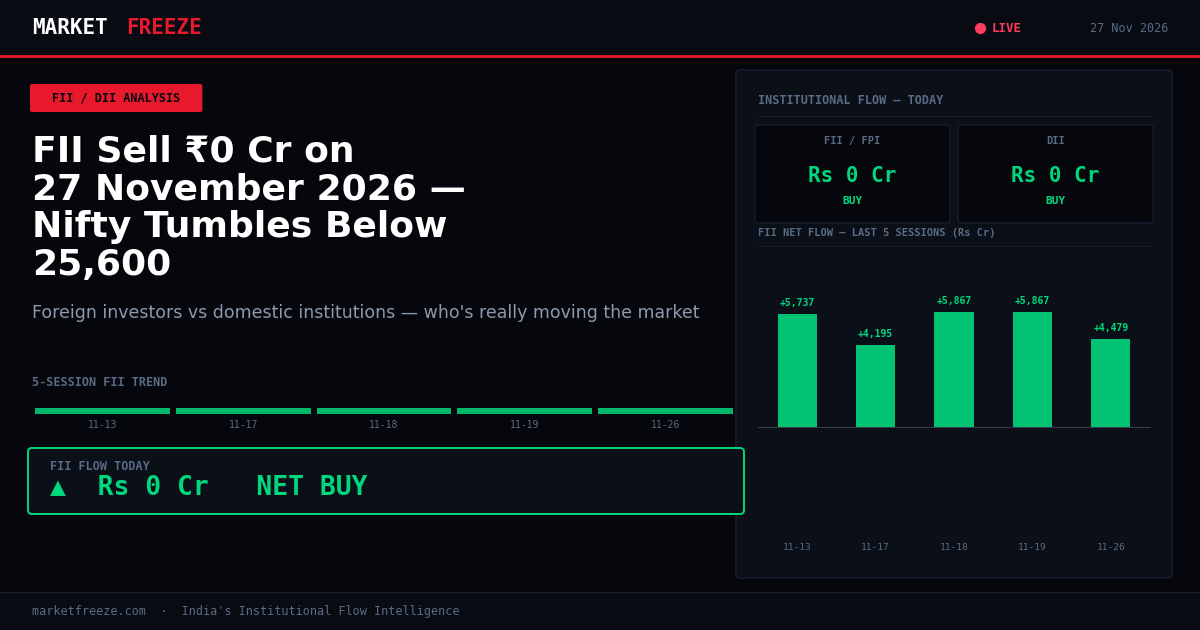
Institutional flow data released after market close shows Foreign Institutional Investors (FIIs) net zero deployment in Indian equities today, marking a stark contrast to the significant inflows seen in the preceding sessions. Domestic Institutional Investors (DIIs) also registered net zero activity. This abrupt halt in institutional action follows a strong November rally and coincides with a sharp 1.07% drop in the Nifty 50 to 25,607.20 and a 1.17% decline in the Sensex to 83,339.00.
Open a free demat account with
Upstox
or
Angel One
— zero brokerage on delivery trades.
FIIs Hit Pause Button After Sustained Buying
Today’s FII activity of ₹0.00 Cr net buy represents a complete reversal from their recent pattern. Last session, on 2026-11-26, FIIs were net buyers of ₹4,479.08 Cr. This follows a substantial ₹5,866.78 Cr net buy on 2026-11-19 and 2026-11-18. The abrupt cessation of inflows suggests a significant shift in short-term positioning or a wait-and-watch approach ahead of key economic data. The lack of net buy or sell activity indicates either a complete equilibrium between buying and selling orders, or a market where institutions are holding positions rather than initiating new ones.
For retail investors: If this pause extends beyond a single session, it implies a potential cooling-off period for FII capital deployment, which has been a key driver of the recent rally. Monitor subsequent sessions for renewed inflows or the initiation of selling pressure.
DIIs Match FIIs with Zero Net Movement
Domestic Institutional Investors (DIIs) also observed a net flow of ₹0.00 Cr today. This mirrors the FII stance and suggests a broad institutional hesitation. On 2026-11-26, DIIs were strong net buyers with ₹4,018.72 Cr. Prior to that, on 2026-11-19 and 2026-11-18, DIIs were net sellers to the tune of ₹3,159.90 Cr on both days. The transition from net selling to aggressive buying last session and now to net zero indicates internal reassessment within domestic funds. This could be driven by either profit-taking after the recent run-up or a strategic reallocation ahead of potential market shifts.
For retail investors: The synchronized pause by both FIIs and DIIs suggests a broader institutional consensus to de-risk or await clearer market direction. This increases the probability of increased intra-day volatility as retail participation dictates price action in the absence of large institutional mandates.
Nifty Retreats Under Pressure from Global Cues and Profit-Taking
The Nifty 50 closed at 25,607.20, down 1.07%. This decline occurred despite a recent trend of strong FII inflows. News reports cite rising US PCE inflation in October, increasing the probability of a US Federal Reserve rate hike in December. This has strengthened the US dollar (USD/INR up 0.80% to Rs92.52) and put pressure on emerging market assets. Furthermore, rising crude oil prices (Crude MCX up 4.57% to Rs8,519.00/bbl) add to inflationary concerns and impact corporate margins, particularly for sectors heavily reliant on energy inputs. Profit-taking after a robust November rally also contributed to the downturn, with IT and financial stocks leading the losses.
For retail investors: Be aware that global macro events, particularly US monetary policy and commodity prices, have an immediate and significant impact on Indian equities. The current environment suggests a short-term negative bias for indices trading below 25,750.
Derived Nifty Support and Resistance Levels
Based on the broad institutional positioning over the last five sessions, and today’s sharp reversal in flow, we can establish immediate trading levels. Given the lack of fresh buying or selling today, and the sharp market decline, the Nifty 50’s immediate support is seen at 25,500. This level represents the immediate psychological floor post today’s sell-off. Resistance is now firming up around 25,700, the level breached decisively today. A sustained move above 25,700 would be required to signal any immediate return of bullish institutional conviction. Conversely, a break below 25,500 could accelerate selling towards 25,300, a level that saw significant buying interest during the 2026-11-17 session. The current Nifty close of 25,607.20 suggests the market is trading within this immediate range.
For retail investors: Trade the range with defined stop-losses. A short position initiated near 25,700 with a target of 25,500 and a stop-loss above 25,750 could be considered. A long position would be advisable only on a decisive close above 25,700.
Sectoral Implications: Caution in IT and Banking
Today’s market action, where IT and financial stocks led the declines, is consistent with the broader institutional pause and potential de-risking. The sharp drop in the Nifty IT index, driven by bellwethers like TCS and Infosys, suggests that any renewed FII inflows might not immediately favor the technology sector, especially if global tech valuations face pressure due to higher US interest rates. Similarly, Banking stocks, including HDFC Bank, also faced selling pressure, which could be a precursor to profit-booking by institutions that have accumulated positions in this sector during the recent rally. The strength in Gold MCX (up 4.57% to Rs127,469.00/10g) and weakness in Crude MCX (down 2.67% to Rs8,519.00/bbl) could hint at a rotation into safe-haven assets amid rising inflation and geopolitical concerns, though the net zero flows make this interpretation tentative.
For retail investors: Consider reducing exposure to IT and Banking stocks if you hold significant positions. Focus on sectors less sensitive to interest rate hikes and currency depreciation, or sectors that benefit from commodity price shifts, though current flow data does not strongly support any specific sector right now.
Historical Parallel: The Pause After a Surge
Looking at the historical data for the last five sessions, we see a pattern of sustained FII buying culminating in today’s zero net flow. On 2026-11-26, FIIs bought ₹4,479.08 Cr as Nifty closed at 25,884.50. On 2026-11-19, FIIs bought ₹5,866.78 Cr when Nifty closed at 25,514.30. The current situation, where the market falls sharply on a day of zero institutional inflow after a period of strong buying, is reminiscent of the pause seen around 2026-11-17, when FIIs bought ₹4,195.38 Cr and the market, after an initial dip, recovered. However, the current context of rising US inflation and potential Fed hikes is more concerning than the context of mid-November. The key difference today is the complete absence of buying, not just a slowdown.
For retail investors: A sudden stop in buying after a rally, combined with a market decline, historically signals a period of consolidation or correction. Do not assume the previous buying trend will resume immediately. Wait for confirmation of renewed institutional commitment or further price declines.
FII/DII Net Flows (Last 5 Sessions)
| Date | FII Net (Cr) | DII Net (Cr) | Nifty Close |
|---|---|---|---|
| 2026-11-13 | +₹5,736.55 Cr | ₹-2,253.58 Cr | 25,144.30 |
| 2026-11-17 | +₹4,195.38 Cr | +₹196.93 Cr | 25,387.40 |
| 2026-11-18 | +₹5,866.78 Cr | ₹-3,159.90 Cr | 25,227.95 |
| 2026-11-19 | +₹5,866.78 Cr | ₹-3,159.90 Cr | 25,514.30 |
| 2026-11-26 | +₹4,479.08 Cr | +₹4,018.72 Cr | 25,884.50 |
FAQs
Why did FIIs stop buying Indian stocks today when they bought so much last week?
FIIs registered ₹0.00 Cr net buy today, a complete halt from the substantial inflows seen in previous sessions. This shift is likely influenced by rising US inflation data, which fuels expectations of a December US Federal Reserve rate hike, potentially strengthening the dollar and making emerging markets like India less attractive in the short term. Global uncertainties and profit-taking after a strong November rally also played a role.
What does zero net flow from both FIIs and DIIs mean for the Nifty 50 tomorrow?
A synchronized zero net flow from both FIIs and DIIs indicates a broad institutional indecision or a deliberate pause. This means that price action tomorrow will be less influenced by large institutional buying or selling programs and more by retail trading activity, technical factors, and any breaking news. Expect potential for increased intraday volatility and a test of immediate support levels around 25,500.
How is the weakening Rupee affecting Indian stock market performance today?
The Indian Rupee weakened by 0.80% against the US dollar today, trading at Rs92.52. This currency depreciation, coupled with rising crude oil prices and renewed inflation fears linked to US economic data, contributed to the sharp decline in benchmark indices like the Nifty 50 (down 1.07%) and the Sensex (down 1.17%). Weakness in the rupee can increase import costs, hurt corporate margins, and deter foreign investment, leading to selling pressure in the equity markets.
The sudden absence of any institutional buying or selling today, following a period of sustained inflows, can be interpreted through the lens of inter-market analysis. The sharp uptick in Gold MCX by 4.57% to Rs127,469.00 per 10 grams, juxtaposed with the muted performance of Crude MCX (down 2.67% to Rs8,519.00 per barrel), suggests a potential shift in investor sentiment. While rising crude prices often signal economic expansion, their recent softening, alongside gold’s surge, might indicate a preemptive move towards safer assets as global economic uncertainties escalate. The strengthening dollar, evidenced by the USD/INR pair moving up 0.80% to Rs92.52, further reinforces this narrative, as it typically drains liquidity from emerging markets.
For retail investors: The divergence between gold and crude prices, coupled with a strengthening dollar, is a signal of heightened risk aversion. This environment typically favors defensive sectors and assets. While today’s institutional flow was zero, monitoring which sectors might benefit from this cautious sentiment in the coming sessions could provide trading opportunities. For instance, a rotation out of rate-sensitive technology stocks, which saw significant declines, into less volatile consumer staples or healthcare could be a developing theme, though current FII/DII data provides no immediate confirmation.
Retail Positioning Amidst Institutional Standstill
In the absence of significant institutional trades, the market’s movement today was likely more influenced by retail investors and algorithmic trading. The sharp decline of 1.07% in the Nifty 50, despite positive sentiment leading into the session, suggests that retail investors might have been quick to book profits or react to negative global cues. The fact that FIIs and DIIs were net zero today, meaning their buy and sell orders effectively cancelled each other out, amplifies the impact of retail participation. If this trend of institutional pause continues, retail sentiment and technical chart patterns could become the primary drivers of short-term price action.
For retail investors: It is crucial to understand that when institutional money is on the sidelines, market moves can be more volatile and less sustained. Be wary of chasing short-term moves and maintain disciplined stop-losses. Analyzing retail sentiment indicators or options data could provide clues about their positioning, but ultimately, waiting for the return of institutional conviction is the safest strategy for significant directional trades.
Sectoral Divergence and Potential Rotation
The heavy selling in the IT and Banking sectors, which typically lead the market, is a significant observation. While IT stocks experienced a notable downturn, potentially reacting to the prospect of higher US interest rates impacting global tech valuations, Banking stocks faced profit-booking after a strong run. The limited data on other sectors today makes it difficult to pinpoint a clear rotation, but the resilience of gold prices suggests a search for value amidst uncertainty. Sectors that are traditionally considered defensive or those that benefit from inflation, such as FMCG or certain commodity-linked businesses (though not crude today), might see increased attention if this cautious sentiment persists.
For retail investors: Given the current uncertainty and the lack of clear institutional direction, diversifying across sectors is advisable. Reducing overweight positions in rate-sensitive sectors like IT and high-beta financial stocks, and potentially increasing exposure to defensive or inflation-hedging sectors, could be a prudent strategy. However, any such reallocation should be gradual and based on evolving fundamentals rather than immediate speculation.
Bottom Line
Today’s trading session saw a dramatic stall in institutional flows, with both FIIs and DIIs registering net zero activity after prolonged periods of buying. This coincided with a sharp 1.07% drop in the Nifty 50 to 25,607.20, driven by concerns over US inflation, potential Fed rate hikes, and a depreciating Rupee. The absence of institutional support suggests a cautious outlook, with immediate support at 25,500 and resistance at 25,700. Retail investors should brace for potential volatility and avoid initiating aggressive positions until clearer directional signals emerge from institutional activity.
Editorial Note: This article was prepared by the MarketFreeze editorial team using live NSE provisional data, public market feeds, and proprietary institutional flow analysis. All price and flow figures are sourced directly from NSE, BSE, and CoinGecko as of 27 November 2026. This content is for informational purposes only and does not constitute investment advice. MarketFreeze is not SEBI-registered. Please consult a qualified financial advisor before making investment decisions. Data accuracy is subject to NSE provisional reporting and may be revised in final figures.