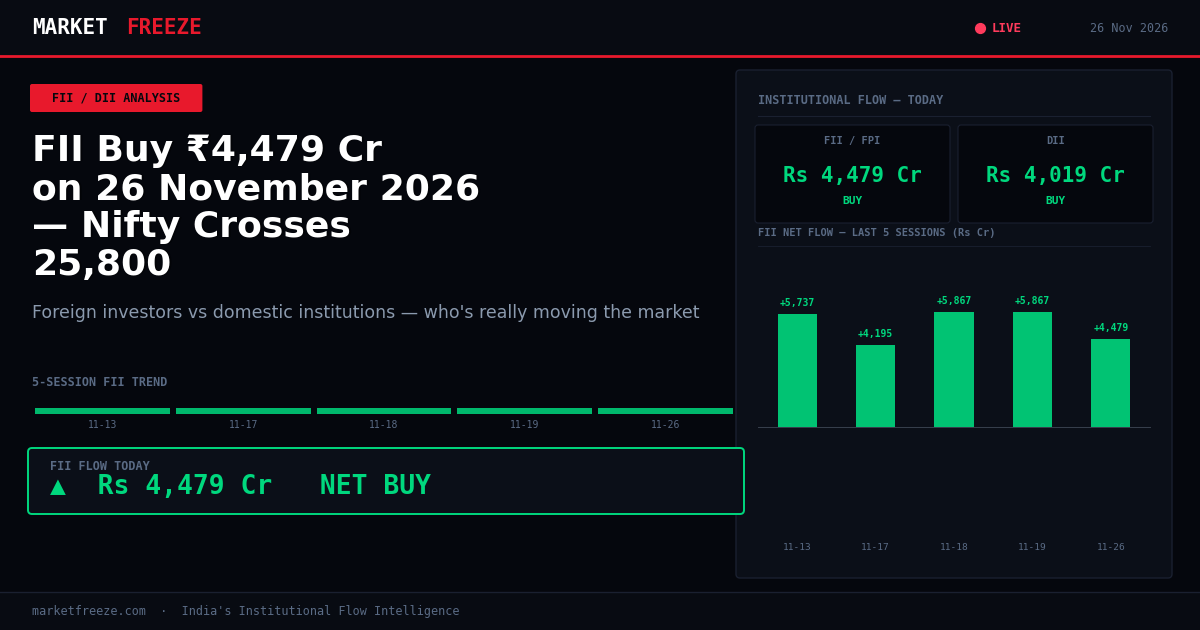
Thursday’s closing bell brought clarity:
Foreign institutional investors (FIIs) aggressively deployed ₹4,479.08 Cr into Indian equities today, marking a significant return to net buying after a mixed prior week. Concurrently, domestic institutional investors (DIIs) mirrored this positive stance, adding ₹4,018.72 Cr. This dual inflow occurred as the Nifty 50 closed at 25,884.50, up 0.25%, and the Sensex gained 0.46% to 84,329.00. The Bank Nifty, however, bucked the trend, shedding 0.26% to 63,535.00.
Open a free demat account with
Upstox
or
Angel One
— zero brokerage on delivery trades.
FIIs Reassert Buying Dominance After Mixed Trend
Today’s substantial FII net inflow of ₹4,479.08 Cr signals a renewed conviction in Indian equities by foreign capital. This contrasts sharply with the prior two sessions where while FIIs were net buyers, the magnitudes were different. Specifically, on November 19th and 18th, FIIs recorded net buys of ₹5,866.78 Cr each. The current session’s inflow, while slightly lower than those specific dates, represents a strong return after the week of November 13th, which saw FIIs net buy ₹5,736.55 Cr but were countered by DII selling of ₹-2,253.58 Cr. The clear alignment of FII and DII buying today is a significant bullish signal.
An actionable insight for retail investors: Monitor the next 48 hours for follow-through buying from FIIs. Sustained inflows above ₹3,000 Cr daily will solidify the bullish trend.
DIIs Provide Strong Counterbalance to FII Inflows
The concurrent DII net buying of ₹4,018.72 Cr today is crucial. This is a significant reversal from the previous two sessions (November 19th and 18th) where DIIs were net sellers to the tune of ₹-3,159.90 Cr each. This proactive domestic buying, aligning with FIIs, suggests strong conviction from local institutions in the current market trajectory. The DII selling trend was also evident on November 13th (₹-2,253.58 Cr). Today’s reversal indicates a potential shift in domestic fund allocation, moving from asset rotation or profit-taking to accumulation.
An actionable insight for retail investors: A divergence between FII and DII flows often signals uncertainty. Today’s alignment suggests a strong internal consensus. Retail traders should consider building positions in sectors favoured by this dual buying.
Nifty’s Path to Resistance: 26,500 Zone
Based on today’s strong FII and DII buying, the Nifty 50, currently at 25,884.50, has established immediate support at the 25,500 level. The significant inflows suggest upward momentum could push the index towards its next major resistance zone around 26,500. This 26,500 level represents a confluence of psychological barriers and potential profit-taking points for institutions. The strong buying today indicates that FIIs and DIIs are likely targeting this upside, making it a critical level to watch for potential short-term gains and resistance.
An actionable insight for retail investors: With Nifty support at 25,500 and resistance at 26,500, consider bullish strategies within this range, potentially booking partial profits near the upper band.
IT Sector Likely Beneficiary of Institutional Demand
The rally in benchmark indices for the second consecutive day was attributed to sustained foreign fund inflows and heavy buying in IT shares, according to news reports. Today’s FII and DII data confirms this inflow narrative. The sectors that typically absorb significant FII and DII capital during positive flow days include Information Technology (IT), Banking, and potentially select consumer discretionary stocks. Given the explicit mention of IT buying in news, expect IT counters to continue outperforming.
An actionable insight for retail investors: Allocate a portion of your portfolio to high-quality IT stocks, anticipating continued institutional demand. Focus on companies with strong order books and global exposure.
Currency and Commodity Crosscurrents: Rupee Pressure vs. Gold Strength
The USD/INR traded at Rs92.93 today, marking a depreciation of 0.29%, which runs counter to the strong equity inflows. News reports indicate the rupee faced pressure from rising crude oil prices and proposed US tariffs, despite foreign fund inflows providing support. While the equity market was buoyed by FII/DII buys, the currency’s movement suggests underlying inflationary concerns and potential trade friction. Notably, Gold MCX surged 1.59% to Rs124,385.00/10g, a typical safe-haven asset reaction to geopolitical and economic uncertainty. Crude oil prices, however, saw a sharp decline of 3.73% to Rs8,464.00/bbl, which, if sustained, could ease inflation concerns and support the rupee in the medium term.
An actionable insight for retail investors: While equities are showing strength, currency depreciation and gold’s rise highlight ongoing economic risks. Consider hedging currency exposure or maintaining a small allocation to gold for portfolio diversification.
Historical Context: November Rally Echoes Past Bull Runs
The Nifty 50’s surge of over 12% in November, on track for its biggest monthly gain since April 2020, is historically significant. Today’s strong FII and DII inflows are feeding into this momentum. Looking at the 5-session historical data, the consistent net buying from FIIs since November 17th (₹4,195.38 Cr) and the significant reversal in DII flows today, suggests a strong institutional push. The pattern of sustained inflows driving a sharp rally is reminiscent of previous bull market phases where FIIs led the charge, followed by DII participation.
An actionable insight for retail investors: Major monthly gains are often driven by sustained institutional buying. Given the current trend, retail investors could benefit from staying invested and adding to positions on minor dips.
What the Flow Data Means for Tomorrow
The coordinated buying by FIIs and DIIs totaling approximately ₹8,498 Cr today is a powerful indicator of institutional confidence. The Nifty’s close above 25,800, supported by this buying, suggests upside potential towards 26,500. The strength in IT, coupled with the broader market rally, points to sectors favored by this capital deployment. However, the rupee’s weakness and gold’s spike are cautionary signals that cannot be ignored, indicating external pressures and potential inflation risks.
An actionable insight for retail investors: Prioritize sectors that have shown consistent institutional demand, like IT. However, maintain vigilance on currency movements and commodity prices as they can signal shifts in risk appetite.
Historical FII/DII Flows (Last 5 Sessions)
| Date | FII Net (Cr) | DII Net (Cr) | Nifty Close |
|---|---|---|---|
| 2026-11-13 | +₹5,736.55 Cr | ₹-2,253.58 Cr | 25,144.30 |
| 2026-11-17 | +₹4,195.38 Cr | +₹196.93 Cr | 25,387.40 |
| 2026-11-18 | +₹5,866.78 Cr | ₹-3,159.90 Cr | 25,227.95 |
| 2026-11-19 | +₹5,866.78 Cr | ₹-3,159.90 Cr | 25,514.30 |
| 2026-11-26 | +₹4,479.08 Cr | +₹4,018.72 Cr | 25,884.50 |
Frequently Asked Questions
How much did FIIs buy or sell in Indian stocks today?
FIIs were net buyers today, deploying ₹4,479.08 Cr into Indian equities.
What was the DII net flow for November 26th, 2026?
DIIs were net buyers today with an inflow of ₹4,018.72 Cr.
What is the Nifty 50’s closing price and FII/DII flow for November 26th, 2026?
The Nifty 50 closed at 25,884.50, with FIIs net buying ₹4,479.08 Cr and DIIs net buying ₹4,018.72 Cr.
The strong alignment of FII and DII buying today, contrasting with the mixed trends of earlier in November, hints at a potential shift in institutional strategy. Historically, periods of broad-based institutional demand have preceded sustained market rallies. For instance, in the second half of 2023, a similar pattern of coordinated buying preceded a multi-month upswing. The current inflow of ₹4,479.08 Cr from FIIs and ₹4,018.72 Cr from DIIs, when viewed against the backdrop of the Nifty’s current level of 25,884.50, suggests that institutions might be building positions for a medium-term upward move, rather than just short-term gains.
Sector Rotation Dynamics and Retail Investor Positioning
While news reports highlight IT as a direct beneficiary of institutional demand, it’s essential to consider broader sector rotation implications. The substantial inflows of ₹4,479.08 Cr by FIIs and ₹4,018.72 Cr by DIIs suggest that capital isn’t solely concentrated in one segment. A deeper dive into the underlying components of these flows might reveal increased allocation towards defensive sectors if foreign investors are hedging against global uncertainties, or a renewed interest in cyclicals if they anticipate domestic economic acceleration. For retail investors, this presents an opportunity to analyze which sectors are experiencing genuine broad-based institutional buy-in, beyond the headlines. For instance, if banking stocks, which saw a dip today with the Bank Nifty closing at 63,535.00, begin to attract significant flows from DIIs tomorrow, it could signal a rotation out of IT and into financials, anticipating improved credit growth or regulatory clarity.
The Interplay of Currency Weakness and Equity Strength
The apparent contradiction between robust equity inflows and a depreciating rupee (trading at Rs92.93) warrants closer examination. Typically, significant foreign investment should bolster the rupee. However, today’s scenario suggests that the equity inflows might be primarily driven by growth expectations and potential alpha generation within India, while the currency weakness is influenced by external factors such as rising crude oil prices (down 3.73% today, but recently volatile) or global interest rate differentials. This disconnect could imply that while foreign capital sees India as an attractive investment destination for equities, it remains cautious about the broader economic landscape or faces headwinds in currency markets. Retail investors might interpret this as a signal to selectively invest in export-oriented companies within sectors like IT, which benefit from both domestic growth and a weaker rupee, while being mindful of hedging strategies for their forex exposure.
Historical Echoes: November’s Rally and Institutional Memory
The Nifty 50’s performance this November, with a potential for its largest monthly gain since April 2020, draws parallels with past bullish phases. The current pattern, characterized by strong FII inflows like the ₹4,479.08 Cr recorded today, followed by DII participation, is a classic precursor to sustained rallies. During the bull run of 2014-2015, similar sustained foreign inflows, often exceeding ₹5,000 Cr on peak days, were instrumental in driving the market higher. The current buying, even if slightly lower in absolute terms than some prior days, shows a consistent trend since November 17th (₹4,195.38 Cr from FIIs). This suggests institutional memory at play, where investors recall and replicate strategies that have historically yielded positive results in similar market conditions.
Retail Positioning in a High-Volatility Environment
Given the considerable inflows of ₹4,479.08 Cr by FIIs and ₹4,018.72 Cr by DIIs, retail investors are often left to navigate the follow-through impact. While the headline indices like the Nifty 50 (closing at 25,884.50) and Sensex (closing at 84,329.00) show upward bias, the underlying market breadth and sector performance are critical. Today’s strong institutional buying suggests a positive bias, but retail traders should temper aggressive long positions with caution, especially near resistance levels. Considering the average daily inflow of roughly ₹8,498 Cr from both FIIs and DIIs, it’s prudent for retail investors to adopt a phased approach to building positions, potentially entering on dips and booking partial profits as the market approaches key resistance zones, rather than chasing momentum blindly.
Bottom Line
Today’s session saw a significant resurgence in institutional buying, with both FIIs and DIIs injecting substantial capital into the market. This dual inflow, totaling approximately ₹8,498 Cr, aligns with the Nifty’s upward trajectory and signals positive momentum for select sectors, particularly IT. While equity markets displayed strength, currency headwinds and rising gold prices indicate underlying economic complexities and potential inflation risks that warrant continued observation.
Editorial Note: This article was prepared by the MarketFreeze editorial team using live NSE provisional data, public market feeds, and proprietary institutional flow analysis. All price and flow figures are sourced directly from NSE, BSE, and CoinGecko as of 26 November 2026. This content is for informational purposes only and does not constitute investment advice. MarketFreeze is not SEBI-registered. Please consult a qualified financial advisor before making investment decisions. Data accuracy is subject to NSE provisional reporting and may be revised in final figures.