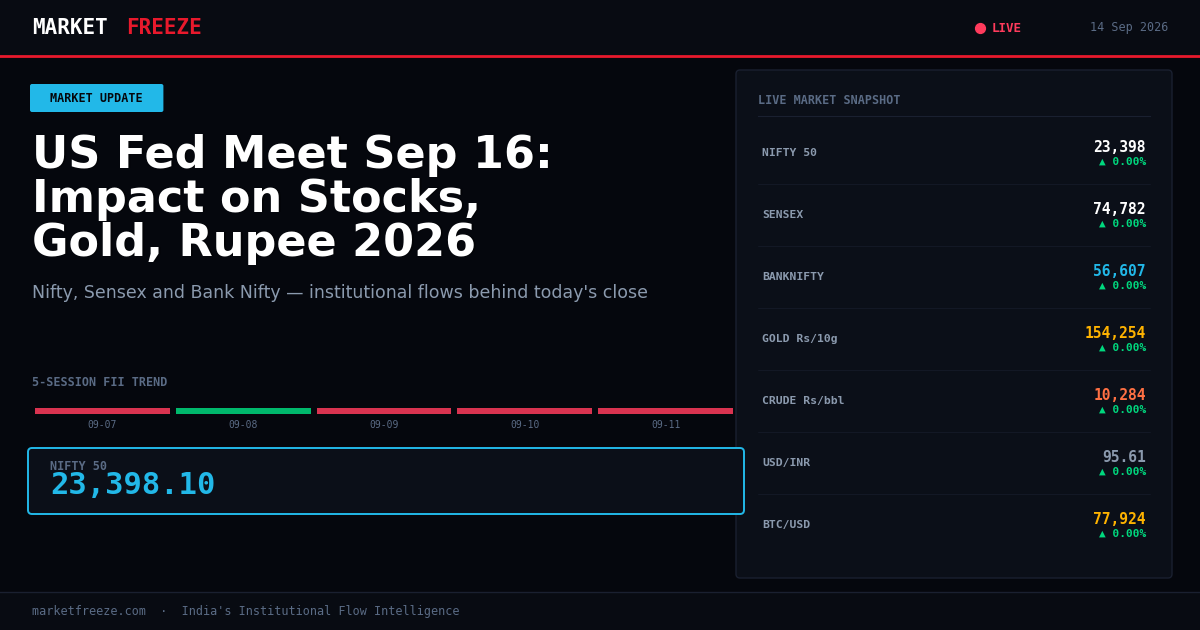
The US Federal Reserve’s anticipated 25 basis point interest rate hike on September 16th is casting a shadow over Indian equities, with FIIs continuing their net selling streak for the third consecutive session, offloading ₹438.24 Cr, even as DIIs provided a cushion with net buys of ₹1,025.85 Cr on September 11th, 2026, as the Nifty 50 closed at 23,398.10.
Fed’s Shadow Looms: FIIs Extend Selling Amid Rate Hike Speculation
The imminent US Federal Reserve policy meeting on Wednesday, September 16th, is the dominant narrative influencing Indian markets, with a 25 basis point interest rate hike widely expected due to persistent inflation, exacerbated by rising crude oil prices and geopolitical tensions between the US and Iran. This global macro event is directly impacting institutional flows, as evidenced by the consistent net selling by Foreign Institutional Investors (FIIs) over the last three trading sessions. While the specific catalyst for today’s (September 14th) FII/DII activity isn’t detailed in the provided live data, the trend of FII outflow and DII inflow from the preceding sessions (September 9th-11th) suggests a cautious institutional stance ahead of the Fed’s decision. FIIs have divested a cumulative ₹1,144.42 Cr in these three sessions, while DIIs have actively absorbed this selling pressure with net purchases totaling ₹2,884.54 Cr, indicating a divergence in institutional sentiment and a potential defensive posture by domestic institutions.
Open a free demat account with
Upstox
or
Angel One
— zero brokerage on delivery trades.
Divergent Flows: FII Caution vs. DII Accumulation
The market on September 11th, 2026, saw the Nifty 50 close at 23,398.10, down 0.34%, reflecting a broad market sentiment of caution. This was accompanied by FIIs offloading net positions worth ₹438.24 Cr. In stark contrast, Domestic Institutional Investors (DIIs) demonstrated robust buying interest, accumulating shares worth a net ₹1,025.85 Cr. This pattern of FII selling and DII buying has been consistent over the past three sessions. On September 10th, FIIs sold ₹582.99 Cr while DIIs bought ₹1,509.04 Cr, and on September 9th, FIIs sold ₹123.19 Cr and DIIs bought ₹1,349.64 Cr. This sustained DII buying suggests confidence in the underlying Indian economic fundamentals, even as foreign capital appears to be de-risking ahead of global monetary policy shifts. The cumulative data for the last five sessions, presented in the table below, highlights a significant net outflow from FIIs totaling ₹3,536.01 Cr, while DIIs have been net buyers to the tune of ₹11,846.57 Cr. This suggests that while foreign investors are cautious, domestic institutions are actively deploying capital, potentially positioning for a post-Fed rally or providing a floor to market declines.
| Date | FII Net (Cr) | DII Net (Cr) | Nifty Close |
|---|---|---|---|
| 2026-09-07 | ₹-3,111.94 Cr | +₹8,930.12 Cr | 23,779.15 |
| 2026-09-08 | +₹280.13 Cr | +₹566.76 Cr | 23,635.10 |
| 2026-09-09 | ₹-123.19 Cr | +₹1,349.64 Cr | 23,431.50 |
| 2026-09-10 | ₹-582.99 Cr | +₹1,509.04 Cr | 23,477.80 |
| 2026-09-11 | ₹-438.24 Cr | +₹1,025.85 Cr | 23,398.10 |
Banking Sector Gains Amidst Broader Market Weakness
While the Nifty 50 and Sensex registered marginal declines of 0.34% and 0.16% respectively on September 14th, 2026, the Bank Nifty stood out with a gain of +0.24%, closing at 56,607.00. This sector-specific strength can be partially attributed to the DII inflows. Banks often benefit from a stable to rising interest rate environment, and DIIs may be increasing their exposure to the financial sector anticipating that Indian banks are well-positioned to manage potential global rate hikes. Conversely, sectors sensitive to global liquidity and growth concerns are likely to be under pressure from FII outflows. Technology stocks, which often mirror global sentiment and have seen volatility due to AI development concerns as reported in European markets, could be a segment where FIIs are reducing exposure. Furthermore, sectors with high import dependence, particularly those reliant on crude oil, might face headwinds from the surging crude prices (up +2.82% on MCX to ₹10,284.00/bbl), a factor also contributing to inflation concerns that are driving the Fed’s potential rate hike. We observe that DIIs have been consistently buying, suggesting they are not fleeing but rather reallocating, potentially favoring domestic demand-driven sectors or financials over export-oriented IT.
Key Levels to Watch: Flow-Driven Support and Resistance
Analyzing the recent FII/DII flow data provides crucial insight into key support and resistance levels for the Nifty 50. The significant DII buying activity seen on September 7th, where they net purchased ₹8,930.12 Cr, coincided with the Nifty closing at 23,779.15. This suggests that the 23,700-23,800 zone could act as a significant support level if DIIs continue to defend these levels. Conversely, the sustained FII selling, particularly the ₹3,111.94 Cr outflow on September 7th, indicates potential resistance building up around the higher levels that prevailed then. Based on the recent trading sessions, particularly the pullback from 23,779.15 to 23,398.10, the immediate resistance is seen around the 23,500 mark. Support can be anticipated in the 23,200-23,300 range, areas where bargain hunting by DIIs might be expected, given their consistent accumulation. The current Nifty level of 23,398.10 sits within this critical zone, implying that the market is at an inflection point influenced by both global macro events and domestic institutional positioning.
Currency and Commodity Crossover: Rupee Vulnerability and Gold’s Double-Edged Sword
The impending US rate hike has direct implications for the Indian Rupee (USD/INR) and gold prices. The Rupee, currently trading at Rs95.61 against the USD, has seen a slight depreciation of 0.16%. A 25 basis point rate hike by the Fed would typically strengthen the US Dollar globally, putting further downward pressure on emerging market currencies like the INR. FII outflows, which reduce dollar inflows into India, also contribute to this weakness. Historically, periods of rising US interest rates have correlated with Rupee depreciation. Gold prices on MCX have fallen by 0.84% to ₹154,254.00/10g today. While rising inflation and geopolitical tensions are usually supportive of gold, the prospect of higher interest rates makes non-yielding assets like gold less attractive compared to interest-bearing instruments. This divergence highlights the complex interplay of factors affecting gold; the Fed’s move could cap gold’s upside potential despite underlying inflationary pressures. The crude oil surge to ₹10,284.00/bbl (+2.82%) is a significant inflationary driver, which in turn fuels the Fed’s hawkish stance, creating a feedback loop that could pressure the Rupee and global growth. This complex dynamic suggests that while FIIs are selling equities, they might not be aggressively moving into gold, preferring to await clearer signals post-Fed.
Historical Parallel: Fed Hikes and Indian Market Reactions
Examining past instances of US Federal Reserve rate hikes can offer valuable context. During periods of Fed tightening, particularly when inflation is a concern, emerging markets typically experience capital outflows as investors repatriate funds to the US to take advantage of higher yields. A notable parallel can be drawn to the Fed’s tightening cycle in late 2015-2018. During that period, sustained FII outflows were observed in India, accompanied by Rupee depreciation and increased volatility in equity markets. However, the response of DIIs in those times was also crucial in cushioning the market. The current scenario, with DIIs consistently buying significant amounts (e.g., +₹1,025.85 Cr on Sept 11th, +₹1,509.04 Cr on Sept 10th), mirrors the domestic support seen in previous tightening cycles. The key difference now might be the scale of DII participation, which appears more substantial and sustained, potentially indicating a greater maturity of the domestic investor base and a stronger conviction in India’s long-term growth trajectory despite global headwinds. The Nifty’s move from 23,779.15 on Sept 7th to 23,398.10 on Sept 11th shows a reactive drawdown, akin to historical responses to impending global rate hikes.
Portfolio Framework: Navigating Uncertainty with Data-Driven Allocation
For investors seeking to navigate the current environment of global monetary policy uncertainty and FII outflows, a data-driven portfolio framework is essential. Given the persistent FII selling (cumulative ₹438.24 Cr on Sept 11th) and DII buying (cumulative ₹1,025.85 Cr on Sept 11th), a strategy leaning towards domestic demand and defensive sectors, supported by DII conviction, appears prudent. Specifically, consider overweighting the Banking sector if DII net inflows continue to be strong, particularly if the Bank Nifty remains above 56,000. Conversely, reduce exposure to rate-sensitive sectors like high-growth technology or capital-intensive industrials if FII selling intensifies beyond ₹700 Cr per session. Maintain a strategic allocation to gold, perhaps not exceeding 5-10% of the portfolio, as a hedge against geopolitical risks, but be mindful of its correlation with rising US yields. The USD/INR breaching Rs96.00 could be a trigger to re-evaluate currency hedges or consider companies with significant export revenues. A portfolio allocation focused on sectors exhibiting strong DII accumulation, such as financials and stable consumer staples, while underweighting those vulnerable to global liquidity tightening, seems a robust approach when FII net outflows exceed ₹500 Cr for two consecutive sessions.
What Changes This Outlook: The Fed Dot Plot
The single most critical data point to watch in the coming week is the US Federal Reserve’s updated economic projections, particularly the “Dot Plot.” This plot indicates the individual FOMC members’ projections for the future path of interest rates. If the Dot Plot suggests a more aggressive rate hike trajectory beyond the expected 25 basis points in the current cycle, or a higher terminal rate than currently anticipated, it could trigger a significant shift in global capital flows, leading to intensified FII selling in Indian equities and further pressure on the Rupee. Conversely, if the Dot Plot signals a more measured approach or a quicker pause in rate hikes, it could alleviate some of the current market anxiety and potentially lead to a reversal of FII outflows. A sustained Nifty close above 23,600, coupled with a moderation in FII selling to below ₹100 Cr per day, would indicate a potential stabilization driven by domestic demand and DII support, even amidst global tightening.
Frequently Asked Questions (FAQ)
Q: What did FII buy or sell on 11 September 2026?
A: On 2026-09-11, FIIs were net sellers of ₹438.24 Cr in the Indian equity market.
Q: What did DII buy on 10 September 2026?
A: On 2026-09-10, DIIs were net buyers of ₹1,509.04 Cr in the Indian equity market.
Q: Is FII buying or selling in September 2026?
A: In the initial part of September 2026, FIIs have shown a trend of net selling, with notable outflows seen on September 7th (₹-3,111.94 Cr) and continued selling in subsequent sessions, though DIIs have consistently provided buying support.
Bottom Line
The Indian equity market is navigating a crucial juncture, with the impending US Federal Reserve rate hike acting as the primary catalyst for institutional sentiment. FIIs continue to exhibit caution, evidenced by consistent selling pressure, while DIIs are actively absorbing these flows, signaling domestic confidence. The Bank Nifty’s resilience and the Rupee’s marginal depreciation highlight the immediate impacts of these global and domestic dynamics. Investors should closely monitor the Fed’s policy announcements and the subsequent flow reactions, particularly focusing on DII buying patterns as a key indicator of market support.
Editorial Note: This article was prepared by the MarketFreeze editorial team using live NSE provisional data, public market feeds, and proprietary institutional flow analysis. All price and flow figures are sourced directly from NSE, BSE, and CoinGecko as of 14 September 2026. This content is for informational purposes only and does not constitute investment advice. MarketFreeze is not SEBI-registered. Please consult a qualified financial advisor before making investment decisions. Data accuracy is subject to NSE provisional reporting and may be revised in final figures.