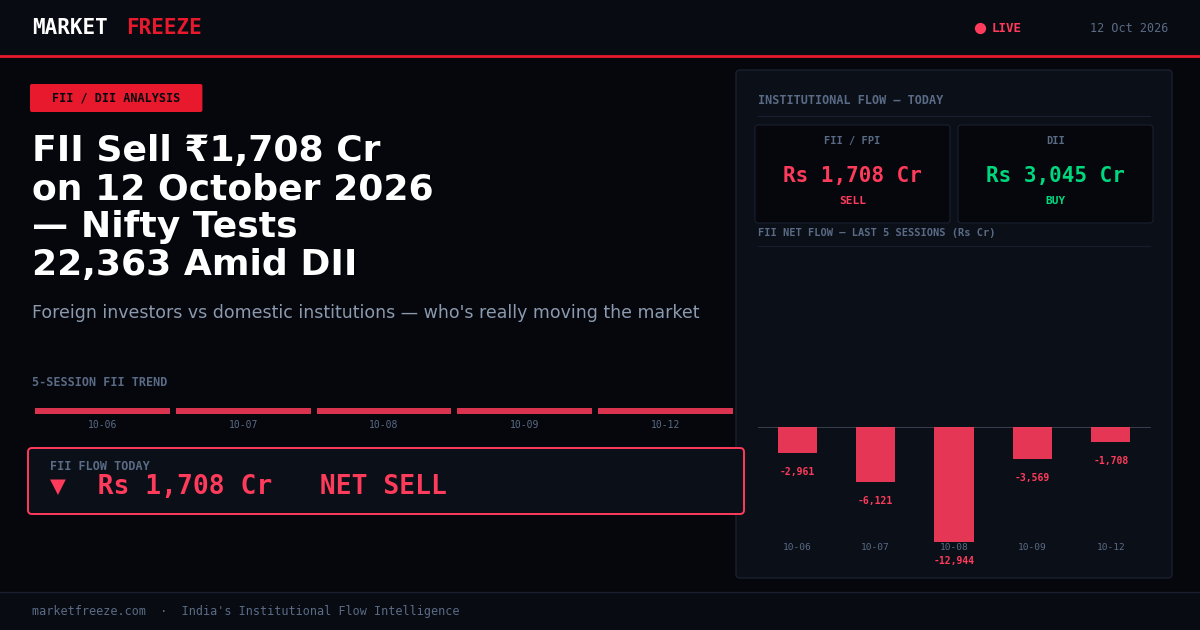
FIIs Net Sold ₹1,708.48 Cr, DIIs Bought ₹3,045.02 Cr on October 12, 2026
Foreign institutional investors offloaded equities worth ₹1,708.48 Cr on October 12, 2026, while domestic institutional investors stepped in with net purchases totaling ₹3,045.02 Cr. This divergence followed a sharp selling spree by FIIs in the preceding sessions, with outflows of ₹12,943.58 Cr on October 8 and ₹3,568.90 Cr on October 9. The Nifty 50 closed at 22,363.35, down 0.70% for the day, mirroring the broader market weakness. The rupee’s significant recovery, gaining nearly 1% to Rs95.96 against the US dollar, was a notable counterpoint to the equity outflows, as reported by multiple news outlets, including the rebound mentioned in STORY 2 and STORY 5, which attributed the gains partly to RBI interventions.
Open a free demat account with
Upstox
or
Angel One
— zero brokerage on delivery trades.
FII Selling Abates but Remains Significant
While today’s FII net selling figure of ₹1,708.48 Cr is substantially lower than the ₹12,943.58 Cr dumped on October 8, it continues a trend of net outflows over the last five sessions. The cumulative FII selling from October 6 to October 12 stands at ₹26,505.13 Cr. This persistent selling pressure has dragged the Nifty 50 from its recent high of 22,776.10 on October 6 to close at 22,363.35 today. The reduced scale of selling today, however, signals a possible pause rather than a complete reversal. Retail investors should monitor if this selling pace is sustained or if FIIs begin to re-enter the market, which could signal a bottoming process.
DIIs Provide Crucial Support Amidst FII Outflows
Domestic institutional investors have consistently absorbed FII selling over the last five sessions, with net purchases on October 12 reaching ₹3,045.02 Cr. This DII buying momentum is a key buffer against further downside. Their cumulative net buying over the past five sessions amounts to ₹27,675.86 Cr, effectively offsetting the FII outflow. Today’s DII activity, as highlighted in STORY 3, was instrumental in preventing a steeper decline in the Nifty, which fell by 157.10 points. Retail participants can interpret this DII support as a sign of confidence in Indian equities at current valuations, suggesting underlying strength in the market structure.
Implied Nifty Support and Resistance Levels
Based on the price action and the FII/DII flows observed today, the Nifty 50 appears to be finding support near the 22,300 mark. Today’s low of 22,300.05, coupled with the reduced FII selling, suggests this as an initial support. Resistance is currently evident around the 22,500 to 22,600 range, where selling pressure emerged during the day, pushing the index down from its opening levels. Any sustained move above 22,600 would indicate a potential shift in FII positioning, while a break below 22,300 could invite further selling, potentially targeting 22,150. Retail investors should use these levels to manage their short-term directional trades.
Sectoral Implications: IT and Banking Under Pressure, Consumption Resilience
The broad-based selling observed in the market today, with the Nifty closing down 0.70%, suggests that FIIs were likely reducing exposure across most sectors. However, the significant DII buying indicates selective accumulation. Historically, IT and Banking sectors often see substantial FII participation. Given the persistent FII selling, it’s probable that these sectors experienced net outflows today. Conversely, DIIs often favour defensive and consumption-oriented sectors. Therefore, FMCG, Pharma, or select Auto stocks might have seen DII inflows that provided a relative cushion against the broader market fall. Investors should watch for sector-specific earnings announcements, such as those from HCLTech and ICICI Pru AMC mentioned in STORY 4, for clues on institutional rotation within these segments.
USD/INR Rebound and its Market Significance
The Indian rupee’s sharp rebound of nearly 1% to Rs96.96 against the US dollar is a crucial development that contrasts with the equity selling. As detailed in STORY 2 and STORY 5, this appreciation is attributed to RBI measures to curb speculative trades and easing pressure on oil marketing companies. A stronger rupee typically reduces the effective cost of Indian assets for foreign investors, making it more attractive. However, today’s FII selling suggests that this currency strength has not yet translated into renewed equity inflows, possibly due to ongoing geopolitical concerns or rising global bond yields, as mentioned in STORY 1. Retail traders should note that continued rupee strength could eventually draw back FIIs if broader market and global factors stabilize.
Historical Parallel: Sustained DII Support
Looking at the past five sessions, the pattern of significant FII selling met by equally substantial DII buying is most reminiscent of the period around October 8-9, 2026. On October 8, FIIs sold ₹12,943.58 Cr while DIIs bought ₹10,703.11 Cr. This sustained DII counter-balancing act has prevented a complete collapse in the index. Historically, periods of such strong DII buying amidst FII outflows have often preceded market recoveries, as DIIs accumulate undervalued assets. However, the duration and intensity of FII selling remain a key factor. Retail investors should observe if the Nifty can hold the current support levels (around 22,300) before betting on a significant upward move, given the precedent of prolonged selling cycles in the past.
FII/DII Flow Table (Last 5 Sessions)
| Date | FII Net (Cr) | DII Net (Cr) | Nifty Close |
|---|---|---|---|
| 2026-10-06 | ₹-2,961.30 Cr | +₹5,088.92 Cr | 22,776.10 |
| 2026-10-07 | ₹-6,121.37 Cr | +₹4,596.57 Cr | 22,603.05 |
| 2026-10-08 | ₹-12,943.58 Cr | +₹10,703.11 Cr | 22,231.80 |
| 2026-10-09 | ₹-3,568.90 Cr | +₹4,743.26 Cr | 22,363.35 |
| 2026-10-12 | ₹-1,708.48 Cr | +₹3,045.02 Cr | 22,363.35 |
Key Takeaways from Today’s Flows
The market experienced a mixed session today, with significant FII selling of ₹1,708.48 Cr being substantially counteracted by DII buying of ₹3,045.02 Cr. This DII support prevented a sharper decline, keeping the Nifty 50 near the 22,363.35 mark. The rupee’s strength, rebounding to Rs96.96 against the dollar, added a positive currency dimension, although it did not immediately deter FII equity outflows. While the pace of FII selling has decreased from the extremes seen earlier in the week, it remains a dominant factor influencing short-term market direction. Retail investors should focus on the 22,300 support level for the Nifty and watch for any signs of FII capitulation or renewed buying interest, particularly in sectors where DIIs are actively accumulating.
FAQ
Why did FIIs sell Indian stocks on October 12, 2026?
FIIs sold ₹1,708.48 Cr worth of Indian equities on October 12, 2026. While the exact reasons are not disclosed, persistent selling has been linked to global geopolitical concerns and rising bond yields, as indicated in news reports. Despite a stronger rupee today, FII outflows continued, suggesting other macroeconomic factors are driving their decisions.
What does the DII buying of ₹3,045.02 Cr mean for the Nifty?
The DII net buy of ₹3,045.02 Cr on October 12, 2026, indicates that domestic institutions are actively absorbing FII selling. This consistent buying provides a floor for the market, preventing steeper declines. It suggests DIIs perceive current market levels as attractive for accumulation, offering underlying support to the Nifty 50, which closed at 22,363.35.
How does the rupee’s movement affect FII flows?
The rupee strengthened by nearly 1% to Rs96.96 on October 12, 2026, partly due to RBI interventions. A stronger rupee typically makes Indian assets cheaper for foreign investors in dollar terms, potentially encouraging inflows. However, today, this positive currency signal did not prevent FII selling of ₹1,708.48 Cr, highlighting that other global and domestic factors are currently overriding the currency effect for FIIs.
Anticipating FII Re-entry: What Triggers a Shift?
The sustained selling by Foreign Institutional Investors, amounting to over ₹26,505 Cr in the last five sessions, prompts a critical question: what could reverse this trend? Typically, a significant de-escalation of geopolitical tensions, a stabilization of global interest rates (particularly US Treasury yields), or a clearer domestic economic outlook would be prerequisites. For instance, a sustained drop in the US 10-year Treasury yield below the current levels seen on October 12, 2026, could reduce the attractiveness of risk-free assets, prompting a re-evaluation of emerging market equities. Furthermore, positive surprises in Indian economic data, such as inflation figures printing below expectations or a robust GDP growth forecast for the next quarter, could also instill confidence and lure back FIIs. Until such triggers materialize, the cautious stance observed in today’s selling figure of ₹1,708.48 Cr might persist.
The Role of Retail Investors in the Current Market Dynamic
While institutional flows grab headlines, understanding the positioning of retail investors is crucial. In periods of significant FII outflows, retail participation often becomes more pronounced, either through direct equity purchases or via mutual funds. Today’s market action, with the Nifty closing at 22,363.35 despite FII selling, suggests that retail demand, channeled through DIIs and direct retail investors, has been a stabilizing force. Mutual fund inflows, which have been consistently strong over the past year, likely continued, absorbing a portion of the selling pressure. If FIIs continue to divest, the resilience of retail demand will be tested, particularly if the market experiences further sharp corrections. A sustained increase in retail participation, especially if accompanied by increased SIP (Systematic Investment Plan) figures, could signal a bottoming process, even in the face of foreign investor caution.
Sector Rotation: A Closer Look at DIIs’ Strategy
The substantial DII buying of ₹3,045.02 Cr on October 12, 2026, implies a strategic sector allocation rather than broad-based buying. While the article alluded to consumption and defensive sectors, closer examination of DII portfolio adjustments is warranted. Historically, DIIs have shown a preference for sectors with stable earnings and strong domestic demand drivers. Given the current market sentiment, it’s plausible that they are increasing their allocation to companies with strong balance sheets in the banking sector, particularly those less exposed to volatile global markets, or in the FMCG space which benefits from consistent consumer spending. Conversely, sectors heavily reliant on export revenues and subject to global sentiment, such as IT, might see continued pressure. Observing the performance of specific sub-sectors within the broader indices, such as PSU banks versus private banks, or staple foods versus discretionary consumption, can offer finer insights into DII’s tactical moves.
Bottom Line
Today’s trading session saw FIIs net sell ₹1,708.48 Cr, a reduction from previous days, while DIIs provided robust support with net purchases of ₹3,045.02 Cr. This DII intervention helped the Nifty 50 close at 22,363.35, down 0.70%. The Indian rupee’s significant recovery to Rs96.96 against the dollar offered a counter-trend positive signal. Sectoral implications point to potential DII accumulation in defensive names while IT and Banking may have faced FII selling pressure. Retail investors should watch the 22,300 support level for the Nifty and the sustainability of DII buying amidst ongoing FII outflows.
Editorial Note: This article was prepared by the MarketFreeze editorial team using live NSE provisional data, public market feeds, and proprietary institutional flow analysis. All price and flow figures are sourced directly from NSE, BSE, and CoinGecko as of 12 October 2026. This content is for informational purposes only and does not constitute investment advice. MarketFreeze is not SEBI-registered. Please consult a qualified financial advisor before making investment decisions. Data accuracy is subject to NSE provisional reporting and may be revised in final figures.