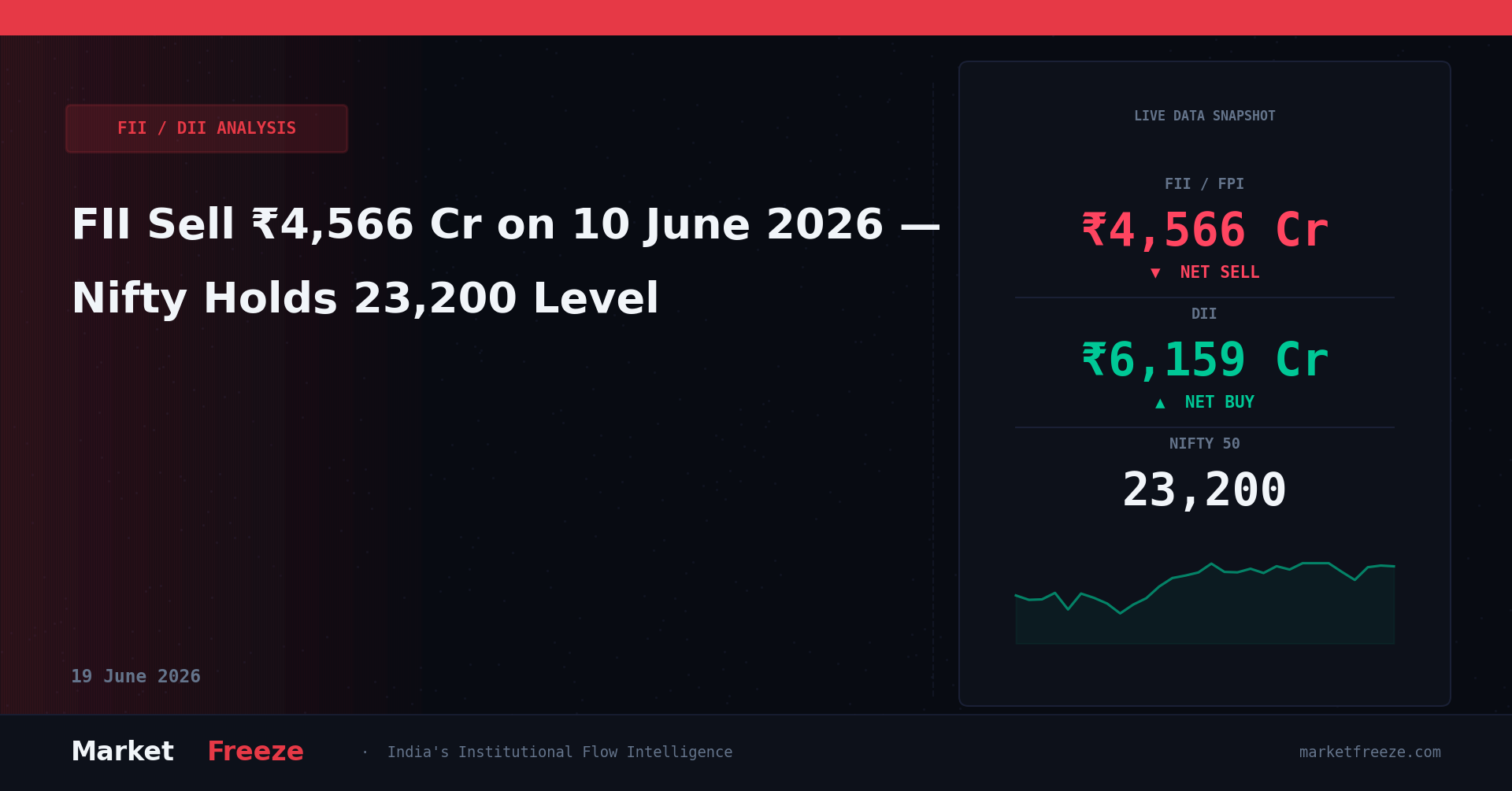
Thursday’s closing bell brought clarity: Foreign Institutional Investors (FIIs) executed a net sell of ₹4,566.03 Cr in Indian equities today. This marks the third consecutive session of substantial FII outflow, following yesterday’s ₹5,555.67 Cr net sell and Tuesday’s ₹8,776.25 Cr net sell. Despite this persistent FII divestment, the Nifty 50 closed at 23,214.95, registering a modest gain of +0.40%. Domestic Institutional Investors (DIIs) provided robust counter-buying, injecting ₹6,159.48 Cr into the market. This DII support has been the primary buffer against FII selling pressure, as seen in the last three sessions where DII net buying consistently outweighed FII net selling.
Today’s FII gross purchases totaled ₹14,735.47 Cr, while their gross sales reached ₹19,301.50 Cr. The resulting net outflow of ₹4,566.03 Cr confirms a deliberate reduction of exposure. This contrasts sharply with DII activity, where gross purchases amounted to ₹18,987.95 Cr and gross sales were ₹12,828.47 Cr, leading to their net inflow of ₹6,159.48 Cr. The sustained DII absorption of FII selling is a critical factor preventing a sharper market correction. For retail investors, this means local capital is aggressively defending current valuations, suggesting conviction in the Indian market’s underlying strength despite external pressures.
FII Selling Continues: Nifty Implications and Sectoral Shifts
The FII net sell of ₹4,566.03 Cr today pushes the three-day cumulative FII outflow to ₹18,897.95 Cr. This sustained selling pressure, even as the Nifty 50 recorded a gain, indicates strong underlying domestic demand. The Sensex also closed up +0.62% at 73,983.00, further highlighting the DII-led resilience. The Nifty’s ability to absorb nearly ₹19,000 Cr of FII selling over three days and still maintain its position above 23,200 suggests significant DII firepower. This robust absorption implies a strong support zone for the Nifty 50 around the 22,500-22,800 range, a level DIIs have consistently defended. Any dip towards these levels could see aggressive DII accumulation.
Given the persistent FII selling, immediate resistance for the Nifty 50 could be observed around 23,500-23,800, as fresh FII buying would be required to push beyond these levels. The current Nifty 50 close at 23,214.95 means further upside may be capped until FII flows reverse or DIIs intensify their buying. The Bank Nifty, in contrast, surged +1.92% to close at 55,100.00. This indicates DIIs are likely rotating into Banking stocks, especially Private Banks, as mentioned in today’s market reports. This selective buying within the banking sector provides a potential tailwind for the broader market, even with FIIs exiting.
The sectoral implications of today’s FII selling, coupled with DII buying, suggest a shift in preference. While market reports highlighted FMCG and Private Banks leading gains, other sectors like Realty, Oil & Gas, PSU Bank, and IT indices declined by 1.2% to 1.5%. This indicates that FII selling is likely concentrated in these underperforming sectors, while DIIs are strategically deploying capital into resilient areas. For a retail investor, this implies focusing on sectors showing DII accumulation rather than chasing broad market rallies driven by a few heavyweights. The relative strength in Bank Nifty at 55,100.00, a gain of +1.92%, strongly points towards DII preference for Financial Services.
DII Counter-Balance: The Unseen Force
Domestic Institutional Investors have been the primary architects of market stability in the face of sustained FII withdrawals. Today’s net buy of ₹6,159.48 Cr follows net purchases of ₹5,165.24 Cr yesterday and ₹9,133.57 Cr on Tuesday. Cumulatively, DIIs have infused ₹20,458.29 Cr into Indian equities over the last three sessions. This figure significantly outweighs the FII net sell of ₹18,897.95 Cr over the same period, providing a net positive inflow of domestic capital into the market. This consistent DII buying has been the bedrock, preventing any major corrections despite the substantial foreign outflows.
The aggressive DII buying is a strong signal of domestic conviction. Even as global markets grapple with issues like “escalating Iran-US tensions,” as reported, DIIs are shoring up Indian equities. This suggests that domestic institutions are viewing current FII selling as an opportunity for accumulation, possibly anticipating future market appreciation. The Nifty 50’s current level of 23,214.95, despite the outflow, is a testament to this domestic strength. For retail investors, mirroring DII activity by accumulating quality stocks during FII-induced dips could be a pragmatic approach, especially in sectors favored by DIIs like Private Banks and FMCG.
The impact of DII activity on specific sectors is becoming increasingly clear. While FIIs appear to be shedding exposure across various segments, DIIs are selectively deploying their capital. The sharp rise in Bank Nifty by +1.92% today indicates a strong DII focus on the Banking sector. Conversely, the decline in IT and Realty indices, as highlighted in market commentary, could be areas where FIIs are liquidating positions, and DIIs are either less active or also selling. This divergence in sectoral flows underscores the importance of understanding the underlying institutional preferences rather than solely focusing on aggregate market movements. A retail investor should scrutinize specific sector ETFs or large-cap stocks within the Banking space for potential DII-driven momentum.
Currency and Commodity Dynamics: Indirect Market Influences
Today’s market dynamics were also influenced by movements in currencies and commodities. The USD/INR pair depreciated by -0.43%, with the Rupee strengthening to Rs95.41. A stronger Rupee typically makes Indian assets less attractive for FIIs when repatriating funds, but it can also signal reduced capital flight concerns. This strengthens the argument for DIIs stepping in, as a stable or appreciating Rupee enhances domestic purchasing power and confidence. The Rupee’s strengthening, despite FII selling, could indicate broader economic stability that DIIs are reacting to positively.
Gold MCX prices slid significantly by -1.72%, settling at Rs148,854.00/10g. A sharp decline in gold prices often suggests a shift of capital away from safe-haven assets and back into riskier equities, which aligns with DII buying patterns. This movement supports the narrative that domestic capital is finding higher conviction in equity markets rather than traditional hedges. For retail investors, a declining gold price could be a signal to evaluate equity exposure, particularly in sectors that have seen DII accumulation.
Crude MCX prices saw a slight increase of +0.13%, reaching Rs8,737.00/bbl. While a minor rise, stability in oil prices, especially against the backdrop of “cooling oil prices” as reported, can be a positive for import-dependent economies like India. Lower or stable oil prices reduce inflationary pressures and improve corporate margins, which DIIs would factor into their investment decisions. The modest rise today does not negate the broader trend of cooling oil prices that supports the market. Retail investors should monitor oil price stability as it indirectly influences corporate earnings and, consequently, stock performance.
Crypto Performance: A Divergent Narrative
The cryptocurrency market presented a divergent narrative today, with Bitcoin declining by -2.27% to USD 61,291.00 and Ethereum falling by -2.80% to USD 1,623.00. While direct correlation to Indian equity flows is often limited, significant shifts in global risk assets can sometimes cascade. The “fizzling AI rally in global markets,” as mentioned, might be contributing to a broader risk-off sentiment in speculative assets like crypto, even if not directly impacting Indian equity flows. This suggests that global capital might be re-evaluating high-beta assets, which could indirectly lead to some FII reallocation away from emerging markets as well.
The declines in Bitcoin and Ethereum could indicate a global re-evaluation of speculative positions. This re-evaluation, while not directly tied to FII selling in India, contributes to a broader understanding of global capital flows. When high-growth, high-risk assets like cryptocurrencies experience pullbacks, it often reflects a reduction in global liquidity for such segments. This could potentially free up capital for traditional equity markets, but FIIs in India are currently choosing to exit rather than enter. For a retail investor, observing crypto movements can provide an additional data point on overall global risk appetite, even if it doesn’t dictate direct Indian equity strategy.
The substantial FII net sell of ₹4,566.03 Cr, combined with the DII net buy of ₹6,159.48 Cr, paints a clear picture of domestic resilience. The Nifty 50’s ability to close positively at 23,214.95 underscores the depth of domestic capital. The Bank Nifty’s surge of +1.92% to 55,100.00 signals targeted DII accumulation in financials. Retail investors should focus on these DII-favored sectors and use FII-induced dips as accumulation opportunities, particularly around the 22,500-22,800 Nifty support zone. The immediate Nifty resistance is at 23,500-23,800, requiring a shift in FII behavior or even stronger DII buying to breach. Monitoring the Rs95.41 USD/INR level and crude prices at Rs8,737.00/bbl will be crucial for understanding the broader economic backdrop for domestic flows.
This sustained DII support, injecting over ₹20,458.29 Cr over three sessions, fundamentally alters the market’s internal dynamics. Unlike previous periods where FII outflows often led to sharp corrections, the current scenario highlights a maturing domestic investor base with sufficient capital and conviction. This robust DII counter-balance is a testament to the growing financialization of Indian household savings and the increasing influence of mutual funds, pension funds, and insurance companies. Their consistent net buying, particularly today’s net inflow of ₹6,159.48 Cr, showcases a strategic approach to accumulate quality Indian assets at perceived attractive valuations, effectively cushioning the blows from FII selling. The domestic market’s ability to absorb an approximate ₹18,897.95 Cr FII outflow in just three days, while still maintaining the Nifty 50 above its psychological 23,000 mark, paints a picture of inherent strength that should not be underestimated by any market participant.
Retail Investor Strategy: Riding the DII Wave
For the discerning retail investor, the current market environment, characterized by FII exits and DII absorption, offers a unique set of opportunities and challenges. The most prudent strategy would be to align with the domestic institutional narrative rather than succumbing to panic induced by FII selling. Given the DIIs’ consistent net buying today of ₹6,159.48 Cr, retail investors should identify sectors and stocks where domestic institutions are actively accumulating. The significant surge in the Bank Nifty by +1.92% today strongly suggests that private sector banks and select financial services companies are currently in favor. Retail investors could consider a staggered approach to accumulate high-quality names within this sector, particularly during any FII-led dips.
Furthermore, the resilience of the Nifty 50, closing positively today despite the FII net sell, indicates that broad-based panic selling is unwarranted. Instead, retail investors should focus on disciplined asset allocation. Instead of chasing momentum in declining sectors like IT and Realty (which saw declines of 1.2% to 1.5% today), a better approach might be to rebalance portfolios towards sectors demonstrating DII conviction. This includes looking at large-cap quality stocks that are constituents of the Nifty 50 and have shown relative strength. The consistent DII net positive inflow, amounting to over ₹20,458.29 Cr over the past three sessions, provides a strong fundamental backing for domestic-led rallies, making it a safer bet for retail participation.
Sector Rotation Implications: Beyond the Headlines
The divergent sectoral performance today provides crucial insights into the ongoing rotation of capital within the Indian market. While the overall market witnessed a modest gain, spearheaded by the Nifty 50’s close at 23,214.95, the sharp rise in Bank Nifty by +1.92% compared to declines in IT, Realty, Oil & Gas, and PSU Bank indices (ranging from 1.2% to 1.5%) highlights a clear shift. This suggests that DIIs are actively rotating out of sectors perceived as vulnerable to global headwinds or valuation concerns, and into sectors with stronger domestic growth drivers and more attractive valuations. The sustained FII selling, culminating in a three-day outflow of nearly ₹19,000 Cr, is likely concentrated in these underperforming segments.
For market participants, understanding these sectoral shifts is paramount. The strength in the banking sector, indicated by the Bank Nifty reaching 55,100.00, implies a positive outlook on India’s credit growth and overall economic stability. This contrasts with the subdued performance of IT, which is more susceptible to global economic slowdowns and FII divestment. This dynamic suggests that domestic institutions are betting on India’s internal consumption and financial sector growth. Therefore, future market rallies are more likely to be led by sectors like financials, and potentially select consumption-oriented industries, rather than export-driven or rate-sensitive sectors that may be facing FII pressure.
Historical FII Pattern Context: A New Chapter?
Historically, FII selling of the magnitude observed over the past three days – a cumulative ₹18,897.95 Cr outflow – would typically trigger a more significant market correction. However, the Nifty 50’s resilience, closing positively today at 23,214.95, signals a potential structural shift in the Indian market’s response to FII activity. In previous cycles, India’s equity markets were heavily reliant on foreign capital, making them susceptible to global risk-off events. The consistent DII counter-buying, particularly today’s net purchase of ₹6,159.48 Cr, suggests that domestic institutions have matured sufficiently to absorb significant foreign outflows without collapsing the market.
This newfound domestic strength implies that the Indian market is becoming less beholden to the whims of global capital flows. While FII activity will always remain an important factor, its impact on market direction may be diminishing due to the robust and growing DII presence. This could herald a new chapter where domestic liquidity acts as a more powerful determinant of market trends. The strong DII net inflow of over ₹20,458.29 Cr over the last three sessions, against the FII outflow, supports this evolving narrative, suggesting that India’s market dynamics are increasingly driven by internal fundamentals and domestic investor confidence, rather than solely by external capital flows.
Tomorrow’s Key Levels to Watch: Navigating the Next Session
As the market heads into the next trading session, several key levels will be critical to monitor, particularly given the ongoing FII-DII divergence. For the Nifty 50, the immediate support zone around 23,000-23,100 will be paramount. A breach below this level, especially if accompanied by continued significant FII selling, could signal a deeper correction towards the 22,500-22,800 range, where DIIs have demonstrated strong accumulation tendencies. The Nifty’s ability to hold above 23,214.95 today, despite substantial FII pressure, implies strong domestic conviction at these levels.
On the upside, the Nifty 50 faces immediate resistance at 23,500-23,800. Sustained FII buying or an intensification of DII purchases beyond today’s ₹6,159.48 Cr would be required to decisively breach this zone. The performance of the Bank Nifty, having closed strongly at 55,100.00, will also be a key indicator. Its ability to maintain momentum will be crucial for broader market sentiment. Additionally, retail investors should keep a close eye on the USD/INR pair, which today strengthened to Rs95.41. Any significant depreciation of the Rupee could re-ignite FII selling pressure, while stability or further appreciation would bolster domestic confidence.
The current market landscape, characterized by substantial FII selling of nearly ₹19,000 Cr over three days being absorbed by DII buying of over ₹20,000 Cr, underscores the robust domestic resilience of Indian equities. Retail investors should strategically align with the DII-favored sectors, particularly financials as evidenced by Bank Nifty’s +1.92% surge, and use any FII-induced dips as accumulation opportunities, especially if the Nifty 50 approaches the strong support zone around 22,500-22,800. This approach allows for participation in India’s growth story, backed by strong domestic conviction, rather than being swayed by transient foreign outflows.
📬 Get FII/DII Data Every Morning — Free
Join thousands of Indian traders who start their day with MarketFreeze. Daily FII/DII flow, Nifty outlook, and crypto — delivered by 8 AM IST.
Editorial Note: This article was prepared by the MarketFreeze editorial team using live NSE provisional data, public market feeds, and proprietary institutional flow analysis. All price and flow figures are sourced directly from NSE, BSE, and CoinGecko as of 10 June 2026. This content is for informational purposes only and does not constitute investment advice. MarketFreeze is not SEBI-registered. Please consult a qualified financial advisor before making investment decisions. Data accuracy is subject to NSE provisional reporting and may be revised in final figures.