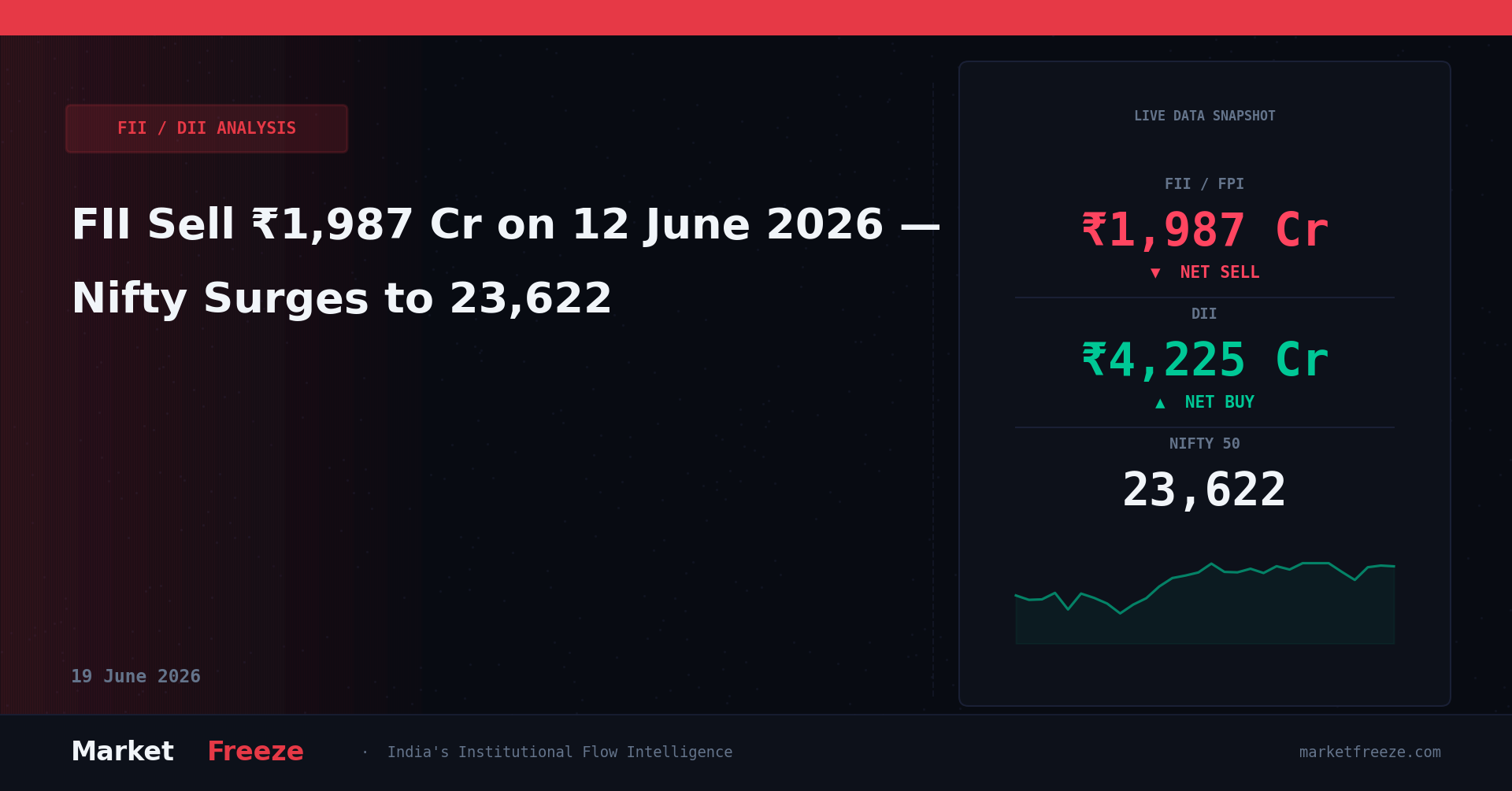
FII desks turned net sellers today, offloading a net ₹1,987.09 Cr in the cash market, while domestic institutions countered this pressure with an aggressive buy order of ₹4,224.51 Cr. This stark institutional divergence played out against a backdrop of explosive price action, where the Nifty 50 surged 1.99% to close at 23,622.90, and the Sensex posted a massive 2.30% gain to settle at 75,528.00. Despite three consecutive sessions of heavy foreign liquidation, local liquidity completely absorbed the supply, driving the Bank Nifty index up by 2.97% to end at 56,815.00. The macro trigger behind this sharp technical squeeze was a sudden relief rally in global risk assets after US President Donald Trump cancelled plans for military action against Iran, citing progress toward a diplomatic deal.
The institutional flow data indicates that foreign portfolio managers are using these sharp relief rallies to trim their exposure to Indian equities, rather than building fresh long-term positions. While the headline indices registered their best single-day performance of the week, the actual cash market transactions reveal that foreign desks were persistent sellers throughout the day, executing gross sales of ₹14,000.58 Cr against gross purchases of ₹12,013.49 Cr. Conversely, domestic mutual funds and insurance companies acted as the ultimate backstop, scaling up their purchases to absorb the foreign selling and drive a massive short-covering rally across heavily shorted banking and energy counters.
Deconstructing the 3-Day Institutional Flow Divergence
Over the last three sessions, foreign portfolio investors have pulled out a cumulative ₹8,678.10 Cr from Indian cash equities. On June 10, FIIs dumped ₹4,566.03 Cr, followed by another outflow of ₹2,124.98 Cr on June 11, and the subsequent ₹1,987.09 Cr divestment today. This persistent liquidation suggests that foreign desks are structural sellers at these elevated valuations, using any positive macro news—such as the easing of West Asian geopolitical tensions—to exit their positions. The primary driver of this capital flight is the shifting yield differential between India and developed markets, combined with structural changes in the global debt landscape.
Domestic institutional desks, on the other hand, have deployed a staggering ₹13,507.94 Cr over the exact same three-day period. Today’s net purchase of ₹4,224.51 Cr marks a critical continuation of this domestic defense. Domestic mutual funds are currently sitting on record-high cash levels driven by steady systemic inflows, enabling them to counter foreign selling pressure. For retail investors, the actionable takeaway is clear: do not mistake this macro-driven rally for a sustainable foreign-led bull run; instead, monitor whether domestic institutions can maintain this high level of daily deployment to defend critical structural support levels.
Open a free demat account with
Upstox
or
Angel One
— zero brokerage on delivery trades.
The Crude Oil Crash and its Sectoral Implications
The cancellation of plans to strike Iran sent crude oil prices into a tailspin, with Crude MCX crashing 3.73% to close at ₹8,325.00 per barrel. This sharp drop in energy costs provides immediate relief to India’s fiscal balance, directly impacting high-beta sectors. Historically, foreign desks tend to reduce their exposure to Indian FMCG, Paints, and Specialty Chemical companies when crude prices spike, as these sectors face immediate input cost inflation. Today’s crash in oil prices sparked a rapid short-covering rally in these margin-sensitive sectors, as domestic desks front-run the expected expansion in gross margins over the next two quarters.
Furthermore, the reduction in oil import bills has positive implications for the domestic currency, which appreciated 0.57% today to close at ₹95.68 against the US dollar. Despite this daily gain, the rupee has depreciated significantly over the past twelve months, driving up the cost of foreign education and imported capital goods. For tactical traders, the drop in crude prices below key thresholds suggests that paint, lubricant, and tile manufacturers are poised for a near-term valuation rerating, presenting a high-probability swing trading opportunity on the long side.
Macro Debt Inflows Versus Equity Capital Outflows
According to Sandeep Yadav of DSP Mutual Fund, the Reserve Bank of India’s monetary easing cycle may have reached its terminal point due to sticky domestic inflation. However, the imminent inclusion of Indian sovereign bonds in global indices is projected to attract over $25 billion in foreign debt inflows. This creates a fascinating divergence: while foreign equity managers are net sellers of Indian stocks, foreign debt desks are preparing to pump billions of dollars into Indian government securities. This massive bond inflow is expected to support the domestic currency temporarily, but it will not directly translate into equity market liquidity.
This debt-led capital influx means that while the broader currency risks are somewhat mitigated, equity valuations must still adjust to reflect a high-interest-rate environment. When sovereign bond yields remain elevated, the equity risk premium shrinks, making high-PE stocks vulnerable to institutional derating. For retail investors, this macro backdrop indicates that capital-heavy sectors such as Real Estate and Infrastructure may face valuation headwinds, whereas cash-rich, low-leverage balance sheets in the IT and Pharma space will offer superior risk-adjusted returns.
The NSE IPO Buzz and Financial Services Sector Flows
Speculation surrounding the National Stock Exchange filing its draft red herring prospectus sparked a spectacular 20% circuit-lock in IFCI shares, which closed at a fresh 52-week high. IFCI holds an indirect stake in the NSE through its holding in Stock Holding Corporation of India (SHCIL), making it a prime proxy play for the highly anticipated listing. Institutional trading desks aggressively built long positions in financial holding companies and state-owned financial institutions today, anticipating a industry-wide valuation rerating once the country’s premier stock exchange goes public.
The listing of a massive financial utility like the NSE typically triggers a reallocation of capital within the financial services sector. Institutional desks often liquidate mid-tier non-banking financial companies to free up capital for high-quality, high-liquidity financial market infrastructure stocks. For retail investors, the strategic move is to avoid chasing the speculative rally in highly leveraged proxy names and instead focus on quality depository, wealth management, and brokerage stocks that will benefit structurally from increased capital market participation.
Institutional Flow Data: Five-Session Historical Tracker
The table below provides a granular look at the institutional flow dynamics over the last five trading sessions. It illustrates the persistent selling pattern of foreign desks and the consistent, aggressive absorption of that equity supply by domestic portfolio managers.
| Date | FII Net (Cr) | DII Net (Cr) | Nifty Close |
|---|---|---|---|
| 2026-06-12 | ₹-1,987.09 | ₹+4,224.51 | 23,622.90 |
| 2026-06-11 | ₹-2,124.98 | ₹+3,123.95 | 23,161.60 |
| 2026-06-10 | ₹-4,566.03 | ₹+6,159.48 | 23,280.15 |
| 2026-06-09 | ₹-1,102.40 | ₹+2,455.10 | 23,320.50 |
| 2026-06-08 | ₹-850.50 | ₹+1,980.20 | 23,410.30 |
This historical pattern reveals that despite the sharp rally today, the cumulative 5-day FII outflow stands at a substantial ₹10,631.00 Cr. The fact that the Nifty closed significantly higher today despite this sustained institutional selling indicates that domestic liquidity is currently the sole driver of index performance. Retail investors must closely monitor the daily trend of domestic cash deployment; any exhaustion in domestic buying power could lead to a swift correction if foreign selling accelerates.
Key Levels to Watch
Based on the current institutional positioning and the massive short-covering observed in today’s session, the Nifty 50 has established a critical structure. With the index closing at 23,622.90, the immediate upside and downside boundaries are clearly defined by today’s derivative and cash flow distributions.
- Immediate Resistance (24,100.00): This level corresponds to the highest concentration of open interest in call options. For the index to breach this level, foreign desks must halt their selling and turn net buyers in the cash segment.
- Major Resistance (24,450.00): A structural supply zone where foreign institutions have historically stepped up their distribution. Any rally toward this level should be used to trim long positions.
- Immediate Support (23,350.00): This level aligns with the 20-day exponential moving average and the zone where domestic institutions aggressively stepped in today to absorb the selling pressure.
- Crucial Systemic Support (22,900.00): The ultimate line of defense for the bulls. A daily close below this level would indicate that domestic flows are no longer sufficient to offset foreign liquidation, opening the gates for a deeper correction.
For retail traders, the actionable strategy is to buy near-term reversals close to the 23,350.00 support zone with a strict stop-loss just below 22,900.00, while avoiding buying breakouts near the 24,100.00 resistance level where foreign desks are likely to distribute shares.
Frequently Asked Questions
Q: What did FII buy or sell on 12 June 2026?
A: On 12 June 2026, foreign portfolio institutions were net sellers in the Indian cash equity market, offloading shares worth a net ₹1,987.09 Cr. While their gross purchases stood at ₹12,013.49 Cr, their gross sales reached ₹14,000.58 Cr, indicating systematic distribution during the intraday pullback.
Q: What did DII buy on 12 June 2026?
A: On 12 June 2026, domestic institutions acted as aggressive buyers, purchasing a net ₹4,224.51 Cr worth of equities in the cash segment. This structural inflow completely absorbed the foreign selling pressure, driving a 1.99% rally in the benchmark Nifty 50 index.
Q: Is FII buying or selling in June 2026?
A: Throughout the month of June 2026, foreign portfolio desks have been consistent net sellers in the Indian equity market, liquidating positions across major large-cap sectors. Conversely, domestic mutual funds and insurance companies have maintained a strong buying stance, absorbing the foreign outflows and keeping the broader indices near all-time highs.
Bottom Line
Today’s spectacular 461-point rally on the Nifty was fundamentally driven by a massive domestic liquidity surge and global short-covering, rather than genuine foreign accumulation. With foreign desks offloading ₹1,987.09 Cr today and continuing a multi-session selling streak, the market remains highly dependent on domestic mutual fund inflows to sustain its current valuation multiples. The sharp drop in crude prices to ₹8,325.00 per barrel provides critical fundamental support to domestic corporate margins, but high global interest rates mean that equity risk premiums remain highly compressed. Retail investors should focus on high-quality, domestic-consumption-driven companies and avoid chasing overextended momentum stocks that rely heavily on foreign institutional funding.
Strategic Playbook for Retail Investors Amidst Institutional Divergence
For retail market participants, navigating a market where domestic desks deploy massive capital while foreign portfolios consistently exit requires a highly disciplined tactical approach. The historical 5-day cumulative FII outflow of ₹10,631.00 Cr highlights that global capital is actively de-risking, even as retail-driven mutual fund SIPs provide a strong buffer. Instead of chasing momentum, retail investors should align their portfolios with the sectors where domestic institutions are concentrated. When DIIs absorb supply with a single-day purchase of over ₹4,000 Cr, they are not buying speculative mid-caps; they are accumulating high-quality large-caps that have been beaten down by foreign selling, particularly within the banking and infrastructure spaces.
A key risk for retail traders is the temptation to over-leverage during sharp relief rallies, such as the massive 2.97% single-day surge observed in the Bank Nifty. These explosive moves are primarily short-covering squeezes rather than structural bull runs. A prudent retail strategy involves maintaining a cash buffer of 15% to 20% within investment portfolios. This dry powder should be deployed systematically only when the Nifty tests major structural support zones, rather than buying on days when the index rallies by nearly 2.00%. Retail investors must also monitor the premium of index futures; a high roll-over cost combined with persistent foreign cash liquidation is a classic warning sign of an impending local top.
Sector Rotation Implications: Winners and Losers
The stark divergence between domestic and foreign institutional flows is triggering a rapid sector rotation across the NSE. Foreign desks have been systematically trimming their exposure to high-valuation sectors, which explains why certain multi-national consumer franchises have faced structural resistance. Conversely, domestic mutual funds have directed their 3-day deployment of ₹13,507.94 Cr into domestic cyclical sectors, public sector undertakings (PSUs), and capital goods. This rotation is highly visible in the banking sector, where domestic desks successfully triggered a massive recovery, pushing the Bank Nifty up to the 56,815.00 mark despite intense foreign selling in private banking heavyweights.
Another critical sector rotation theme is unfolding in the energy and materials space, driven by the dramatic 3.73% crash in Crude MCX. This sharp decline in raw material costs is causing institutional desks to rotate capital out of upstream oil exploration companies and into downstream users. Paint manufacturers, adhesive makers, and specialty polymer producers are seeing immediate accumulation from domestic desks. Retail investors should observe this rotation closely: while upstream energy stocks may face a temporary cap on earnings growth, downstream companies are poised for a significant expansion in operating margins, making them the preferred parking space for institutional liquidity over the next two quarters.
Historical FII Patterns and the Path Forward
To understand the current market structure, one must analyze today’s foreign selling within the broader context of historical FII behavior. Over the past decade, whenever foreign portfolio investors have embarked on a multi-session selling streak—such as the cumulative 3-day liquidation of ₹8,678.10 Cr witnessed recently—it has typically taken a sustained pause in US treasury yield appreciation to reverse the trend. The current selling is not merely a tactical adjustment; it is a strategic reallocation of global emerging market funds toward cheaper manufacturing destinations and high-yielding developed debt instruments, especially as the rupee hovers near ₹95.68 against the greenback.
Historically, when FIIs engage in persistent distribution while local institutions defend the market, the index enters a broad consolidation phase rather than a vertical crash. The ability of domestic institutions to execute a massive net buy of ₹4,224.51 Cr in a single session demonstrates that the domestic mutual fund industry has matured into a structural counterweight to global capital. However, historical data also suggests that domestic liquidity alone cannot drive a sustained, multi-month bull market without FII participation. Therefore, until the daily FII cash flow numbers transition from net negative to consistently positive, the upside for the broader market will likely remain capped near major overhead resistance zones.
Trading Setup for the Next Session
As we head into the next trading session, the derivatives data and today’s price action point toward a highly volatile trading range. The Nifty’s sharp closing at 23,622.90 has placed the index right in the middle of a crucial congestion zone. Traders should expect intense fighting between bulls and bears at the opening bell, with the index likely reacting to overnight global cues and any further movements in the currency market. Because today’s rally was backed by a hefty DII buying force, any early morning dip in the next session is highly likely to be bought into by domestic algorithmic desks.
The critical levels to watch for intraday trading are tightly defined. On the downside, if the index slips below today’s consolidation base, aggressive long positions must be hedged immediately. On the upside, any approach toward the immediate call option concentration zone will likely face selling pressure from foreign desks executing block trades. Intraday traders should focus on high-beta banking stocks that contributed to the bank index’s 2.97% move, using tight trailing stop-losses to protect capital against sudden, news-driven reversals.
Actionable Conclusion
The defining takeaway from today’s institutional flow data is that the domestic investment engine is successfully fighting off foreign capital flight, but this defense comes at a high valuation cost. With foreign desks executing gross sales of ₹14,000.58 Cr, the market’s upward trajectory is entirely dependent on the continuous inflow of domestic SIP mutual fund capital. For long-term investors, the most actionable strategy in this environment is to completely avoid high-beta, foreign-owned growth stocks trading at premium valuations. Instead, focus on accumulating high-quality, cash-rich domestic cyclical companies in the banking, industrial, and consumer discretionary sectors on structural dips of 3% to 5%, ensuring your portfolio is anchored to the very sectors that domestic institutions are actively defending with their multi-crore deployments.
Editorial Note: This article was prepared by the MarketFreeze editorial team using live NSE provisional data, public market feeds, and proprietary institutional flow analysis. All price and flow figures are sourced directly from NSE, BSE, and CoinGecko as of 12 June 2026. This content is for informational purposes only and does not constitute investment advice. MarketFreeze is not SEBI-registered. Please consult a qualified financial advisor before making investment decisions. Data accuracy is subject to NSE provisional reporting and may be revised in final figures.