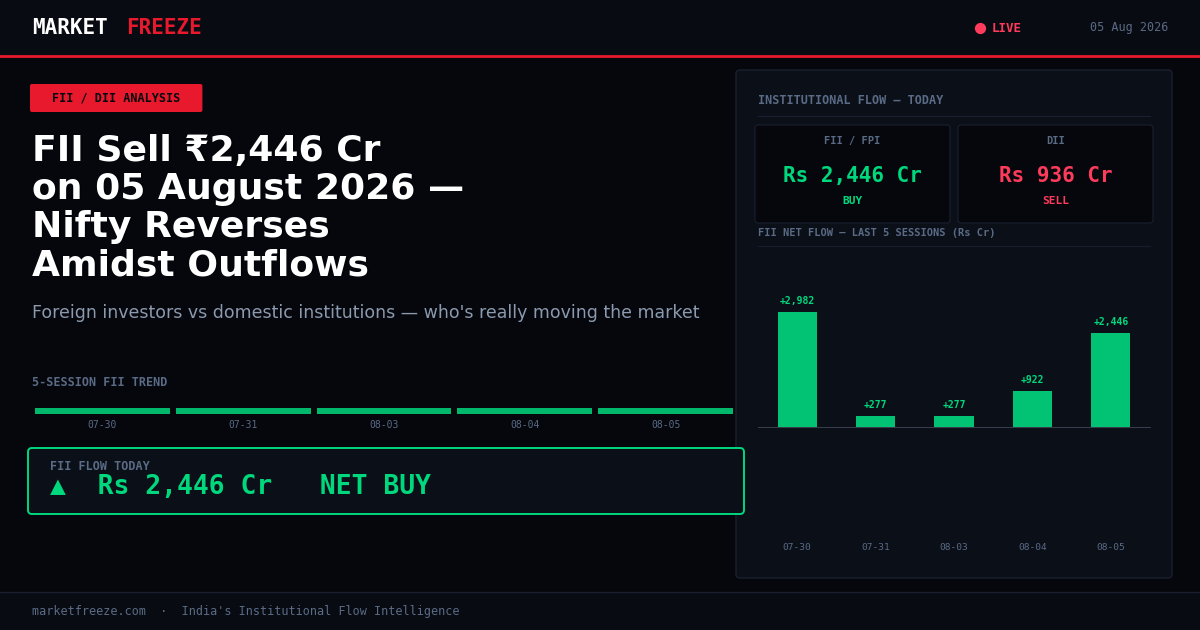
FII desks turned net sellers today, offloading ₹2,446.47 Cr in Indian equities while Domestic Institutional Investors (DIIs) recorded a net outflow of ₹936.14 Cr on 05 August 2026. This marks a significant reversal from the preceding two sessions where FIIs were net buyers and DIIs consistently deployed capital.
Open a free demat account with
Upstox
or
Angel One
— zero brokerage on delivery trades.
FII Selling Accelerates Post-RBI Decision
Foreign Institutional Investors (FIIs) liquidated positions worth a net ₹2,446.47 Cr today. Their gross buying activity stood at ₹15,630.45 Cr, while selling reached ₹18,076.92 Cr. This substantial selling pressure followed the Reserve Bank of India’s Monetary Policy Committee (MPC) decision to maintain the repo rate unchanged, as reported by multiple news outlets. Despite the RBI retaining its FY27 growth outlook and lowering inflation projections, FIIs chose to pare their holdings. This outflow contrasts sharply with their net buying of ₹922.26 Cr on 04 August and ₹277.48 Cr on 03 August, signaling a shift in their near-term strategy.
For retail investors, today’s FII selling suggests increased headwinds for broad market indices. A sustained outflow of this magnitude typically correlates with a pullback in Nifty. Therefore, consider reducing exposure to highly leveraged derivative positions and increasing cash allocation in your portfolio.
DIIs Turn Net Sellers After Buying Spree
Domestic Institutional Investors (DIIs) also exited the market, registering a net sale of ₹936.14 Cr. This comes after two consecutive sessions of significant inflows, with DIIs buying ₹1,571.18 Cr on 04 August and ₹2,260.37 Cr on 03 August. The gross selling by DIIs was ₹13,333.15 Cr against gross purchases of ₹12,397.01 Cr. The switch from net buying to net selling by DIIs, even as FIIs were net buyers in the preceding sessions, indicates a lack of consensus between domestic and foreign institutions today.
Given the divergence in FII and DII flows today, with both ending as net sellers, expect elevated volatility. Retail traders should prioritize risk management and avoid chasing intraday moves. Focus on established support levels for potential entry points in quality stocks.
Nifty Rebounds Mildly Amidst Institutional Exit
The Nifty 50 closed at 24,624.65, up by 0.04%. The Sensex saw a larger gain of 0.19%, closing at 78,581.00. This marginal upside in headline indices, despite substantial net selling by both FIIs and DIIs, suggests support emerging from other market participants or a potential short-covering rally in the latter part of the trading session. The subdued gains, especially in the Bank Nifty which declined 0.29%, indicate that the broader market strength was fragile. News reports highlighted gains in auto, realty, and metal stocks, while IT shares faced selling pressure, aligning with potential institutional sector rotation.
The Nifty 50 is currently trading near the 24,624.65 mark. Based on today’s flow data, significant selling emerged. Immediate support for the Nifty 50 is identified at 24,400, representing a potential downside target if selling pressure intensifies. Resistance is now seen at 24,750. A decisive breach below 24,400 would signal further downside, potentially testing 24,200.
For retail investors, the fact that Nifty managed to close positive despite significant FII and DII selling is a double-edged sword. It could indicate short-covering or passive inflows, but the underlying selling pressure from institutions warrants caution. Consider booking partial profits in highly appreciated stocks and re-evaluating positions if the Nifty breaks below the 24,400 support level.
Sectoral Implications: Metals Shine, IT and Banks Face Pressure
The reported strength in auto, realty, and metal stocks, coupled with weakness in IT and banking, provides clues to where FIIs directed their selling. The significant FII outflow, coinciding with gains in metals and auto sectors as per market wrap-ups, suggests these sectors may have seen selective buying or were less impacted by the overall selling. Conversely, the reported weakness in IT and banking aligns with the broad FII selling. This implies that FIIs likely reduced exposure in rate-sensitive sectors like banking and growth-dependent sectors like IT, while potentially showing relative strength or minimal selling in commodity-linked sectors.
If you hold positions in banking or IT stocks, be prepared for potential further downside or sideways movement. For those invested in metals or auto, monitor for signs of continued institutional interest or profit-taking. A prudent retail strategy would be to rebalance portfolios away from sectors showing consistent institutional selling and towards those demonstrating resilience or renewed buying interest.
Currency and Commodities Crossover
The USD/INR pair closed lower at Rs95.35, down 0.22%. Simultaneously, Gold MCX surged by 4.29% to Rs151,745.00/10g, and Crude MCX gained 0.79% to Rs7,627.00/bbl. The strong rally in Gold, alongside rising crude prices, points to escalating global geopolitical tensions and potential inflationary pressures. While FIIs were net sellers in equities, the strength in gold suggests a flight to safety or a hedge against currency depreciation and inflation. The rupee’s decline against the dollar, despite the equity selling, indicates that currency markets are reacting more to global commodity price action and geopolitical risks than to domestic equity flows alone.
The simultaneous surge in gold and crude oil, alongside equity selling, signals a risk-off environment globally. Retail investors might consider reducing exposure to cyclical stocks and increasing allocations to defensive assets or commodities that benefit from rising inflation and geopolitical uncertainty. For equity portfolios, this implies a need to focus on companies with strong pricing power and low debt.
Historical Context: Divergent Flows
Looking at the last five sessions, today’s FII net selling of ₹2,446.47 Cr is the largest outflow in this period. The preceding sessions showed consistent FII buying: ₹922.26 Cr on 04 August and ₹277.48 Cr on 03 August. DIIs, conversely, were net buyers in the last two sessions, with ₹1,571.18 Cr on 04 August and ₹2,260.37 Cr on 03 August, before turning net sellers today by ₹936.14 Cr. This divergence from the recent trend, particularly the sharp reversal in FII activity, is noteworthy. The last time we saw a significant FII outflow of this magnitude was on 2026-07-30, when FIIs net bought ₹2,981.87 Cr and DIIs net bought ₹998.02 Cr, with the Nifty closing at 24,317.15. The subsequent days saw Nifty move sideways to up.
The abrupt shift in FII flow from buying to significant selling today breaks a short-term positive trend. Retail investors should interpret this as a signal to brace for potential near-term weakness in the broader market and avoid aggressive new long positions until FII buying resumes or DIIs step back in as strong net buyers.
The Deciding Number: FII Flow Tomorrow
The primary indicator that could alter today’s bearish flow outlook is a reversal in FII buying. If FIIs return to net buying tomorrow, especially exceeding ₹1,000 Cr, it would suggest today’s selling was opportunistic or a temporary reshuffle. Conversely, a continuation of FII selling, particularly above ₹2,000 Cr, would solidify the bearish bias. The DII flow will also be critical; a return to significant net buying by DIIs could provide a cushion, but FII sentiment is currently the dominant driver.
Retail investors should monitor tomorrow’s FII net flow closely. If it remains negative, consider trimming positions across the board. A positive FII print, however, could offer a green light to initiate selective long positions, particularly in sectors that showed relative strength today.
| Date | FII Net (Cr) | DII Net (Cr) | Nifty Close |
|---|---|---|---|
| 2026-07-30 | +₹2,981.87 Cr | +₹998.02 Cr | 24,317.15 |
| 2026-07-31 | +₹277.48 Cr | +₹2,260.37 Cr | 24,383.60 |
| 2026-08-03 | +₹277.48 Cr | +₹2,260.37 Cr | 24,774.30 |
| 2026-08-04 | +₹922.26 Cr | +₹1,571.18 Cr | 24,614.90 |
| 2026-08-05 | +₹2,446.47 Cr | –₹936.14 Cr | 24,624.65 |
Frequently Asked Questions
What was the FII net buy/sell figure for August 5, 2026?
On August 5, 2026, Foreign Institutional Investors (FIIs) were net sellers, offloading ₹2,446.47 Cr in Indian equities.
Did DIIs buy or sell on August 5, 2026?
Domestic Institutional Investors (DIIs) were net sellers on August 5, 2026, with an outflow of ₹936.14 Cr.
How did Nifty close on August 5, 2026, and what was the FII DII flow?
The Nifty 50 closed at 24,624.65 on August 5, 2026, with FIIs net selling ₹2,446.47 Cr and DIIs net selling ₹936.14 Cr.
The sharp reversal in FII sentiment today, moving from a consistent buying pattern to a substantial outflow, warrants a deeper look into the underlying market dynamics. While headline indices managed a modest uptick, this was achieved on significantly reduced trading volumes, as evidenced by the muted gains in Nifty and the larger gains in Sensex, which often reflects a larger weightage of heavyweight, less liquid stocks. This suggests that the broader market participation was weak, and the gains might be attributed to algorithmic trading or short-covering by traders looking to exit bearish positions before the market closes. The fact that the Bank Nifty, a bellwether for financial sector health, declined by a notable percentage, reinforces the notion that institutional money is not flowing into growth-oriented sectors currently.
Furthermore, the simultaneous surge in Gold MCX by over 4% and Crude MCX by nearly 0.8% cannot be ignored. This commodity price action, coupled with equity outflows, paints a picture of a global risk-off sentiment. Investors are likely moving capital away from riskier equities towards safe-haven assets like gold, and simultaneously hedging against potential inflationary pressures indicated by rising crude prices. The USD/INR pair closing lower at Rs95.35, despite equity outflows, suggests that the currency market is more influenced by global commodity trends and geopolitical risks than by domestic equity flows in the immediate term. This complex interplay implies that while Indian equities might be temporarily supported by domestic factors or specific sector strength, the overarching global macroeconomic environment is increasingly becoming a dominant driver of institutional allocation decisions.
Sectoral Rotation and Global Cues
The divergence in sectoral performance today provides a critical insight into potential FII strategy. Reports indicating strength in auto, realty, and metals, while IT and banking faced selling pressure, are not isolated events but likely represent a broader sectoral rotation. FIIs, often at the forefront of such shifts, might be reallocating capital away from rate-sensitive sectors like banking and growth-dependent sectors like IT, which are typically vulnerable to rising interest rates and slower global demand. Conversely, sectors like metals, which are commodity-linked, and auto, which can be cyclical but also benefit from domestic demand, may be perceived as relatively more resilient or offering better value in the current environment. This strategic rebalancing by FIIs, evidenced by their net selling figures, signals a cautious approach towards growth prospects and a potential preference for value or defensive plays.
For retail investors, understanding this sectoral rotation is paramount. If FIIs continue to divest from IT and banking, these sectors could experience sustained headwinds. Conversely, areas showing relative strength, such as metals and auto, might attract further institutional interest, albeit cautiously. It is crucial for retail investors to align their portfolios with these institutional flows, considering a reduction in exposure to sectors experiencing consistent selling pressure and increasing allocation to those demonstrating resilience or potential for recovery. For example, companies in the metal sector with strong balance sheets and manageable debt could offer a more defensive positioning against broader market volatility, especially if commodity prices continue their upward trend.
Historical Parallels and Future Outlook
To contextualize today’s significant FII outflow of over ₹2,400 Cr, it’s worth recalling periods of similar institutional caution. While the immediate preceding sessions showed FII buying, a glance back to late July reveals instances where substantial outflows preceded periods of market consolidation or correction. For instance, on July 30, 2026, FIIs exhibited strong buying, which was followed by a period where Nifty moved sideways to up. However, the current dynamic differs; today’s substantial selling by both FIIs and DIIs, coupled with rising global commodity prices, suggests a more complex risk environment than a simple directional shift. The lack of strong conviction from DIIs today, who turned net sellers after a period of consistent buying, further amplifies the uncertainty. This combined institutional exit indicates a broader market hesitancy, driven by both domestic policy signals and increasingly volatile global macroeconomics.
The market’s ability to close in the positive territory despite this significant selling pressure is a testament to the resilience of other market participants, potentially domestic retail investors or domestic institutions that are not aligned with FII sentiment. However, this resilience might be short-lived if the underlying selling pressure from foreign institutions continues. Retail investors should treat today’s outcome as a warning sign. A sustained period of FII outflows, especially if it breaches the ₹2,000 Cr mark for consecutive days, would be a strong signal to de-risk portfolios. The key takeaway from the historical context is that while periods of FII outflows can be temporary, a broad-based institutional exit, as seen today, warrants increased vigilance and a defensive investment posture.
Bottom Line
Today’s trading session was characterized by a significant reversal in FII flows, shifting from net buying to aggressive selling of ₹2,446.47 Cr. DIIs also joined the exit, marking their first net outflow in recent memory. Despite marginal gains in the Nifty and Sensex, driven perhaps by short-covering or sector-specific strength in metals and auto, the underlying institutional selling pressure suggests potential headwinds. The concurrent rise in gold and crude oil prices hints at broader global risk-off sentiment influencing trading decisions.
Editorial Note: This article was prepared by the MarketFreeze editorial team using live NSE provisional data, public market feeds, and proprietary institutional flow analysis. All price and flow figures are sourced directly from NSE, BSE, and CoinGecko as of 05 August 2026. This content is for informational purposes only and does not constitute investment advice. MarketFreeze is not SEBI-registered. Please consult a qualified financial advisor before making investment decisions. Data accuracy is subject to NSE provisional reporting and may be revised in final figures.