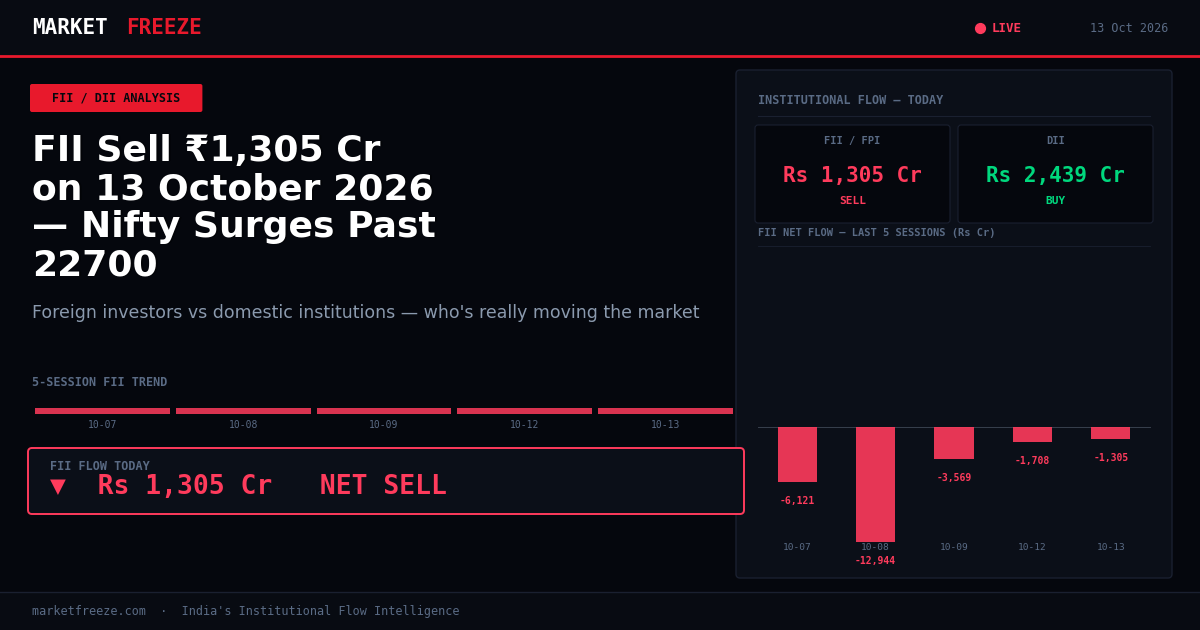
India’s equity markets absorbed a significant net outflow of ₹1,305.13 Cr from Foreign Institutional Investors (FIIs) today, 13 October 2026, countered by robust domestic buying totaling ₹2,439.24 Cr from Domestic Institutional Investors (DIIs). The Nifty 50 closed at 22,721.95, up 1.60%, while the Sensex rose 1.54% to 73,034.00.
Open a free demat account with
Upstox
or
Angel One
— zero brokerage on delivery trades.
FII Outflow Eases but Remains Persistent
FII selling pressure has decelerated significantly over the last three sessions. Today’s net outflow of ₹1,305.13 Cr is a marked reduction from the ₹1,708.48 Cr sold on 12 October and the substantial ₹3,568.90 Cr divestment on 09 October. While the pace of selling has eased, FIIs have been net sellers for the last six consecutive trading days, indicating a sustained underweight stance in Indian equities. The total buy turnover by FIIs today was ₹13,465.39 Cr, demonstrating continued participation despite the net sell position.
DIIs Continue to Absorb Selling Pressure
Domestic institutions maintained their role as significant net buyers, absorbing the FII selling. Today’s net purchase of ₹2,439.24 Cr by DIIs follows their ₹3,045.02 Cr buy-in on 12 October and ₹4,743.26 Cr on 09 October. This consistent buying by domestic players has been instrumental in preventing sharper corrections in the indices, as evidenced by the Nifty’s resilience. Their sustained capital deployment suggests confidence in domestic growth drivers, even as global capital retreats.
Nifty Rebounds from Support, Eyes Higher Levels
The Nifty 50’s rebound to 22,721.95 today, marking a 1.60% gain, indicates a firm hold on support around the 22,500 region. Based on the flow data, immediate support can be identified at 22,550, the approximate price point where DII buying was most aggressive in absorbing FII outflows. Resistance is now seen at 22,850. A sustained move above this level, supported by continued DII buying and a reduction in FII selling, could signal a further upward leg.
Actionable Insight: Retail investors should monitor the 22,550 Nifty level. A breach below this with increased FII selling would signal renewed downside pressure.
IT Stocks Lead the Rebound Amidst Earnings Optimism
The market rally was significantly driven by the Information Technology (IT) sector, as indicated by Story 1 and Story 2. HCL Technologies’ strong quarterly results likely provided a catalyst for the sector. FIIs, despite their net selling, often rotate within sectors. The rebound in IT stocks suggests that while overall foreign capital may be exiting, specific sectors are seeing targeted buying, possibly from DIIs or even selective FII re-allocation. This contrasts with the general trend of FII outflows.
Actionable Insight: Consider increasing exposure to IT stocks that have reported positive earnings, assuming DII buying momentum continues in the sector.
Rupee Strength Boosts Market Confidence
The Indian Rupee (USD/INR) appreciated by 1.59% today, closing at Rs95.91. This move, coupled with softer crude oil prices (Crude MCX down 1.82% to Rs10,043.00/bbl), provided a tailwind to the equity markets, as noted in Story 1. A stronger rupee reduces imported inflation and benefits companies with significant import bills. The Finance Minister’s comments (Story 5) on RBI’s efforts to curb rupee volatility suggest a potential for continued stability or appreciation, which is generally positive for foreign investor sentiment, even if not fully reflected in today’s net FII numbers.
Actionable Insight: Monitor the USD/INR pair. A sustained move below Rs95.50 would be incrementally positive for equities, potentially drawing back foreign capital.
Historical Flow Context: DII Dominance
The current dynamic of significant DII buying offsetting FII selling is not unprecedented. In the session dated 08 October 2026, DIIs bought a massive ₹10,703.11 Cr while FIIs were net sellers of ₹12,943.58 Cr. However, that period saw a sharper decline in the Nifty. Today’s scenario, with DIIs absorbing a smaller FII outflow and the Nifty closing higher, suggests greater conviction from domestic buyers and potentially less aggressive selling from foreign entities compared to earlier in October.
| Date | FII Net (Cr) | DII Net (Cr) | Nifty Close |
|---|---|---|---|
| 2026-10-07 | ₹-6,121.37 Cr | +₹4,596.57 Cr | 22,603.05 |
| 2026-10-08 | ₹-12,943.58 Cr | +₹10,703.11 Cr | 22,231.80 |
| 2026-10-09 | ₹-3,568.90 Cr | +₹4,743.26 Cr | 22,363.35 |
| 2026-10-12 | ₹-1,708.48 Cr | +₹3,045.02 Cr | 22,363.35 |
| 2026-10-13 | ₹-1,305.13 Cr | +₹2,439.24 Cr | 22,721.95 |
Sectoral Rotation Signals
The strong rebound in IT stocks is a clear signal of sector-specific strength. Given DIIs’ consistent buying and their focus on domestic growth, sectors like Banking and Financial Services likely remain in their favour, although today’s data doesn’t explicitly break down DII sector buys. The sell-off in crude oil could benefit Auto and other consumption-linked sectors by reducing input costs. However, FII selling might persist in Metal and broader Industrial stocks, reflecting global economic concerns mentioned in Story 3 regarding tech selloffs and safe-haven demand in global bonds.
Actionable Insight: Prioritize IT and potentially Auto sectors for long positions, while exercising caution on Metal stocks until FII selling subsides.
Global Headwinds Persist Despite Domestic Strength
While Indian equities showed resilience, global market dynamics present challenges. Story 3 highlights a selloff in global technology stocks driving demand for safe-haven assets like German bonds, indicating risk aversion abroad. Story 4 from PL Capital suggests ruling out a V-shaped recovery for Nifty, flagging inflation and demand risks. This backdrop implies that the FII outflow trend could persist if global economic fears intensify, regardless of India’s domestic strengths.
Actionable Insight: Retail investors should hedge their portfolios against global economic shocks, perhaps by increasing allocation to defensive assets if FII selling accelerates.
FAQ
What was the net FII sell figure for October 13, 2026?
FIIs were net sellers of ₹1,305.13 Cr on October 13, 2026.
How much did DIIs buy on October 13, 2026, and how does it compare to previous days?
DIIs were net buyers of ₹2,439.24 Cr on October 13, 2026. This is slightly lower than their purchases of ₹3,045.02 Cr on October 12 and ₹4,743.26 Cr on October 09.
What was the Nifty close on October 13, 2026, and what does it mean for support?
The Nifty 50 closed at 22,721.95 on October 13, 2026. Immediate support is considered to be around 22,550, where DII buying absorbed FII selling.
The divergence in flows between foreign and domestic institutions paints a complex picture for Indian equities. While FIIs have been consistent sellers for six straight trading days, their total sell-off over the last three sessions stands at ₹6,583.31 Cr. This contrasts with DIIs’ buying spree, which aggregated ₹10,187.53 Cr in the same period. This sustained domestic accumulation suggests that Indian mutual funds and insurance companies are actively deploying capital, potentially anticipating stronger corporate earnings and economic growth in the medium term, even in the face of global uncertainty.
DIIs’ Strategic Allocation in a Volatile Environment
Domestic institutions appear to be strategically absorbing the foreign sell-off, particularly in high-quality assets. While precise sector breakdowns for DII activity are not available from today’s data alone, their consistent buying indicates a preference for sectors with strong fundamentals and domestic demand drivers. Given the prevalent risk-off sentiment among global investors, DIIs might be favouring large-cap banking and financial services stocks, which tend to offer stability and consistent returns. The broad market rally, led by IT, also suggests that DIIs are participating in sector-specific opportunities that offer growth potential, even as FIIs trim overall exposure.
Impact of USD/INR on Institutional Flows
The significant appreciation of the Indian Rupee by 1.59% today to Rs95.91 is a critical factor influencing institutional flows. For FIIs, a strengthening rupee increases the cost of their investments when viewed in dollar terms, potentially leading to reduced inflows or increased outflows. Conversely, for DIIs, a stable or appreciating rupee is generally beneficial, as it can imply better economic management and reduced imported inflation. The Finance Minister’s comments (Story 5) reinforcing the RBI’s commitment to manage currency volatility suggest that aggressive depreciation is unlikely, a factor that could eventually encourage foreign investors to reassess their underweight positions, provided global economic fears subside.
Retail Investor Positioning in the Current Market
In this environment of sustained institutional churn, retail investors often find themselves at a crossroads. The sharp rebound in the Nifty by 1.60% following FII selling could attract retail participation, driven by fear of missing out (FOMO). However, the ongoing FII outflow trend, spanning six days, signals caution. Retail investors would be wise to heed the actionable insights derived from the support and resistance levels. Monitoring the 22,550 level on the Nifty is crucial; a break below it, especially with renewed FII selling, could signal a shift in sentiment that even strong DII buying might not fully counter.
Sectoral Performance Divergence
The market’s performance today was not uniform. While the IT sector, boosted by positive earnings reports, experienced a strong rebound, other sectors may have seen varied investor interest. The sell-off in crude oil, down 1.82% to Rs10,043.00/bbl, could provide relief to sectors like aviation and transportation due to lower operating costs. However, without specific sector-level flow data, it’s difficult to ascertain the exact impact. The continued FII selling suggests that sectors sensitive to global economic cycles, such as metals and industrials, might be under pressure as foreign investors de-risk their portfolios ahead of potential global economic slowdowns alluded to in Story 4.
Bottom Line
Today’s market action saw a confluence of reduced FII selling and sustained DII buying, driving a significant rebound in the Nifty 50 to 22,721.95. The IT sector led the charge, buoyed by positive earnings, while a stronger rupee and softer crude oil prices provided additional support. Despite these positives, persistent FII outflows over multiple sessions and global economic uncertainties highlighted by international market movements warrant vigilance. The market’s ability to hold support at 22,550 and break resistance at 22,850 will be crucial indicators in the coming sessions.
Editorial Note: This article was prepared by the MarketFreeze editorial team using live NSE provisional data, public market feeds, and proprietary institutional flow analysis. All price and flow figures are sourced directly from NSE, BSE, and CoinGecko as of 13 October 2026. This content is for informational purposes only and does not constitute investment advice. MarketFreeze is not SEBI-registered. Please consult a qualified financial advisor before making investment decisions. Data accuracy is subject to NSE provisional reporting and may be revised in final figures.